English

Chapter 22
The Presidency

After the board meeting, Don pulled me aside.
"Now that you're president," he said, "your words have weight." I nodded, not entirely sure what he meant yet.
"People will listen differently," he continued. "What you say casually, they'll take as policy. What you suggest, they'll hear as directive. You need to remember that."
I would learn what he meant soon enough.
The president's office had three executive offices—all next to each other on the second floor.
The far right one was the president's office. The far left was for the chancellor. The middle office belonged to the executive assistant
—the gatekeeper.
King had brought in someone who had worked in the same capacity for him at another university. She was professional, thor-ough, and had the right balance of being friendly but firm with people who called or wanted meetings. You didn't just walk into the president's office. You went through her first.
King's role had shifted. He was no longer my boss. He was my advisor. The dynamic was different—more collaborative, less hierar-
chical. But his presence next door was steadying. When I needed guidance, I could walk twenty feet and knock on his door.
The college was a small community. I knew I had the support of the newer students and some of the faculty. But there was also skep-ticism—particularly among those who had been there longer, who had seen leadership come and go, who weren't sure what a thirty-six-year-old president could possibly know about running a college.
I didn't blame them. I wasn't sure either.
One of the first things I did was walk into classrooms to observe faculty.
I'd stand quietly at the back of the room, watching how they taught, how students responded, whether the material aligned with what we said we were teaching.
The first time it happened, the instructor looked up mid-lecture and said, "Oh, would you like to take a seat?"
"No, sorry," I said. "I'm the president." The instructor's face went blank. Then red. The students laughed.
It happened again. And again.
"You must be a new student—take a seat up front."
"Actually, I'm the president. But thanks for the compliment. It's nice to think I look young enough to be a college student."
More laughter. The instructor would recover, embarrassed but trying to play it off. I kept it light. I wasn't there to humiliate anyone. I was there to see what was actually happening in the classroom.
But the message was clear: I was watching. The faculty didn't make it easy.
Some were excellent—dedicated, engaged, genuinely invested in student success. But others resisted anything that felt like additional responsibility.
I told them they needed to be involved in student advisement. That every full-time faculty member needed to serve as a faculty advisor, helping students navigate their programs, stay on track, graduate.
They balked.
I told them they needed to attend open houses—meet prospec-tive students, talk about the programs, help with recruitment.
They balked again.
The attitude was clear: I'm here to teach. That's it. Don't ask me to do anything else.
But that wasn't how small colleges survived.
The college had to run on an operating surplus. That meant we couldn't look to fundraising or donations to cover shortfalls. If the college was run inefficiently, if enrollment dropped, if students left
—that was on the president. That was on me.
And if there were no students, there were no jobs.
I started saying it plainly: Students are our customers. If there are no customers, you don't have a job.
Some faculty hated that language. They thought it was too corporate, too transactional. But it was the truth.
One afternoon, I was walking past the copy center and heard an adjunct say, loud enough to carry into the hallway, "These damn students."
I stopped.
I walked into the copy center.
"If it wasn't for the students," I said, "there would be no college."
He looked at me, stunned. I kept walking.
I started to hire staff and faculty who understood the students were the customer.
I needed people on the ground who could see what I couldn't from the president's office.
I went to King and Don first.
"I want to ask Mary to step down from the board and run Admissions," I said. "She's a natural at sales, and she cares about the students."
They agreed—if Mary did. I called Mary.
"Mary, just so you know, I spoke to Don and King about this and they said it's up to you."
She gave me a quizzical look, like what are you up to now, Lisa. "What about?"
"I'd like you to run the Admissions department." She grinned. "I do like sales."
Two months into my presidency, in August, the call came from New York State.
A college in Brooklyn was closing—immediately. Students were stranded mid-program. Credits were in progress. Lives were paused. The state wanted to know if we could step in and do a teach-out.
It wasn't framed as an opportunity. It was framed as an emergency.
There was no time to debate philosophy. Students had nowhere to go.
Through Don's connections, classroom space was secured at Brooklyn Hospital—Brooklyn Caledonian specifically. We were given our own wing for classes and clinics. It wasn't ideal, but it was real. And it meant continuity.
We outfitted the classrooms ourselves—desks, lamps, chalk-boards, projectors. Everything the main campus had, we tried to replicate. The goal wasn't expansion. It was stability.
I spoke with Sarah directly about what mattered most.
"These students can't feel like they're starting over," I said. "Same curriculum. Same expectations. As much continuity as possible."
She understood immediately.
She and another instructor agreed to split their time—half their classes in Brooklyn, half on Long Island. It wasn't convenient. It wasn't easy. But it preserved something essential: trust.
We started with about fifty students. There was room for expan-sion, but that wasn't the priority. The priority was making sure those fifty students could finish what they'd started.
For a while, it worked.
Two years later, my office received another call—this time from Brooklyn Hospital.
They were closing Brooklyn Caledonian. Immediately. That day.
There would be no security. No staff. No support.
By then, we had over a hundred students. They were displaced overnight.
I went to Brooklyn to meet with them in person. The room was tense but hopeful—chairs pulled too close together, coats still on, people standing along the walls. No one spoke until I did.
They wanted to know one thing: whether they would be able to finish.
I told them the truth. The space was gone. I could secure other classrooms, but they wouldn't be the same. Or, I said, I could arrange transportation to Long Island so they could continue their studies without interruption. If needed, we would mirror their Brooklyn schedules exactly.
They didn't panic.
They asked questions. They talked among themselves. Then they agreed.
During the meeting, one student raised her hand.
"If…" she said, hesitating, "…if I finish my undergraduate program here, and I want to continue into the graduate program, would you still cover transportation to Long Island?"
The room went quiet. I didn't pause.
"Yes," I said.
There was a release—not applause, not celebration—just relief.
A collective exhale. Shoulders dropped. Pens came out again.
It was enough.
That moment stayed with me.
Leadership, I was learning, wasn't about expansion or ambition.
It was about absorbing disruption so others didn't have to.
Brooklyn taught me something essential.
When institutions fail, students pay first—unless someone steps in.
THE ROBE
Months before commencement, I wrote the letter.
Not a form letter. Not something drafted by an office and signed for me. I wrote it myself.
Commencement mattered. It was the most public expression of what the college stood for, and I wanted the speaker to reflect that—to embody the bridge we lived on every day, between disciplines, between tradition and exploration.
I thought of Shirley MacLaine.
She was an internationally acclaimed actress—a Hollywood star whose career stretched back to the golden age of film, recognized around the world long before celebrity became disposable. An Academy Award winner, part of the Rat Pack era, one of the last remaining icons of that generation. Beyond film, she was also an author and a lifelong seeker—someone who had openly explored spirituality, consciousness, and alternative approaches to health long before those conversations became mainstream.
She carried stature. And she carried curiosity. That combination mattered.
I hesitated.
Then Don said I should ask her. The worst she could say was no. And if she came, it would be because I asked—not because of who he was, not because of connections.
So I sent it.
I invited her to be our commencement speaker and offered to confer an honorary doctorate in recognition of her achievements as an artist, an author, and an advocate for holistic and integrative health.
There was no introduction. She didn't know Don. There was no back channel.
Just an invitation.
Her response came almost immediately. It was brief. Gracious. Direct.
She would come. That was all.
From that point on, commencement stopped being abstract. It had a center of gravity.
My mother and my grandmother arrived a few days before the ceremony. I put them up at a hotel nearby and brought them to my apartment at Olympic Tower. The glass façade reflected St. Patrick's Cathedral across Fifth Avenue.
My grandmother stood at the window and laughed.
She said I had no excuse now—that I could go to church every Sunday.
I laughed and said, "But, Granny, in this condo, I'm closer to God than the entire cathedral."
I wasn't sure how that would land. She laughed anyway.
On the morning of commencement, I went to meet Shirley at the Carlyle.
The hotel was quiet in that old New York way—soft light, polished wood, no sense of arrival being announced. The Carlyle didn't declare importance. It assumed it.
Shirley was waiting in the lobby with her terrier, her assistant close by.
She stopped when she saw me.
"But you're just a kid," she exclaimed, her mouth hanging open. "You're a kid."
I laughed and said, "You started young too." She laughed back.
On the drive over, she talked easily—about staying curious longer than people expect, about choosing your own timing and not apologizing for it. Nothing framed as advice. Just observations, offered without weight.
I introduced her to my mother. "This is my mom," I said.
My mother smiled and said, simply, "I'm Lisa's mom."
Shirley smiled, put out her hand, and said, "Hello, Lisa's mom." Not a title. Not a formality.
Just that.
I had been on a dais before. I had spoken publicly. But not like
this. Not as president. I didn't yet have gravitas—only responsibility. There's a difference.
Backstage, the dressing room was crowded with robes and quiet logistics. Everything had been measured and labeled ahead of time
—caps, gowns, hoods.
Everything except Shirley's robe.
She tried to put it on. It wouldn't go past her chest. She looked down, then back at us.
"Well," she said, completely deadpan, "you do know I was a showgirl."
The room broke.
Without hesitation, Don stepped forward and handed her his robe.
"I'll manage," he said. And he did.
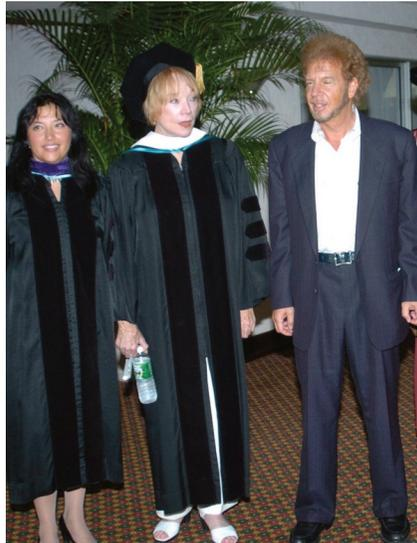
Left to right: Lisa Pamintuan, Shirley MacLaine and Donald Spector
As I put on my own robe, Steve Kaufman stepped in close. He reached over and adjusted my cap, straightening it with two fingers, smoothing a strand of hair that had slipped loose.
"Look at you," he said.
No joke in it. No ceremony either. Then it was time.
Steve received an honorary doctorate that day as well, recog-nized for his contribution to contemporary art and for his AIDS memorial work in New York. Even in academic regalia, he was unmistakable—six-foot-seven, irreverent and luminous, grinning as he crossed the stage.
The ceremony unfolded the way ceremonies do—procession, music, speeches.
I spoke briefly. I didn't try to perform authority. I spoke about wellness becoming mainstream, about prevention, about partner-ship with patients, about responsibility. About service.
Afterward, at the reception, my mother and grandmother found themselves seated with Shirley, Don—and Steve's mother.
Steve and I were standing together across the room when we started walking toward the table.
We didn't make it all the way.
We overheard them first—talking animatedly, comfortably, as if Steve and I weren't even in the room. As if the decision had already been made.
Shirley's voice cut through the rest.
"I know this type of guy," she said. "He's like my brother… no—he's worse than my brother!"
Steve and I looked at each other.
We started laughing—and quietly turned around, walking away from the table before anyone noticed.
A reporter circulated through the room and asked if he could speak with Shirley. I said of course. Later, he pulled me aside and began explaining she was speaking about what some people may consider controversial and asked if there was anyone else I would would like him to interview.
I introduced him to a physician.
The next day, the paper mentioned Shirley's honorary doctorate
and her role as commencement speaker. The quote came from the doctor.
That was fine.
Before the day ended, I made sure there was a photo of the three of us—my mother, my grandmother, and Shirley.
I sent it to them later.
It mattered to me that they had it.
The speech. The graduates. My family in the front rows.
Two honorary doctorates, each for a different kind of contribu-tion. An internationally known actress calling me a kid. An artist straightening my cap before I walked on stage.
Laughter where there could have been distance.
Leadership, I was learning, wasn't only about pressure and proof. It was also about being taken seriously before you looked the part.
Sometimes it was about standing up and saying what you believed. And sometimes it was about knowing when to laugh—and letting the moment carry you forward.
THE VISION
The decision was driven by vision.
The board believed the college had the potential to become something more than a collection of professionally accredited disci-plines. It could grow into a university—one with an applied research center, international partnerships, and a role in advancing integra-tive health beyond the classroom.
Programmatic accreditation could not support that future.
Programmatic accreditation evaluated individual programs in isolation. It ensured that massage therapy, acupuncture, and Tradi-tional Chinese Medicine met professional and licensing standards. It protected students' eligibility to practice. But it did not confer insti-tutional standing. It did not allow the college to evolve structurally, academically, or strategically.
A university—and an applied research center—required some-thing else entirely.
Institutional accreditation.
When the board voted to pursue it, the vote was not about fixing programs. It was about changing the identity of the college.
Institutional accreditation meant saying:
We are no longer just a collection of professionally approved programs. We are a fully recognized institution of higher education.
That distinction carried consequences.
The Assignment
I was at the board meeting when the decision was made, so the assignment didn't come as a surprise.
I understood, in broad terms, what institutional accreditation required. But knowing what had to be done and having done it before were very different things.
I had never led an institutional accreditation process. Neither had the faculty. Neither had most of the staff.
Programmatic accreditation had been familiar terrain. People understood their roles within their departments. They knew how their programs were reviewed and what documentation was expected. Institutional accreditation was different. It cut across silos. It required coordination, shared responsibility, and a level of trans-parency that was new to almost everyone involved.
The first task wasn't writing. It was alignment.
Before a single section of the self-study could be drafted, everyone needed to understand what this process was—and what it was not. Institutional accreditation wasn't something administration could complete alone, and it wasn't something faculty or staff could opt out of. Every office, every role, every function of the college would be examined.
That meant bringing people together and explaining, clearly and calmly, what was coming.
What role each department would play. What information would be required. What timelines would look like. What standards we were being measured against.
And just as important—what this process was not meant to do.
It wasn't about blame. It wasn't about exposing people. It wasn't about rewriting the past.
It was about documenting the institution as it actually existed—and demonstrating that it was capable of meeting a higher standard.
Faculty Concerns
In one of the early meetings, a faculty member spoke up.
She'd been teaching for twenty years. Her students passed their licensing exams. They got jobs. They respected her.
But her degree didn't match the level at which she was teaching.
Under programmatic accreditation, that hadn't mattered. Her professional credentials and experience were enough.
Under institutional accreditation, it did. She heard it as: you're not qualified.
"I'm not saying you're not qualified," I said. "The regulations require us to document why you are. Your experience, your outcomes, your professional standing—all of that matters. But we have to show it on paper."
The room was tense. Other faculty were watching. Some had the same concern.
I understood exactly how she felt.
Another person telling me I couldn't do something. Another set of standards I didn't meet on paper. Another room where I had to prove I belonged.
The difference was, I couldn't walk out of the meeting. I had to help everyone in that room demonstrate their qualifications—while quietly wondering if I could demonstrate my own.
The work continued.
Working the Process
I didn't do this alone.
From the beginning, I worked closely with King. He understood institutional accreditation from experience. He knew what accredi-tors were actually looking for—not perfection, but self-knowledge and the capacity to correct course.
King could speak to anyone. He could read a room, frame an issue, and land a point without force. When questions came, he knew how to answer them.
But institutional accreditation wasn't won in conversation. It was won on paper.
Documents assembled across departments. Data analyzed and reconciled. Policies aligned with practice. Outcomes tracked and explained.
That was my focus.
Together, we approached the self-study as what it really was: a comprehensive SWOT analysis of the institution.
Strengths. Weaknesses. Opportunities. Threats.
Every area was examined. Academics. Administration. Finances.
Student services. Governance. Outcomes.
We looked in the mirror.
Not to indict ourselves—but because no institution is perfect, and pretending otherwise would have been fatal. Accreditors didn't expect flawlessness. They expected honesty and evidence of improvement.
So we documented what worked. We named what didn't. And we showed what was being done about it.
The Outside View
I brought Marion and John in at the same time.
Marion understood accreditation from inside institutions. She had guided complex systems through it before. She understood how self-studies were structured, how standards were interpreted, and where institutions typically misjudged themselves. She helped us understand the roadmap.
John understood accreditation from the other side. He had
worked closely with New York State. He knew how accreditors read documents, where scrutiny focused, and what raised flags imme-diately.
Between them, there was no ambiguity about what we were facing.
John interviewed people across the college. Department heads. Faculty. Staff in admissions, financial aid, the registrar, student services. He reviewed documents and listened carefully. It wasn't one conversation. It was the accumulation.
When he finished, Marion, John, and I sat down together. We agreed on the strengths. We agreed on the weaknesses. Nothing felt catastrophic. The institution was functioning. The issues were real but manageable.
Before John headed back to Albany, he, King, and I called Don to let him know how things were going.
The tone was steady. The work had been done. The institution was on solid ground.
Then I asked John a question I hadn't planned to ask. "What do you think our biggest weakness is?"
He didn't hesitate. "You."
I stopped him. "What do you mean—me?"
He said that accreditors look closely at senior leadership. Presi-dents are expected to demonstrate academic credibility. From an accreditor's perspective, leadership signals seriousness.
"You don't have the academic credentials an accreditation agency would typically want to see," he said.
I pushed back. I said there were plenty of universities led by presidents without traditional academic backgrounds.
Don said I would be fine. King agreed. The conversation moved on.
But the comment stayed with me.
Not because it felt threatening—but because it reframed every-thing. Until that moment, accreditation had been about systems, documentation, and structure.
Now it was personal.
The call ended. The work continued.
But once a question like that is raised, it doesn't disappear. It waits.