English

Chapter 25
Klaus

Friends kept asking if I was dating anyone.
I wasn't. Nobody had caught my fancy, as they say. I was busy with the college, traveling, working. Dating wasn't a priority.
Then I tore my meniscus at a student party.
We were having an outdoor event on campus—music, food, students dancing. At some point, there was a dance-off. The students asked me to join. I did. I always did. And somewhere in the middle of it, I felt something give in my knee.
I limped off to take a phone call, but by the time I got back to my apartment building in Manhattan, I could barely walk. I needed to get to Lenox Hill Hospital. There was a brace on my knee, and I was in sweats, a T-shirt, and a baseball cap.
And there was a taxi strike.
I stood in the lobby, trying to figure out how I was going to get uptown, when the doorman said, "Ms. Pamintuan, where are you going?"
"Lenox Hill," I said.
Several black sedans were lined up at the curb—private cars idling. He held up a finger.
"Hold on."
The doorman scanned the line, then jogged a few cars ahead to a black sedan parked two cars up. He knocked on the back passenger window. The window rolled down.
I stood there, weight shifted awkwardly, watching. After a brief exchange, the doorman waved me over.
"Dr. Richter said he'd be happy to take you to Lenox Hill." His chauffeur opened the driver's side passenger door.
I eased myself into the back seat—brace first, then bag, then the rest of me—trying not to make a production of it. The door closed quietly behind me.
"Are you okay?" the man asked.
His accent was European. German, as it turned out. Polite.
Direct.
"Yes," I said. "Thank you. I'm sorry to impose."
"No problem at all," he said. "I was headed to the airport anyway."
We talked on the way. Nice enough conversation. Where are you from, what do you do, that kind of thing. It was a short ride. He dropped me at the hospital, gave me his card, and left.
I wrote him a thank-you note.
A couple of weeks later, he returned from his trip and asked me to dinner.
I thought I should be the one taking him to dinner—he'd helped me out. But he insisted.
We went to the Four Seasons.
We talked for hours. About his life in Germany, his previous marriage, his kids, his work, about Europe.
I asked if he played tennis. No.
Golf ?
Once in a while. Any other sports?
No, he said. He preferred to read biographies.
At some point, he mentioned a poem—Ithaca, by Cavafy. He said it was his favorite. Something about the journey being more important than the destination. I listened, found it interesting.
Neither of us was thinking about marriage. It was just a conversation.
He asked me questions—peppered me with them, really—and I found myself answering more openly than I expected. The staff was clearing tables around us by the time we left.
The next day, Don and Marion asked how the date went. "It was fine," I said.
"Fine? You were there for three hours." "So?"
"So you must like him." "He's really not my type."
"What does that mean?" Don asked. "He doesn't do sports."
Don looked at me. "You're too picky. You have this idea in your head of how someone is supposed to be. Perfect. If you keep doing this, no one will be good enough."
I didn't answer.
I wasn't convinced he was wrong.
A few days later, flowers arrived. And a poem. Ithaca. He was trying—earnestly, deliberately—to win me over. I agreed to see him again.
And then again.
Not because I was swept up. But because I was curious.
If I worked late, it wasn't an issue. That had always been an obstacle before—men who said they understood my work but resented the hours, the travel, the unpredictability. With Klaus, he just didn't mind. He made it easy.
#### HICKORY HILL
A few weeks later, Klaus asked if I would go to Washington with him.
There was an event—formal, political, the kind of gathering announced on heavy paper with an unspoken dress code. He was going regardless, he said, but thought I might enjoy it.
I hesitated.
Then he added, almost casually, that I would have my own room.
I mentioned it to Don and Marion.
"You should go," Marion said immediately. "He did the right thing," Don added. "He made it easy for you to say yes."
So I did.
We stayed at the Four Seasons, just off Pennsylvania Avenue—quiet luxury, restrained, the kind of place where nothing announces itself and everything works. The lobby was calm, hushed, attentive without hovering. It felt like Washington itself: deliberate, measured, confident in its own gravity.
That afternoon, we attended the event together.
It wasn't stiff, but it was serious. Conversations overlapped in familiar rhythms—people greeting one another with shorthand built over decades. Names carried weight. I listened more than I spoke at first, letting the room reveal itself.
At some point, someone asked about tennis. I mentioned Wimbledon. The U.S. Open.
And then—without thinking too much about it—I told a story.
I described being deep into a match when a call went against me. One of those calls that lands wrong in your body before your mind catches up. I said I reacted without thinking, muttering some-thing under my breath in Irish.
I told them how the chair umpire stopped play. "Warning," he announced. "Verbal abuse."
I said I spun around and asked why. Then I leaned in and lowered my voice.
He motioned me closer to the chair. Covered the microphone. Looked straight at me and said, "I speak Gaelic. I know exactly what you said."
I told them I froze.
I laughed as I told it, because at the time it wasn't funny at all. I honestly hadn't thought for a second that he would know what póg mo thóin meant.
I said I went completely sheepish.
"Oh," I told him. "Okay. I'm sorry."
The priest, Courtney—one of the Kennedys—and others laughed. Klaus laughed.
Who would have thought the chair umpire would know that phrase.
Later that afternoon, Klaus introduced me to Senator Edward Kennedy.
When he learned I was president of a college focused on health professions, he said he'd like to talk to me about healthcare later that evening.
I smiled and nodded. Inside, I panicked.
I wasn't a healthcare policy expert. I was an administrator—a steward, a translator between worlds. As I was getting ready for dinner, I got briefed over speakerphone by Don about various sides regarding U.S. Healthcare policy. Enough to be conversant. Enough not to embarrass myself.
That evening, we drove to Hickory Hill.
As we approached the house, Courtney's daughter—Saoirse—appeared ahead of us, holding a dog. The moment she saw me, she took off running, her voice ringing out as she moved.
"Póg mo thóin!" Over and over again.
The words echoed through the open space. I stopped short. Klaus laughed.
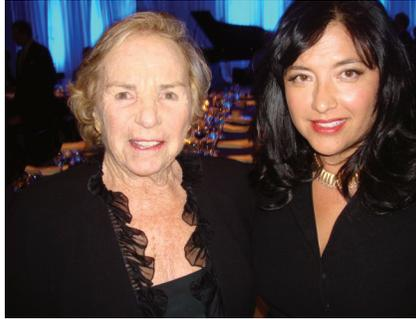
We reached the front door, where Ethel Kennedy greeted us. She looked at me, then at Klaus.
"Oh, Klaus," she said, "she's a stunner."
Ethel Kennedy and Lisa Pamintuan
No pause. No performance. Just a statement, delivered and done.
Inside, the dinner was intimate—maybe twenty people. Conver-sation moved easily, the way it does in rooms where history is shared and nothing needs explaining. I was seated next to someone involved in international affairs, and we spoke quietly as plates were passed and glasses refilled.
At one point, I caught Saoirse watching me from across the room, the dog at her feet.
She grinned.
I grinned back.
And I laughed to myself, knowing exactly how that phrase had found its way here.
FIANCÉ
That summer, I finished my deposition for Anna's malpractice lawsuit.
It had been hanging over me for months—another unresolved thread, another reminder that parts of my life were still under examination even as everything else appeared orderly. When it was finally over, Klaus and I talked about it. He listened carefully, asked measured questions, didn't rush me toward reassurance or try to reinterpret what had happened.
In early November, I had to leave for Arizona for the mediation.
The issue was whether we would go to trial. If we did, the next step would be my mother's deposition.
I laid everything out the way I always did—on paper. I charted the settlement offer against the likely outcome of a trial. If we won, the amount my parents would receive would be nearly the same. Months—maybe years—of testimony and exposure would change nothing that mattered.
It wouldn't bring Anna back. There was no reason to drag it on. So we settled.
That decision was made with clarity, not resignation. It was the last thing I could do to protect my parents from becoming part of the machinery.
While all of this was unfolding, Klaus and I were accelerating.
I told myself it was because we were older. That this was what adult love looked like—less drama, more alignment. I wondered if I'd been wrong to think I could have it all: someone who would sweep me off my feet and not be intimidated by my work.
Men my age had always seemed to measure themselves against me. My professional life landed like a comparison. With Klaus, there was none of that. He was seventeen years older. Established. Looking forward, not sideways.
He liked that I could handle myself in his world.
I was arm candy with a brain—and he didn't apologize for it. My girlfriends thought I was overthinking it.
"He's worth millions," one of them said. "Why are you even hesitating?"
I didn't see it that way. I wasn't like anyone else.
Because we lived in the same building, time compressed. We spent a great deal of it together. Conversation turned, naturally, to marriage. It didn't feel like pressure. It felt orderly. Considered.
I could be myself.
He wasn't trying to make me fit an idea.
We flew to Florida so he could meet my parents. Klaus spoke privately with my father. Later, he spoke with Don.
The only question my father asked me afterward was simple.
"What does Don think?" I told him the truth.
Don said that as long as I was happy, he supported it. And that there would be a prenup.
Everyone assumed the prenup was for Klaus. It wasn't.
It was for me.
We agreed that whatever each of us brought into the marriage remained ours. Any projects I worked on—ideas, intellectual prop-erty, work that hadn't yet taken shape—would remain mine. There was no argument about it. No hesitation. Just agreement.
In December, we left on a twelve-day trip through Europe.
The trip began with dinners. Polite ones. We met his closest friends in Munich, then traveled on to Geneva. Conversation was warm but careful. Everyone was gracious. Everyone was observing.
I felt like I was being tested. If they didn't like me, they could tell Klaus not to move forward.
From there we drove to Crans-Montana, where his best friend lived—a dramatic sweep of Alps and snow, skiers carving down slopes, children tubing and laughing. I watched from inside cafés, hands wrapped around cups of coffee, thinking how much I would rather be outside, moving, than sitting through one more composed dinner.
After each one, Klaus was delighted.
"They liked you so much," he'd say. "You're so good for me." Then we went on to Switzerland's lake country.
We were staying in Lausanne, at the Beau-Rivage, in the Presi-dential Suite—a vast, sunlit space with tall windows, a marble bath-room, and a terrace overlooking Lake Geneva. The water was impossibly blue. The Jet d'Eau caught the light in the distance. It felt less like a hotel room than a temporary life.
One morning, we drove to a small airport with a helipad. Snow had already started falling—thick, steady, the kind that absorbs sound. I assumed we were just heading out.
It wasn't until we were back in the car, leaving the airport, that he told me.
He had planned to take a helicopter to the top of a mountain.
That was where he intended to propose.
The blizzard made it impossible. The helicopter couldn't fly.
Visibility was gone.
We returned to the hotel.
The next morning, I was still in bed when he came into the room. He sat on the edge of the bed and presented the ring.
"I love you," he said. "Will you marry me?" I said yes.
Afterward, I did what my friends had done when they got engaged.
I called them from the suite.
There had been no mountain. No spectacle. Just the two of us, inside a quiet room with snow pressing against the windows.
There were congratulations, laughter, the familiar rush of voices across time zones.
After I hung up, I said I needed to take a shower. I shut the door to the bathroom and let the tears come in the shower.
I told myself it was just anxiety. That I was tired.
Pull yourself together, I thought. Any other woman would be over the moon.
The rest of the days passed without event.
We read the papers in the morning. Sat on the terrace. Watched the light change. There was no urgency, no drama. Just stillness.
The trip ended with a New Year's Eve party at the hotel. Black tie. Music. Champagne. An evening designed to mark beginnings.
I went to bed that night thinking only one thing. I hope this is the right decision.
Six Months In
A week after we returned to the United States, something shifted.
It wasn't dramatic. There was no argument, no single moment I could point to. But the air between us felt different—tighter, more deliberate.
Klaus mentioned, almost casually, that he'd like me home when he got home from work.
Not a demand. Just a preference. Something he thought I'd want to know.
I didn't respond right away. My schedule wasn't predictable. Meetings ran late. Emergencies came up. The college didn't operate on a clock that ended at five.
He mentioned it again a few days later. And then again.
Each time, it sounded a little less like a preference and a little more like an expectation.
A few weeks after that, he brought up St. Patrick's Cathedral.
He remembered that I'd once said—years before we met, in some conversation I barely recalled—that I thought it would be beautiful to get married there. He said he was working on it.
"Klaus," I said, "that was just something I thought about once.
A long time ago. We can't get married at St. Patrick's." "Why not?"
"Because you were married before. The Church doesn't allow it."
He paused, then smiled—not dismissively, but with a confidence I was starting to recognize.
"Well," he said, "when people say no, that's when it gets interesting."
I waited for the joke. It didn't come.
He genuinely believed obstacles were things other people accepted. That with enough money, enough connections, enough persistence, the rules didn't really apply.
I didn't know what to say.
Not long after, he told me his son was getting married in Brazil.
He wanted me to come.
I didn't want to go. His ex-wife would be there. His children—who were still adjusting to the fact that their father was engaged again—would be there. I could feel the tension already, the unspoken resistance. No one wanted me at that wedding.
"Klaus, I really don't think I should go," I said. "Your ex-wife will be there. The kids need time. I need time."
He looked genuinely confused.
"They'll be fine," he said. "We're engaged now. This is normal." I didn't go.
But the fact that he couldn't see why anyone might be uncom-fortable stayed with me.
Then it was Germany.
He had business meetings in Munich and wanted me to come with him.
"Klaus, I have a job," I said. "I can't just leave for Germany. You'll be in meetings all day anyway. What am I supposed to do there?"
"You can explore the city," he said. "Go shopping. Relax." "I don't need to relax," I said. "I need to work."
He looked at me as if that thought had never occurred to him. Then came the wedding planning.
He told me I didn't have to do anything—that he'd take care of it. He suggested a reception at 620 Loft & Garden at Rockefeller Center. I could see it from my office window: a rooftop overlooking St. Patrick's Cathedral.
The same cathedral he'd tried to book for the ceremony.
He talked about getting our photo in the New York Times wedding announcements. Not as a possibility. As a plan.
At some point I said, "So all I have to do is show up?" "Yes," he said, smiling. "Exactly."
He thought he was being generous.
What I heard was that I didn't need to be involved. I just needed to be there. Beautiful. Polished. Present.
I caught the flu a few weeks later. While I was home resting—actually resting—flowers arrived, along with a book: The History of Opera. The note said he was looking forward to taking me to Madame Butterfly, a show we'd missed earlier because of my work schedule.
It was thoughtful. I appreciated it.
That afternoon, PBS was showing an opera. I stopped and
watched, figuring I should learn something about it. Klaus was a patron of the Metropolitan Opera. He talked about it often. I assumed it mattered to him.
A few days later, I mentioned it.
"I watched an opera on PBS," I said. "It was interesting. I'm trying to learn more about it."
He looked confused.
"Oh," he said. "I don't actually watch them." He paused.
"I just give money to the organization."
That was the moment something settled in me.
He didn't care about the opera. He cared about being seen as someone who supported the opera.
The same way he cared about being seen with me.
Not because of who I was—but because of what I represented.
He suggested we go to the Four Seasons again. We'd already been there three times that month.
"Why don't we try something new?" I said. "There's a great place in Chelsea."
He didn't want to. He never did. He liked what he knew. The same restaurants. The same routes. The same controlled environ-ment where nothing surprised him.
On weekends, he wanted to sit at home and watch television or read.
I wanted to work.
That's when the phrases started.
"I love your hair." "You are so beautiful." "You look wonderful." "I love you."
Always one of those four.
They weren't meant for me. They were meant to redirect me—to pull me away from whatever I was doing and back into stillness.
Late that spring, he started hinting that I should take the summer off.
Then he suggested Hyannis Port again. I said I couldn't.
He asked again, as if I might change my answer.
That's when I understood.
Oh. He thinks this is a negotiation.
"Klaus," I said, "this is one of your scenarios. When people say no, that's when it gets interesting. This isn't a business deal. This is my life. My work. You're asking me to change who I am."
He smiled gently.
"Oh, darling," he said. "You're just tired. We can talk about it later."
"Sure," I said.