English

Chapter 27
Expansion

DON KING
I didn't anticipate the backlash.
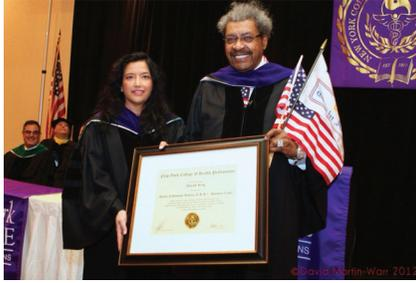
When I announced Don King as commencement speaker and honorary doctorate recipient in 2010, everyone agreed on the facts. His impact on sports was undeniable. He had brought boxing onto the world stage and transformed it into a global enterprise.
But agreement on impact did not translate into comfort.
Don King had promoted some of the most consequential sporting events of the twentieth century—events that weren't merely athletic contests, but cultural moments. The Rumble in the Jungle. The Thrilla in Manila. These weren't just fights. They were geopo-litical theater. Moments when race, politics, media, and sport collided in full view of the world.
King had pioneered the modern boxing promotion model—pay-per-view, closed-circuit broadcasts, international licensing, fighter branding—long before sports marketing became an acad-emic discipline. He negotiated with governments, broadcasters, sponsors, and athletes across continents, often operating in spaces where few American businessmen had ever ventured.
That was the record.
But record and reputation are not the same thing.
By the week of commencement, half the graduating class announced they would boycott the ceremony. Faculty expressed concern. Emails circulated. Rumors hardened into positions.
Then I received a package. Large black and red markers across the front: BEWARE OF DON KING. URGENT. OPEN PACK-
AGE. Inside were documents and a videotape.
I did not pull the invitation.
Leadership, I had learned, wasn't about choosing what made people comfortable. It was about standing behind decisions that could withstand scrutiny.
I introduced Don King. The applause was uneven.
He began his speech by saying he had killed a man who was robbing his house.
The room froze.
Then he told the rest of the story—how that moment had changed everything. How prison became an education. How he read history, philosophy, economics, politics. How he rebuilt himself deliberately, intellectually, intentionally.
He spoke about education not as something confined to class-rooms, but as something claimed wherever the mind is engaged and discipline is applied.
Transformation, he said, was not accidental.
When he spoke about education, a woman sitting in the first row began waving her hand. Pink Chanel dress. Texas drawl.
"I have a check here," she said.
It was a donation to the Don King Scholarship Fund. Something shifted.
By the time he finished, the room was with him. The showman hadn't disappeared—but he had brought substance with him.
At the after-party, Don King and Don Spector were sitting alone at a table. No one would go near them. The optics made people nervous.
I found it ridiculous and sat down.
King was talking about the plight of enslaved Africans.
"What about the Irish slaves?" I asked.
He stopped. Looked at me. Then looked at Don.
"I like her," he said, bringing his ring-covered hand down on the table like a gavel.
A few days later, a private dinner was arranged between them.
Don wasn't feeling well, so I went instead.
"Whatever you do," Don told me, "don't try to outthink him. If you don't know something, say you don't know. Don't bullshit."
We met at the Marriott.
In the glass elevator, Don King didn't face the doors like everyone else. He stood with his back against the metal panel, numbers at his shoulders, addressing the other guests.
"Only in America," he said.
When they got off, I asked, "How does the metal feel against your back?"
He smiled.
Dinner was at Patsy's. He insisted on a corner table, his back to the wall.
He talked about projects he was pursuing. I mentioned interest in a television concept—China's Next Champion—perhaps speaking with more confidence than certainty.
He stopped me gently.
"My dear," he said, "you had a conversation." I understood immediately.
There's a difference between vision and agreement. Between possibility and commitment. Between momentum and reality.
The commencement forced questions no one wanted to answer. We answered them anyway.
Lisa Pamintuan and Don King
RIVERSIDE
By 2010, the commute had become too expensive. The data showed a hard red line at the East River. Nothing was coming through the Midtown Tunnel anymore. Students wanted to attend, but geog-raphy—and cost—had quietly closed the door.
The economy had turned in 2007, and by 2009 and 2010 the effects were unmistakable. Enrollment was tightening. We were a commuter college without dorms, which meant location mattered. If we wanted to serve students in Manhattan and New Jersey, we would have to be in the city.
I think it was Don who first mentioned a church that had classrooms.
Not long after, I went to the church Don had recommended. It was a rainy morning in Harlem. I stood outside the building for a moment before going in, the street slick with rain, traffic hissing past.
A priest appeared.
He was standing in the rain, wearing his collar and a New York Yankees baseball cap.
"Hi," I said. "I was wondering if the church was still leasing its classrooms."
He smiled. "Yes," he said. "Come in out of the rain." Inside, I asked if he was Filipino.
He smiled again. "Yes." "Kumusta ka," I said.
He looked at me more closely. "You're Filipina," he said.
I smiled. "Half - my dad is from Pampanga, and my mom is from Ireland. When I go to the Philippines, they say I don't look Filipina. When I go to Ireland, they say I don't look Irish."
He laughed. "You look like a pretty Filipina," he said. That was how the conversation began.
He showed me the rooms. They were modest but usable. Before I left, he mentioned another place I should call—Riverside Church.
I hadn't heard of it.
The next day, I called. A young woman answered the phone. Her name was LaTonya, the leasing manager. I introduced myself and asked if I could see the space.
"If you want to come this afternoon," she said.
When I arrived, Riverside was imposing—stone, light, history. She walked me through classrooms, a library, a ballroom, a cafete-ria. Everything was there.
"So," she said, "how much space do you need?" "I don't know," I said.
She paused. "You don't know?"
"No," I said. "Because I don't know how many students will show up, or which programs they'll want. I won't know until I hold an open house."
"When do you need it?" "As soon as possible."
She thought for a moment. "This room isn't being used next week," she said. "You can have it for your open house—for free."
We had five days.
Barbara adjusted the ads to read: Open House in Manhattan @ Riverside Church.
Not one faculty member volunteered to help. Some were openly resistant.
"We don't need to open there," one said. "There?" I repeated. "Harlem?"
"They're not our students," another said. "We have enough students here."
"So you're willing to turn your back on prospective students?" I asked.
That conversation ended quickly.
With that, I relied on Mary, Barbara, Sarah and King to help me recruit students.
The open house was held in Harlem, in a ballroom usually reserved for weddings, with a small stage at one end. The room filled slowly at first, then all at once.
King spoke first.
He stood at the podium and talked about education, opportu-nity, and access—about what it meant for a college to meet students where they were, not where it was most convenient. Then he intro-duced me.
I stepped forward and explained who we were, what we offered, and what kind of commitment it took to finish.
Then a voice came from the back of the room.
"She's telling you the truth," the woman said. "She's telling you exactly how it is."
The woman stood and began walking down the aisle toward me. "President Pamintuan is telling you the truth," she said. "This
school is the best thing that ever happened to me." As she got closer, I recognized her.
It was Sharon—the student from Brooklyn. She hugged me hello.
"Can I say a few words?" she asked.
I handed her the microphone, then walked over to where King and Barbara were standing.
"Look at this," I said quietly.
Sharon talked about continuity. About being supported when things fell apart. About finishing when it would have been easier to quit.
That was the moment the room changed.
Afterward, Sharon came over and told me she had to see this for herself. She said she was so happy we were in the city, and that if I needed her, she would help spread the word in Brooklyn.
"Let's do it," I said. "And if we do this right, I'm going to need some help coordinating all of this. Do you think you'd be up for that?"
She hugged me again.
We opened both a day and an evening cohort. I worked out an agreement with LaTonya to pay after four weeks, once enrollment stabilized. She agreed.
The local paper ran a story: Holistic Meets Holy-ism. Then Riverside went radio silent.
I called for the contract. No response. I called again. Nothing.
Classes were starting in two weeks, and I still didn't have a signed lease.
The deans told me most Long Island faculty didn't want to teach in the city.
"That's fine," I said. "Each of you will be at the location one day, teach one class, and be there for the students. King is also going to pitch in. We need to be there."
Sarah asked, "What are we going to do if Riverside falls through?"
"We'll find qualified instructors," I said. "And I'll find another location."
SoHo.
I made the same arrangement there—wired classrooms, staffed, ready.
The day after I signed with SoHo, Riverside called.
"I'm so sorry," LaTonya said. "I was on vacation. The contract's been sitting on my desk."
I told her I had already signed with SoHo.
She sounded genuinely disappointed. "We love your mission," she said.
As it turned out, we had enough students to open two locations.
Riverside would open the day after Syosset started. SoHo the following week.
At the faculty meeting the Friday before classes, one instructor asked, "You're still trying to open there?"
"No," I said. "We're opening in Harlem and SoHo."
Sarah slammed her hand on the table. "That's right," she said. "Two locations."
That Sunday night, I lay awake wondering if there was some-thing we had forgotten.
Monday morning, my phone rang.
I heard Mary whisper, "They're here." "Who's here? Where?" I asked.
"The students," she said, her voice high, trying not to squeak. "They're at Riverside."
"But they start tomorrow," I said, still half asleep.
"They think they start today. They called the college and were told classes start today. We forgot to tell the receptionists."
"How much money do you have?" I asked. "I have a credit card."
"Perfect. Take them to breakfast—all of them. Then go to the public library and get library cards. Don't worry—we'll have the address and an appointment in the next ten minutes. I'll have a faculty member there in an hour and a half. I'll also send Daniel. He can bring T-shirts, whatever. Make it a special opening day."
There was a pause. "Okay," she said. "Okay."
Before I hung up, I said, "Well—at least we didn't have time to get nervous."
Mary laughed. "Nope," she said. "We don't." That's how we opened Manhattan.
It wasn't until the following year that we told the students what had actually happened that first day.
At the time, they didn't need to know.
I felt like the person behind the red velvet curtain, pulling levers just fast enough to get the curtain to rise—making sure the lights came on, the stage was set, and no one saw how close it had come to staying dark.
THE OPEN CENTER
After the success of Riverside and SoHo, the next problem was inevitable.
We needed Midtown.
Riverside had proven demand. SoHo confirmed it. Students would come if we met them where they were. Geography mattered. Cost mattered. Access mattered. Once the door opened, it didn't quietly close again. Enrollment grew. Programs expanded. What had felt bold six months earlier now felt constrained.
That's when I called Walter Beebe.
Walter was the founder and longtime president of the New York Open Center, and he carried himself like someone for whom ideas
were not a hobby, but a responsibility. Intellectualism had been born into him. His father, Fritz Beebe, had been chairman of The Wash-ington Post, and Walter had grown up in a world where careful thought—and public consequence—mattered.
He completed his undergraduate degree at Harvard, went on to Stanford Law School, and built a four-decade career in law, retiring as a senior partner at Jacobs, Persinger and Parker. Along the way, he served on numerous nonprofit boards. In 1984, he brought those strands together by founding the New York Open Center, a not-for-profit organization devoted to integrating the intellectual, emotional, physical, and spiritual elements of life. Long before that language became fashionable, the Open Center had become a quiet anchor in New York—a place for serious inquiry without pretense.
Walter himself had an unmistakable presence: a rugged Mr. Rogers in a wide-brim hat, with the instincts of a tough New York attorney. Well-spoken. Scholarly. Unfailingly polite. And underneath it all, formidable.
When we sat down, we traded niceties first. Not small talk exactly—more a careful circling. The city. Education. The Open Center's long history. The college's growth. He asked thoughtful questions. I answered plainly. It was a conversation that signaled respect without sentimentality.
Then Walter stood and said, "Let me show you the space."
The sound reached me first—Buddha-Bar music drifting through the café, hypnotic and understated. Lounge beats layered with global rhythms, electronic and organic at the same time. The kind of music that slowed your pace without asking permission.
Along one wall, a waterfall moved steadily over stone, softening the edges of the room and dulling the city outside. People sat with tea and books, speaking quietly. No one rushed. The café functioned as a pause rather than a passageway.
We passed the bookstore, shelves lined with titles that suggested curiosity rather than certainty, and moved upstairs. The classrooms were simple and flexible, built to hold dialogue or silence equally well.
Walter gestured lightly.
"This," he said, "is where people come when they want to think without being interrupted."
I picked up one of the Open Center's brochures from a table near the stairs and flipped through it.
"I might need to take one of your class offerings," I said. He smiled.
"Curiosity," he said, "is usually how people find their way here."
By the time we sat down again, the symmetry was clear. Walter had classrooms that sat empty for long stretches of the week. The mission was intact. The reputation strong. But unused space doesn't serve anyone—and unused space still has bills attached to it.
When the moment came, he didn't dress it up. "How much rent would the college pay?"
I told him exactly how I had structured it with Riverside Church and with SoHo—usage-based, flexible, paying only for the space we actually used.
Walter folded his hands, considering this.
"So," he said evenly, "you're asking me to trust demand that hasn't fully declared itself."
"Yes," I said. "I am asking you to take a leap of faith." He looked at me for a moment, then nodded once.
"All right," he said. "I'm willing to take that leap with you—carefully."
I wasn't concerned about enrollment. The projections were solid. The question—unspoken—was operational: could his staff, accustomed to intermittent programming, support the daily disci-pline of classes running six days a week?
The agreement itself was simple.
The college would offer its accredited courses. All academic responsibility—curriculum, faculty, oversight—would remain entirely with us. The Open Center would supply space. Nothing more, nothing less.
It would remain what it had always been: not a degree-granting institution, but a home for serious thinking.
No blurred lines.
As the meeting ended and I stood to leave, I paused at the door.
"Walter," I said, "have you ever seen Jaws?"
He smiled—the kind of smile that suggested he already knew where this was going.
"Yes," he said. "Of course."
"Well," I said, "we're going to need a bigger boat." He laughed softly.
"Let's just make sure," he said, "that we know who's steering." That was Walter.
Midtown was coming.
THE GOLDEN CAGE
Klaus was seventeen years older than I was, but sometimes it felt as if we came from entirely different eras. He spoke fluently about equality. He admired powerful women. But when it came to his own expectations, his actions told a different story.
The moment came at Mary's wedding.
We were seated three rows from the front. The church was full. Light poured through the windows, catching on polished wood and pressed fabric. The music swelled as Mary began walking down the aisle—slowly, deliberately, radiant in the way people are when they know the moment is meant to be held.
Mary was a colleague. I cared about her. I was happy for her. Weddings usually fill me with warmth—the sense that something is beginning, that two lives are stepping into alignment.
Klaus sat beside me.
As Mary reached the middle of the aisle, he leaned toward me and nudged my arm. Not hard. Just enough to draw my attention.
And in that instant, my body betrayed me.
A wave of nausea rose sharply, disorienting and immediate. My vision narrowed. I felt faint.
Don't faint, I told myself. This is Mary's day.
I focused on my breathing. On the pew in front of me. On staying upright.
This made no sense.
I should have been giddy. Delighted. Emotional in the right way.
I should have felt the quiet thrill people talk about—the unspoken recognition: We're next.
Instead, my body recoiled.
Not dramatically. Not visibly. No one around us noticed anything at all. I smiled when I needed to. I clapped when it was appropriate. I did everything right.
But something in me had pulled away before my mind could catch up.
I didn't say anything to Klaus. I didn't analyze it. I didn't trust it yet.
I told myself I was tired. That work had been heavy. That weddings can stir complicated emotions even when everything is fine.
Still, the feeling lingered. Not fear. Not panic.
Recognition.
The kind that arrives quietly and unsettles you because you don't yet have language for it.
Not long after, Klaus told me he had spoken to someone. He said it casually, as if it were a minor logistical update. "I talked to Joe Gargan," he said.
The name landed before the meaning did.
Joe Gargan was not just someone who knew how to make things happen. He was family—a Kennedy cousin, a confidant, a man who had stood close enough to power to understand how rules bent when the right names were spoken softly. Invoking him wasn't about logistics.
It was about signaling that no was provisional.
"It's done," Klaus continued. "We can get married at St.
Patrick's Cathedral." I stared at him.
We had talked about this before. I had been clear. The answer had been no—not as a negotiation, not as an obstacle to work around, but as a fact.
"I wish you would have asked me about this," I said carefully, "before you asked for a favor."
He looked surprised. Not apologetic. Genuinely surprised. "Why?" he said. "Aren't you happy?"
"You were married for twenty-five years," I said. "That matters. What does this say—to Ingrid? To your children—if the solution to a 'no' is finding someone who can make it go away?"
He didn't answer.
Instead, his posture shifted. His tone tightened. He looked displeased—not because I was wrong, but because I wasn't grateful.
That was the moment I understood something essential. This wasn't romance.
It was override.
What unsettled me wasn't the favor itself. It was how easily he dismissed the meaning of a marriage that had lasted twenty-five years. How quickly it became procedural. Something already handled.
To him, a boundary wasn't an answer. It was an inconvenience. A problem to solve quietly.
I did what I always did when something didn't make sense. I tried to fix it.
Insanity, as the saying goes, is doing the same thing and expecting a different result. So this time, I changed my behavior completely. I went to every event Klaus wanted me to attend. I trav-eled when he asked. I sat through dinners that felt like performances rather than conversations. I made myself still.
Nothing changed.
If anything, the imbalance became clearer.
I was unhappy—not dramatically, not visibly. Quietly. Persis-tently. The kind of unhappiness that doesn't announce itself but erodes you all the same.
One evening, he tried to explain what he wanted. "I just want to give you a beautiful life," he said. Then he searched for a metaphor.
"Think of it this way," he said. "It's like a golden cage. You'd be my beautiful songbird. You can come and go as you please."
He smiled, clearly pleased with himself, as if this framing solved everything.
"But it's still a cage," I said.
He looked at me, genuinely puzzled.
I don't think he understood why that mattered.
In his mind, the cage wasn't confinement; it was protection. He saw beauty where I saw boundaries. He saw care where I felt containment.
But freedom that exists by permission isn't freedom. It's access.
The cage had a mythology behind it.
Klaus admired the Kennedys deeply. Not casually. Reverently. He read the biographies. Quoted them. Spoke of legacy and destiny, of men who moved through the world at scale. Their lives, he believed, proved something essential—that greatness required exception. That personal failures could be absorbed by public achievement.
One evening, as he was talking about them again, I stopped him.
"Klaus," I said, "it's nice. But infidelity isn't a virtue." The room went still.
He knew immediately that I wasn't talking about history. I was talking about him.
He didn't defend himself. He dismissed it.
As if fidelity were negotiable. As if commitment were flexible.
As if the rules applied differently to him.
The Kennedys weren't an interest. They were permission.
Not long after, he asked me if I had ever heard of a book called The Story of O.
I hadn't.
He bought me a copy and told me I should read it. That I would find it interesting.
I remember thinking, Really? An S&M novel? Fine.
I wasn't prudish. I wasn't afraid of sexuality or experimentation.
If this was about fantasy or provocation, I could engage with that.
But as I read, I realized the book wasn't about sex at all. It was about surrender.
Not erotic surrender—existential surrender. About identity being erased under the guise of devotion. About obedience framed as love. About a woman proving herself by disappearing.
As I read, my head spun. This wasn't intimacy.
It was annihilation.
And suddenly, everything came into focus. This was what he wanted.
Not partnership. Not equality. Acceptance. Endurance.
A woman who would reshape herself to fit a structure already built—and call erasure love.
I closed the book.
When I looked at him, I said the only honest thing there was to say.
"You should have told me this is what you wanted." He shook his head immediately.
"No," he said. "You misunderstood." I hadn't.
The cage had come first. I just hadn't understood it yet. Now I did.
The end, when it came, was matter-of-fact.
"I love you," I said. "But I'm not in love with you." He nodded.
"That's probably for the best," he said. "We'll always be friends."
Later, when I told him I was ending it, he added casually, "I met a stewardess."
I laughed.
"Of course you did," I said.
And in that moment, any lingering doubt dissolved.
I saw Courtney not long after. His daughter. Bright, thoughtful, kind. She had just moved into a new apartment in Midtown—outside the narrow orbit of her father's world.
We talked easily. About work. About New York. About Wake Forest.
"Go Deacs," I said, and she laughed. Before I left, she looked at me carefully.
"Whatever happened," she said, "happened. But when I get married—will you come to the wedding?"
"I promise," I said. And I meant it.
Eventually, I told Don and Marion. Don listened quietly.
Then he said, "Think of Klaus like a bowl of ice cream. You love ice cream, right?"
He paused.
"But what if the bowl turns into a bowl of—" "Shit," I said, cutting him off.
He smiled.
"Right," he said. "Do you still want the bowl?" I laughed.
Not nervously. Not defensively.
I laughed because of the clarity of it. Because it sliced clean through everything I had been overthinking. Because it named what I already knew without asking me to justify it.
I didn't want the bowl.
Then I asked him, "Why didn't you tell me this before?" Don looked at me for a moment.
"Because I knew you would do what I suggested," he said. "And you had to make up your own mind."