स्थानीय

Chapter 8
Chasing the Summit

FOR FREE
The days at the Academy blurred together. On the courts, running, lunging after every ball, sweat dripping, catching breath between drills and points. Nick's voice cutting through the humid air. The rhythm was relentless: drills, classes, study hall, more drills, lights out. The machine never stopped, and neither could we.
At night, in the condos, we tried to carve out pieces of ourselves. Posters taped to walls, flags draped over beds, cassette tapes replayed until the sound warped. Then we slept. Then it started again.
The divide was there, even if no one said it out loud. You could see it in the courtyard after drills—the scholarship kids with racquets and shoes from sponsors, gear we had fought to earn. To outsiders it might have looked the same as the wealthy kids' brand-new bags and fresh clothes, but it wasn't. Most of the wealthy kids weren't cruel. Some were kind, some just as serious about the grind as we were. But there was always that fraction—maybe one in five—who carried themselves like the place belonged to them, like the rest of us were lucky to orbit their world. They were the ones who made the divide sting.
And then came the week when the divide wasn't abstract anymore. It was in our condo, in our hands, in the things that started to vanish.
Paula
Paula arrived two weeks into March.
Short-timer from Chicago. She was only at the Academy for three weeks—some kind of spring training package her parents had paid for.
But she didn't play tennis.
While the rest of us drilled in the Florida heat, Paula sat by the pool. Reading magazines. Working on her tan. Someone saw her smoking behind Building C once, cupping the cigarette in her palm like she was hiding it from a teacher.
She didn't want to be there. You could see it in the way she moved through the place—like she was doing time. Her parents made her come. Probably thought it would straighten her out or give her some discipline or whatever parents like that told themselves.
She was small, mousy. Didn't talk much. Didn't have the fire you saw in the scholarship kids or even the rich kids who were serious. No backbone. No drive.
Ninety-nine percent of kids like her lived off campus. They stayed in hotels, showed up for clinics, took their lessons, then disap-peared back into their regular lives.
But Paula got placed in our condo. Inside our space. Inside our codes.
Missing
Things started going missing in March.
Small stuff at first.
A shirt. A bag of chips. Someone's good sports bra.
Easy to dismiss. Easy to think you'd just misplaced it, left it in the laundry room, forgot you'd eaten the last of something.
But it kept happening.
Raffy came back from a tournament in Boca and asked if I'd borrowed anything from her suitcase.
I had been watching it while she was gone. I felt the sting imme-diately—like I'd failed some unspoken duty.
"No," I said. "Why?"
"I'm missing a shirt," Raffy said. "The Ellesse one. The new one."
My stomach dropped.
Because I was missing something too.
A Racquet
One of my Prince Graphites. I'd thought maybe I'd left it on the courts, but when I went back to check, it wasn't there. I'd asked around. No one had seen it.
Now Raffy was missing something.
Others started whispering in the dorms, comparing notes in low voices during study hall.
Things gone. No explanation.
It wasn't just carelessness anymore. Someone was taking our stuff.
The Search
One afternoon, we all searched the condo together.
The tile floor was cool under our bare feet, a relief from the heat outside. Sweat still clung to our skin from morning practice, making our clothes stick to our backs.
Raffy checked under beds. Ei went through the closets. I rifled through the laundry pile again, even though I'd already checked it twice.
Paula was there too, moving from room to room with us.
"I'll check my room again," she offered, her voice soft, concerned. "Maybe someone put something there by mistake."
She looked sympathetic. Worried, even.
The perfect ally.
The Igloo
I was heading out to practice when I realized I'd forgotten my igloo. The little cooler I kept stocked with ice water and Gatorade. I couldn't make it through an afternoon session without it, not in the
Florida heat that turned the courts into griddles by noon.
So I race back before the condo door was locked by one of the instructors or security guards.
It was already after one. The condos were supposed to be empty. Everyone on the courts or in the gym or at physical therapy. It was a rule everyone knew.
I slid the door open expecting silence. Instead, I heard movement in the kitchen.
My hand froze on the doorknob. The metal was warm from the sun, almost hot against my palm. My heart stopped—just stopped—for one full second before it kicked back in, pounding so hard I could feel it in my throat.
Someone was in there.
Someone was here when no one should be here.
I stood in the doorway, not moving, barely breathing. The air conditioning was struggling, making that clicking sound it always made when it couldn't keep up. Through it, I could hear the rustle of fabric. The soft scrape of something being moved.
Time slowed down. Everything sharpened.
Paula was standing in the kitchen, her back to me. Her shoul-ders were hunched forward, tense. In her hands: clothing. I could see the orange stripes even from where I stood.
She hadn't heard me yet.
My mind was trying to catch up, trying to process what I was seeing. Someone's here. But no one should be here. That's Paula. Why is Paula—
Then I saw the suitcase.
Open on the floor between us. Gaping. The one we all stored
together against the wall, lined up like a row of secrets we thought were safe.
My breath caught in my chest. Paula spun around.
Her eyes went wide when she saw me. For a fraction of a second, we just stared at each other. Then her hands moved—fast, guilty—shoving whatever she was holding into the suitcase.
But I'd already seen it.
Raffy's Ellesse shirt. The one with the orange stripes down the sleeves. The one she'd been looking for all week.
My eyes dropped to the counter.
Leaning against it, half-hidden behind a chair: my racquet. My Prince Graphite.
The one I'd torn the condo apart looking for. The one I'd thought I'd lost.
My hands went cold. My stomach dropped like I'd missed a step going down stairs. Everything in my body was screaming at once—shock and fury and disbelief all crashing together.
Paula didn't move. Didn't speak. Just stood there, caught.
Her face had gone pale, but her eyes—her eyes weren't scared. They were annoyed. Like I'd walked in on something private. Like I was the one intruding.
The Confrontation
My voice cut through the air before I even realized I was speaking. "Why?"
Paula didn't flinch.
She just looked at me. Then she shrugged. "So?"
The word hung there, casual. Dismissive.
My heart was still pounding. My hands were shaking. "Why are you taking our things?"
She rolled her eyes. Actually rolled her eyes. Like I was boring her.
"It's not a big deal."
My hands clenched into fists.
"Not a big deal? You've been STEALING from us."
Another shrug. She looked away, examining her nails like this conversation was beneath her.
"You shouldn't care. You got it for free anyway." The words hit like a slap.
For a second, I couldn't breathe. Then the fury hit.
"For free? FOR FREE?"
My voice was louder than I meant it to be. Louder than I'd ever been.
"That is NOT free. We EARNED it. Do you even know what that means, Paula? To EARN something?"
She crossed her arms, annoyed now. Like I was the one in the wrong.
"Whatever. It's just stuff." "Just stuff ? JUST STUFF?"
I took a step closer. My whole body was shaking now, not from fear but from rage so pure it made my vision sharp.
"Yeah." She sighed, like I was exhausting her. "You'll get more.
You guys always do."
"We don't just GET more. We EARN it. Every single time." "You're being dramatic."
That word—dramatic—hit me like a slap. Made everything worse. Made the anger spike higher.
"Dramatic?" My voice cracked. "You stole from us. You STOLE from people who trusted you. Who let you into our space. And you think I'M being dramatic?"
"I was just borrowing—"
"Don't." I cut her off, my voice sharp as a blade. "Don't you DARE call it borrowing."
She looked away again, jaw tight, like she was the victim here. "That racquet?" I pointed at it, my hand shaking. "I EARNED
it. Raffy's shirt? She EARNED it. Every piece of gear, every sponsor—we EARNED it. You think we got this for free? We
proved we were worth it. Every day. Every match. Every ranking point."
My chest was heaving. My hands were still clenched. "So don't you DARE say we got it for free."
I wanted to scream. I wanted to throw something. I wanted her to understand, to feel even a fraction of what she'd taken from us.
But she just stood there, arms crossed, looking at me like I was overreacting.
Like none of this mattered.
Carolina
Carolina appeared in the doorway.
She must have heard me yelling from next door. Her condo shared a wall with ours.
She didn't interrupt right away. She just stood there, arms crossed, watching.
Letting me finish.
When I finally stopped, when the silence stretched too long and my throat was raw, Carolina stepped inside.
She looked at Paula. Then at the suitcase. Then at me. Her face was calm. Unshakable.
She pressed the button on her walkie-talkie and called security. Her voice was steady. Professional.
"We have a situation in Condo 7. Need someone here now." Then she looked at me.
"I'll handle this."
I nodded, still shaking with anger, and grabbed my igloo from the counter. The plastic was slick with condensation, cold against my hot palms.
I didn't look at Paula again. I just left.
The Pile
When I came back after practice, the condo told the story without words.
On the table: a neat pile.
One of my racquets. Raffy's clothes. Another girl's sneakers. A bracelet. A racquet bag. T-shirts.
Carolina had arranged it all like evidence waiting to be claimed. The room was crowded. Word had spread fast—the way it always did at the Academy. Not just my roommates, but girls from the neighboring condos too. They stood in clusters, arms crossed,
voices low.
Later, Carolina told me she'd searched Paula's room with secu-rity after I left. Found everything stuffed in that suitcase—some things still had tags on them from our bags.
Raffy picked up her Ellesse shirt slowly, holding it in both hands. Her jaw went tight. She didn't say anything, just stared at it like she was trying to understand how it had ended up there.
Ei stood back from the table, arms crossed, not reaching for anything. Just staring at the pile. Her face was stone.
"That's mine," someone said quietly, picking up a bracelet. Her voice cracked. "This was from my grandmother."
"Oh my God, I thought I lost that."
Then another voice, breaking: "She was helping us SEARCH. She was right there helping us look."
The words hung in the air.
We'd been searching all week. Tearing through our rooms, checking the laundry, asking around. And she'd been right there with us. Concerned. Sympathetic. Helping us look for the things she'd taken.
Now the truth was spread across the table. Everything we'd lost. Everything she'd taken.
Someone said quietly, "She was right there with us. How do you just... take?"
The silence that followed was heavy. Thick.
I watched their faces. The shock settling into something harder.
The betrayal carving itself into the space between us.
Raffy finally set the shirt down, her hand lingering on it for just a second before she pulled away.
Gone
Paula was supposed to leave in three days.
But Carolina had already called her parents. Her last day was that day.
By morning, her room was empty. Bed stripped. Closet cleared out. Like she'd never been there at all.
Carolina didn't make an announcement. She didn't need to. Everyone knew.
Word spread through the dorms by breakfast. By lunch, it was all anyone was talking about. Girls from other condos were checking their stuff, asking each other: "Did she take anything from you?" The ripple effect went beyond just our condo. It shook the whole community. Made everyone look twice at their belongings, at the people they'd let into their space.
The girl who got caught stealing.
The girl who thought we got everything for free.
The Code
The stuff came back.
But the violation stayed.
Because it wasn't really about the things. It was about what they represented.
She'd denied everything we'd fought for. And that's what made it unforgivable.
At the Academy, you could survive the heat. You could survive the drills that left you gasping, the two-a-days that made your legs shake, the fluorescent hum of study hall at night when you were too tired to think.
You could survive the hierarchy. The rankings. The coaches who screamed at you. The parents who pushed too hard.
You could even survive the tourists—the short-timers who floated through like ghosts, never really there.
But betrayal from within? That was harder.
Once the code cracked, nothing felt safe.
After
That night at dinner, the cafeteria was louder than usual. People talking about it, processing it, confirming that Paula was gone.
But at our table, Raffy was laughing again. Ei was planning her matches for the weekend. The rhythm returned.
The stuff went back to where it belonged. And the next day, Ei borrowed a racquet for practice because she broke the strings in all of hers. I handed one to her without hesitation.
That was the difference.
Paula had never understood: the code wasn't about the things. It was about belonging to the same world. Fighting the same fight. Being honest because that's just what you did.
She didn't.
And now she was gone.
Off The Court
On Saturdays, if you weren't at a tournament, there was the mall.
De Soto Square Mall in Bradenton. We'd pile into the bus—the same school bus we took to tournaments—and one of the staff members would drive us there.
Pizza. Movies. Walking around the shops.
It was supervised, but loosely. Only a couple of staff members for dozens of kids. You had space to breathe, to feel normal for a few hours.
The big issue was trying to sneak into R-rated movies. We were underage, so one of the instructors would always walk through the theaters checking if any of us were in there.
I went to see Poltergeist with all my friends. I'd just started wearing mascara. I was so scared I came out looking like a raccoon
—black mascara running down my face.
Raffy took one look at me and cracked up. "You look like you've been crying for a week."
"I feel like I have," I said, wiping at my face with my sleeve.
We always stopped at the chocolate chip cookie place. They had these things called Double Doozies—a chocolate chip cookie with icing in the middle and another chocolate chip cookie on top. We'd pool our money, split them, savor every bite.
Those Saturday nights felt like freedom. Like being a normal kid again, even if just for a few hours.
The Calling Card
Nobody knew where the AT&T international calling card came from, but once it appeared, everyone used it.
I could rattle off twenty names—Raffy and me included.
It wasn't for calling home. That would have raised too many questions. Who was paying? Why so long?
Instead, we called our friends—from everywhere.
We'd crowd around the payphone, pressing each number one by one, the keypad stiff under our fingers. Then the voice: "Welcome to AT&T..."—the same voice from the commercials that promised, "Call anywhere, anytime."
And we did. We put it to the test.
I even used it at Wimbledon to call Tami Agassi in Vegas. The line stretched across oceans and time zones like it was nothing. For a few minutes, the world felt small, and we felt bigger than the machine.
Eventually, someone got caught.
One by one, kids were pulled into the office for questioning. Raffy went in. Others too. But nobody ratted on me. The code held.
Then Nick pulled all of us onto the bleachers. He went to town
—pacing, voice rising, arms slicing the air. It was part discipline, part theater, the kind of speech that left you buzzing even if you weren't the target.
And then, mid-rant, he turned.
"And you, you… my dear…"—he paused, searching for the name—"…Lisa, don't sit there so quiet and act innocent. I know you were in on it too."
Fifty kids swiveled to look at me. I just shrugged my shoulders.
Afterwards, Raffy and I walked shoulder to shoulder with our heads down, whispering oh my god under our breath.
The Bus
The bus was a rite of passage. Vinyl seats, sticky and chemical smelling. Windows cracked open to let the air in. No food, no comfort.
Sometimes it was used to take us to tournaments. Usually, they were short trips but long enough for one of the guys to fall asleep. One time, David fell asleep on the bus. By the time he woke up, we'd shaved a line on his shin—about six inches, straight down. He didn't notice until someone pointed it out. A bald streak on one leg. He had to walk around like that for weeks.
One trip was long. We went to Tallahassee. It was so cold we kept the windows shut. All of us wearing layers of clothing to stay warm.
We even wore layers when we played matches. It was so cold I don't know how many layers I had on. I won the tournament anyway. My body stiff under all that clothing, every swing a fight against the chill.
Andre won the boys' tournament. He played his final on the stadium court, and he did it wearing jeans. Only Andre could pull that off.
When we got back, Nick herded fifty of us onto the bleachers.
He launched into one of his drill-sergeant speeches—pacing, voice rising, arms slicing the air. Part discipline, part theater.
Somebody was always called out. This time it was Andre.
Except I don't remember Andre being there. If anything, he'd ignored the command to sit with the rest of us. That was Andre too
—the rules bent differently around him. His absence was as loud as Nick's voice.
I don't think Nick was truly angry. It was cold out—really, really cold—and maybe the speech was as much about keeping us moving, keeping the machine humming, as it was about discipline. But when Nick performed like that, you never forgot it.
The Cleanest Room Contest
They used to have contests for who had the cleanest rooms—best girls and best guys.
Our condo won every week.
The prize was free meals or free dinners. We'd get to pick some-thing better than the cafeteria food, and it mattered. Not just the food, but the proof that we could win at something besides tennis.
One time we won, Julio made us ice cream sundaes. He scooped the ice cream into soup bowls—huge portions, way more than we'd get anywhere else. We sat there with our oversized sundaes, feeling like we'd beaten the system.
After about two months, they stopped the contest. No one was going to beat us.
Andre's Mullets
One weekend, some of the guys—including Andre—went to get haircuts.
They all came back with mullets.
Business in the front, party in the back. The whole compound buzzed about it for days.
I caught sight of Andre walking past the courts, the mullet catching sunlight.
"Only Andre," Raffy said, shaking her head. "Only Andre," I agreed.
Sneaking Food
Food wasn't allowed in the dorms, but we found ways.
Hide it in your bra. In your underwear. Packed between some-thing in your bag. If you had a shopping bag, one of the supervisors would look inside, so you had to be smart.
Candy. Chips. Anything that wouldn't spoil.
Yes, students got caught. Their stuff confiscated. But it was no big deal. Just part of the game.
One trick was genius: take a big box of maxi pads, remove half of them, and hide food in the bottom. No one was going to check that.
Small rebellions that made the rules feel less absolute.
FCA Nights
Faith came with guitars and back-masking warnings.
FCA—Fellowship of Christian Athletes—was Wednesday nights. Mike Henderson ran it. Guitars, singing, testimonies. Some kids took it seriously. Others showed up because it was something to do.
There were warnings about rock music played backwards, hidden messages, the devil in the details. We'd sit there, half-rever-ent, half-rolling our eyes.
Reverence and irreverence lived side by side.
NBTA Radio Show
After midnight, if you pressed your radio to the window and tuned to the right frequency, you could catch the NBTA Radio Show.
Kids would sneak into a dorm room and broadcast live. Inter-views, dirty jokes, gossip, music. The staff didn't know—or maybe they did and just let it slide.
For once, the airwaves were ours.
These weren't the moments that made headlines. But they were the culture.
The mall. The calling card. The bus. The contests. The mullets.
The sneaking. The codes.
They were proof that even inside the machine, we were still kids.
Still finding ways to laugh. Still finding ways to rebel. Still finding ways to be ourselves.
BELFAST TO DUBLIN
The Conversation
By spring, I was settled at the Academy. Easter break brought fami-lies together, and Michael's father joined us for lunch. My mom was there too.
We were sitting on the pool deck between practice sessions. The Florida sun was high, the concrete warm through our towels.
He asked her, "When was the last time you were in Ireland?"
She said, "A couple of years. But my mom and I are planning a trip to Belfast in June for my father's funeral. We have his ashes—his wish was to be buried at Milltown Cemetery."
Michael's father nodded. "Is Lisa going too? Did you know the Irish Open is at the end of June? If you're already there, why not have Lisa play it? It's the biggest tournament in Ireland. She'd qualify."
My mother looked at him, surprised. A funeral and a tourna-ment? Grief and competition in the same trip?
But when she told Granny, the reaction was immediate. Granny lit up. "Wouldn't that be great? Grandda would be so proud."
And just like that, the plan shifted. Not just a funeral. A tourna-ment. Not just grief. A chance to carry Grandda's legacy forward.
Belfast
In June, we met in New York—Granny and Mom flying in from Michigan, me from Tampa—then flew together to Belfast.
We landed late at night. I don't remember the flight, only what came after.
The airport was small and tense. British soldiers everywhere. Rifles. Checkpoints. They stopped us, checked our passports, searched our bags. Mom's face went tight. Granny said nothing, just moved forward with her eyes straight ahead.
Outside, the sounds hit me—cars rolling past, kids shouting in the distance, the smell of smoke hanging in the damp air.
This wasn't Michigan. This wasn't Florida. This was a war zone.
Earlscourt Street
The next morning, I looked out the window of No. 10 Earlscourt Street.
Narrow. That was the first word. Everything was narrow. The street. The houses. The spaces between. Red brick rows facing each other, chimneys smoking, everyone packed tight. No front yards. No driveways. No space between you and your neighbors.
But beyond the rooftops, rising up behind the city, I could see the hills—the Black Mountain, dark green and brown, with a mast piercing the sky. The hills made the streets below feel even smaller, more enclosed.
This was where Mom grew up. This was where Grandda wanted to come back to.
Inside No. 10, the house was small but alive. A coal fire burned constantly, the kettle always on, smoke curling into every room. The front parlor was tight—a sofa, a chair, a small table, and a bucket of coal beside the hearth. The wallpaper was faded, the curtains heavy, the air thick with cigarettes and grief.
Granny moved slowly, her voice softer than I'd ever heard it. My mother was composed, her face unreadable. Cousins came and
went, pressing close, trying to make it normal. Tea was poured. Coats were hung. The fire never went out.
The Outhouse
I went upstairs looking for the bathroom. I found a bathtub, but nothing else. I came back down and whispered to Mom, "Where's the toilet?"
She looked at me. "It's outside."
Outside. An outhouse. In Belfast. In 1982.
Later, Granny's cousin said, "We're not going to put in an indoor toilet and then have them increase our property taxes!" She meant the British government. The occupiers.
Everyone nodded like this was obvious.
I nodded too. It didn't really make sense to me—wouldn't a toilet be worth the taxes?—but I wasn't going to argue.
It was freezing. And raining. And in the middle of the night, I had to go outside with a flashlight, making clanging noises with whatever I could find to scare away anything that might be lurking near the outhouse.
The Falls Road
Outside, the Falls Road carried its own rhythm.
It was busy—women with shopping bags, men smoking outside pubs, kids darting between parked cars. Black taxis lined up at the curb, their horns honking. Buses rumbled past. Shops had wire mesh over their windows—corner groceries, small bakeries, betting shops. The scent of coal fires mixed with diesel fumes and the cold, damp air that clung to the pavement.
And everywhere, the murals. Painted on the gable ends of the last row houses—massive portraits of men in balaclavas, Irish tricol-ors, slogans in bold colors. "Brits Out." "IRA." Names of men who'd died. I'd seen photos of them before. In person, they felt different. Important. Patriotic.
British soldiers patrolled in groups, rifles across their chests.
Armored Saracen vehicles rumbled up and down the road, their engines growling. Checkpoints blocked intersections—barbed wire, sandbags, metal barriers. Soldiers stood behind them, radios crackling.
People walked past with practiced indifference, heads slightly down, eyes forward. Even the kids moved with a cautious awareness, keeping their distance.
Ordinary life and conflict, side by side.
##### Stay in the Middle
Tara, my cousin, asked, "Can we show Lisa the park?" My mother looked worried.
Granny said, "Just keep Lisa in the middle of all of ya." She turned to me, buttoning the top of my coat and pulling my hat over my ears. "You need to stay in the middle so they can't see you."
What did she mean by that?
Someone said, "Do you really think they can't see that tan from a mile away?"
Everyone laughed. Everyone was in on the joke but me.
But Granny wasn't laughing. She kept her hand on my shoulder the whole walk. Collar up. Hat down. Stay in the middle.
This wasn't a joke to her.
We walked down the Falls Road, my cousins darting ahead, laughing, throwing rocks at the armored vehicles like it was a game. The tanks rumbled past, soldiers scanning from above.
"Come on, Lisa," one of them said, handing me a stone.
I shook my head. I kept my collar up, my hat down, just like Granny told me. I stayed in the middle, silent, watching.
They threw. I didn't. I wasn't ready.
Milltown Cemetery
Sunday morning. St. Paul's Church was packed.
The church sat on the Falls Road, an imposing stone building with large arched windows and a tall bell tower. Dark grey stone,
weathered by Belfast rain. Inside, light filtered through stained glass, casting soft colored patterns across the pews. The smell of candle wax and old wood.
A special mass for Grandda. I sat between Mom and Granny, the pews hard, the incense thick. Prayers in Irish that I didn't understand.
Then the procession to Milltown Cemetery.
The rain was steady. Not a Florida downpour but a Belfast drizzle that soaked through coats and settled into your bones.
I wore the Evan Picone suit my mother had bought me—gray jacket, matching skirt. My hair braided in a French braid, the way I often wore it. It felt like armor, a way to hold myself together.
Milltown Cemetery spread across a gentle slope at the edge of West Belfast, bordered by the Falls Road. From inside, you could see the mountains rising beyond the city, the hills that had watched over Belfast for centuries.
Tall Celtic crosses rose above the graves. Weathered gravestones tilted slightly with age. Long rows of older burials. Fresh flowers and memorial ribbons marked recent graves.
We walked slowly through the gates. Granny held my arm, her steps small and deliberate. My mother held Granny's other arm, her face unreadable, her eyes fixed ahead.
The priest spoke, but I barely heard him. I was watching Granny. Her shoulders hunched against the rain, her hands clenched around a folded tissue. She didn't cry loudly. She just stood there, silent.
The priest said, "In the name of the Father, the Son, and the Holy Ghost. Amen."
I started to cry. It came sudden and wouldn't stop. Then Granny's knees buckled.
Mom caught her. Held her up. Granny didn't make a sound, but her whole body shook.
That's when I understood. Grandda wasn't in Michigan anymore.
He was here. In Belfast. Where he had always wanted to return. Gerry Adams Sr. stood nearby, his coat dark with rain. He and
Grandda had been friends—old Republican ties, stories I only half understood. But this wasn't about politics. Not today.
This was about family. About a man who had left Ireland to build a life in Michigan, and who had come home in the end.
After the Burial
We stayed at the Hendersons' a few more days. The house filled with people—neighbors, friends, distant relatives. Tea and whiskey and stories about Grandda.
Someone told a story about Grandda at seventeen, getting arrested for painting a mural on the Falls Road. Another about the day he left for America, promising he'd come back.
Granny sat by the fire, listening, nodding, not saying much.
The Train to Dublin
A few days after the funeral, it was time for me to go and get ready for the tournament.
That morning, Granny got up early to see me leave. She looked smaller than she had a week ago. Older.
"Enjoy yourself and good luck," she said. Her voice was steady, but her hands shook when she reached for me. "Grandda would be very proud of you."
She held me tight. For a long time. Like she didn't want to let go.
When she finally did, she turned away quickly. Went back inside before I could see her face.
Mom and I boarded the train south. Granny stayed in Belfast with the Hendersons. Belfast fell away behind us—the narrow red-brick streets, the murals, the soldiers, the cousins.
For the first hour, I stared out the window seeing nothing. Just Granny's face. The cemetery. The rain.
Then the countryside opened up. Green fields. Stone walls.
Sheep scattered across hillsides.
Mom reached across the table and squeezed my hand. "You ready?" she asked.
I nodded.
The tournament. I'd almost forgotten.
Belfast fell away. Ahead was Dublin. Fitzwilliam. The courts. Competition. A goal. Something to do instead of feel.
Dublin
The cab pulled up to the Shelbourne Hotel, its façade rising stately over St. Stephen's Green. The doorman in a deep green coat tipped his cap as he opened the door. "Welcome to Dublin, miss," he said, his voice warm and formal.
Inside, the lobby was all polished brass and crystal chandeliers casting warm reflections across the marble floors. It felt like stepping into another century.
Our room overlooked the Green. I stood at the window and watched people walking the paths below, the trees thick and full, the pond glinting in the afternoon light. Dublin felt different from Belfast. Wider. Older. Quieter in a way that wasn't about fear.
From the hotel, we crossed into St. Stephen's Green. The city noise softened into rustling leaves and the splash of ducks on the pond. Office workers hurried through, briefcases swinging, while a street vendor near the gate called out, "Roses, fresh roses!"
Leaving through the south-eastern gate, we stepped into the rhythm of Georgian Dublin. Rows of red-brick townhouses rose three and four stories high, each doorway brightly painted—deep reds, blues, greens—brass knockers gleaming, fanlights catching the light.
We walked down Lower Fitzwilliam Street, past brass plaques for embassies and solicitors' offices, cyclists in wool coats, scarves trailing in the breeze. At Fitzwilliam Square, the private garden enclosed by iron railings stood lush and exclusive.
Everything felt deliberate, elegant, like someone had planned it all to last forever.
Fitzwilliam
Fitzwilliam Lawn Tennis Club was tucked into one of the Georgian streets. A wrap-around high brick wall hid everything from view. You couldn't see in unless you were meant to.
Inside, the grounds opened up—neatly trimmed grass courts glowing with that intense green that came from meticulous care, and their new hard courts off to the side. The faint scent of cut grass floated over everything. White-painted clubhouse walls, sash windows overlooking the courts. The thwack of tennis balls echoed in polite rhythm, laughter drifted from the clubhouse bar.
It was formal, traditional, the kind of place where you felt like you should whisper.
Michael's parents were waiting for us at the club. They greeted Mom warmly, and Michael appeared beside them, grinning.
"Want to see the city?" he asked.
We walked through Temple Bar, across the Ha'penny Bridge, past Trinity College. Michael pointed out buildings, told stories, his voice animated in a way I hadn't heard at the Academy.
"Back home," he kept saying. "Back home, we'd go here. Back home, this is where—"
I'd heard him say it at the Academy. "Back home." Always with a kind of longing I didn't fully understand.
Now I did.
The Irish Way
Everything was different in Ireland. The pace of people, the rhythm of the city—slower, more deliberate. Fitzwilliam felt completely different from the American tournaments I knew.
Everyone had to wear white. I remember one American boy who got into trouble because his socks looked slightly gray—stained from red clay courts back home. Officials gave him a hard time until I slipped him one of mine and took one of his in return. That way, no one could say his socks weren't white.
The courts themselves were strange. Hard courts with tiny holes
drilled through them so the rain could seep down. I wasn't used to sliding on a hard surface.
One match, the rain began to fall, steady and cold. Drops spat-tered against the lines, the sound mixing with the thwack of tennis balls. Above us, members of the club leaned over the only balcony, sheltered under its awning, watching with polite amusement as the drizzle thickened.
I sprinted for every shot, my shoes skidding across the slick surface. Each time I lunged, I felt the slide carry me farther than I expected, the court pulling me into a rhythm I didn't yet know. My skirt clung damp against my legs, my braid heavy with rain, but I kept chasing, sliding, recovering.
Finally, I looked up at the umpire. "Are we going to have a rain delay?" I asked, breathless but composed.
He leaned forward from his chair, smiling kindly but firm. "Miss, if we stopped every time it rained in Ireland, we'd never finish a match."
The balcony murmured in agreement, laughter drifting down with the rain. And so we kept playing—me sliding, skidding, chasing every ball—learning the Irish way of tennis point by point.
I won anyway.
And then there were the customs. After you won a match, you were expected to buy the drinks. I had never heard of that before. Suddenly I was running around trying to find the players I had beaten, offering them a soda or something stronger, learning that victory came with responsibility.
The Semifinals
The semifinals were different.
I played the top seed. She was older, stronger, more experienced. She knew these courts, knew how to play in the rain, knew how to grind.
I fought. I slid. I hit every ball I could reach. But I lost.
Straight sets.
Afterward, I sat in the locker room, still in my wet clothes, staring at my racquet.
Mom found me there. She didn't say anything at first. Just sat down beside me.
"It's ok," she said finally. I nodded.
The Promise
That night, I stood at the window of the Shelbourne again, looking out over St. Stephen's Green. The city was quiet, the lights soft against the dark.
I thought about Michael. About the way he'd said "back home" all week. About the way his face had changed when we walked through Dublin.
I understood now. What it meant to leave. What it meant to carry a place with you.
I thought about Grandda. About Milltown Cemetery. About the train ride south.
Grandda never saw me play tennis. Not once. He died before I got good enough to matter.
But I played on his soil. Lost on his soil. In the country he'd left and spent his whole life trying to get back to.
I thought about the tournament. About losing. About what it meant to try and fall short.
And I thought about coming back. I owed him a win.
I would come back.
The Irish Open
The next year was different.
Mom and I flew to Dublin first. We stayed at the Shelbourne for two days—the same red brick elegance, the same polished brass and chandeliers, the same doorman who remembered us from the year before. "Welcome back, miss," he said, tipping his cap.
Then Dad, Sean, and Anna arrived.
When they landed, we left the Shelbourne and moved into the house Dad had rented on the south side of Dublin. A real house, tucked away in the countryside, far enough from the city to feel like a different world.
Granny stayed in Belfast. She'd said her goodbye to Grandda.
This trip was mine.
The road narrowed as we left the last of the Dublin suburbs behind, the houses thinning until only the odd mailbox or stone gate showed that anyone still lived out this way. The sky had begun to pale with the late afternoon light, and the tall hedgerows cast long shadows across the tarmac, creating the feeling of traveling through a leafy tunnel.
"We're nearly there," someone said, though there was no sign of a house anywhere.
We passed another long stretch of rock wall, moss softening its jagged edges, and then the car slowed. At first I thought it was a mistake—there was nothing but a break in the stone, barely wide enough for a vehicle. Then the nose of the car tipped inward, gravel replacing pavement, and the world seemed to grow quieter.
The narrow drive twisted gently beneath a canopy of trees. Branches arched overhead, filtering the light into shifting patterns on the bonnet. The house stayed hidden, as if it were keeping itself tucked away from strangers.
Then, just as I wondered if there even was a house at the end of all this, the driveway widened and the trees pulled back. The bungalow appeared—long, low, steady, with soft golden light glowing behind its front windows. A ranch-style home, unmistakably modern against the rural backdrop, yet nestled into the land as if it had always been there.
It was the first moment I understood why people chose to live outside the city: there was a calm here that didn't exist anywhere else.
But I didn't stay at the house with the family. I stayed in a bed-and-breakfast just down the street from Fitzwilliam. Closer to the courts. Closer to the tournament.
A Georgian townhouse converted into guest rooms, its living room turned into a dining room. Each morning I came down the narrow staircase, the smell of porridge and tea filling the air, the clink of spoons against china.
One morning, I sat at the long table with my porridge and opened the paper. In the sports section, I saw my name.
Lisa is from the Falls Road.
I looked at the other guests, startled. "How would they know that? How would they know I came from the Falls Road?"
The landlady smiled. "They found out you took a black cab to the train station last year. In Belfast, that means something. Only people from the Falls Road take those cabs."
It was one of the things about Ireland—everyone was curious, everyone trying to figure out who I was and why I was there, entering their world.
The next day, the same reporter wrote again. This time I was the cheeky young American.
I had to ask what "cheeky" meant. Someone explained: "It means bold. A little fresh."
There was a photo to go with it—me on the members' balcony at Fitzwilliam, sitting in a chair with my feet up on the rail.
Michael laughed when he saw it. "Cheeky? That's perfect," he said. "You look like you own the place."
I didn't feel like I owned anything. I just felt comfortable. At home in a place I'd only just arrived.
I wasn't just here to play. I was here to win.
Last year I'd lost in the semifinals. I'd stood at the window of the Shelbourne and promised myself—and Grandda—that I would come back.
This year, every match mattered. Not just for me. For him.
Grandda never saw me play tennis. Not once. He died before I got good enough to matter. But I'd played on his soil, lost on his soil, buried him in Belfast, and promised I'd come back.
This was that promise.
This year, Michael brought Caitlin. His girlfriend.
She was easy, funny, completely at home here. Dark hair, quick
smile, the kind of person who made you feel like you'd known her for years within five minutes of meeting her.
Between matches, the three of us walked through Dublin. Michael and Caitlin showed me the city the way locals knew it—not just the tourist spots, but the cafés where students gathered, the bookshops tucked down side streets, the river walks where couples strolled in the evenings.
The cobblestone streets Michael had talked about all year at the Academy. The buildings that had stood for centuries. The rhythm of Irish life he'd been trying to conjure in Bradenton with his constant "Back home… oh, you have no idea."
It was exactly what he'd said it was.
Watching him with Caitlin, I understood what "home" meant for him—not just a place, but a person. Someone who knew you, who belonged in the same world you did.
The first round was easy. I won 6-1, 6-1. My opponent was younger, nervous, trying too hard.
The second round was faster. 6-0, 6-2. The girl I played had a decent serve but couldn't return mine. I kept the pressure on, moved her around the court, refused to give her time to settle.
The third round felt like practice. 6-2, 6-1. I was in the rhythm now—fast, relentless, refusing to give an inch.
I was playing the way I'd been trained to play. But more than that, I was playing with purpose.
Every ball I chased, every point I won, I was thinking: This is for Grandda. This is the promise.
The quarterfinals were tougher. She was older, more experi-enced, with a heavy topspin forehand that pulled me wide off the court. But I adjusted. I started hitting flatter, taking the ball earlier, cutting off her angles before she could set them up.
I won in straight sets. 6-4, 6-3.
Afterward, someone asked how I felt. "Good," I said. "I'm not done yet."
The Semifinals
This was the match I'd lost last year. Same round. Same stakes. Same court.
But this year, I was ready.
Last year's loss stayed with me because I knew I should have won. I had something to prove. Not to Nick. Not to my parents. To myself.
I beat her. It felt good. Not triumphant, but satisfying in the way revenge always is—quiet, clean, final.
Then I made it to the finals.
The Final
Rhona was waiting for me.
The number one seed. Older, stronger, more experienced. She had the kind of game that should have overpowered mine—big serve, aggressive at the net, the confidence of someone who expected to win.
Everyone expected her to win.
But I'd been training at Nick's for two years by then. I knew how to grind. I knew how to stay in points longer than anyone thought I could. I knew how to make my opponent work for every single ball.
And I was fast.
I don't remember every point. But I remember being down 0-4 within twenty minutes.
She can't keep this up, I told myself. She's playing out of her mind. She can't. Dig in and run.
I worked my way back to 4-4, only to lose my service game.
Down 4-5.
"Come ON!" I yelled and pumped my fist.
I broke her serve to make it 5-5. The momentum turned my way.
I won the set 7-5.
Then the rain came, and the final was forced inside.
The atmosphere shifted completely. The court echoed with
every ball, every footstep. Spectators lined the bleachers, stomping their feet when they liked a point.
At one moment, they broke into song—"Come on, Eileen"—my middle name turned into a chorus bouncing off the walls.
I was sprinting. She would not miss. Every rally stretched me to the edge. The indoor surface was slick, and I found myself sliding as I lunged for shots, skidding across the baseline, catching myself just in time to recover for the next ball. Each slide carried the echo of my shoes against the floor, magnified by the hall.
There was a backdrop curtain on each side of the court, and just like I had done when I was nine, I ran everything down. But sometimes, when I needed a breath, I'd roll a ball behind the curtain and pretend I was searching for it. In truth, I was catching my breath, hiding the heaving gasps for air.
When I came back out from behind the curtain, I was composed. No one saw the fatigue. They only saw the competitor—relentless, unshaken, still pressing forward.
Michael and Caitlin were there, watching from the bleachers. Michael had been the one to push for this tournament the year before, the one who believed I belonged here. I could feel his eyes on me, steady, almost willing me through each point.
The second set was a war. Every game fought. Every point earned.
At 5-3, I was returning serve to win the match. Match point.
She served wide. I stepped in, took it early, drove it deep to her backhand corner.
She sent it back, but it was short.
I moved forward, set up, saw the opening.
And in that split second, before I hit the ball, one thought cut through everything:
Win this for Grandda.
I hit the ball as hard as I'd ever hit anything. Down the line.
Clean. Unreturnable.
She didn't even move. The hall erupted.
I won.
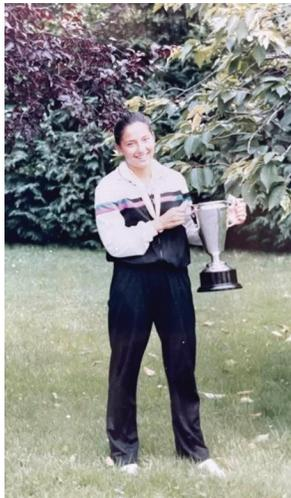
Match after match, until I was holding the trophy. The youngest ever to win the Irish Open.
Michael had even placed a small wager on the final. When I won, I heard him turn to a group of guys nearby, grinning wide: "I told you!"
Irish Open Winner’s Trophy
Bunratty Castle
A few nights later, the whole family went to Bunratty Castle for a celebration dinner.
The banquet hall felt like something from another century—heavy stone walls, long wooden tables, and torches burning in great iron brackets along the walls. Plates of roasted chicken, warm bread, and potatoes lay scattered among the candles. The fire in the great hearth crackled, sending the scent of woodsmoke drifting through the hall.
Then someone—my uncle, perhaps—lifted the Irish Cup trophy from the center of the table. Its silver surface glowed in the firelight, and inside it swirled a deep, ruby-red wine.
"Alright now," he said, clearing his throat though the grin on his
face ruined his attempt at seriousness. "We're not ending this night without a proper toast."
A hush fell over the table. Forks lowered. Chairs turned. Even the younger cousins quieted, eyes wide as they stared at the giant, gleaming cup.
I rose slowly, my hands sliding around the cool metal handles as my uncle passed the trophy to me. Its weight surprised me—heavier than it looked, warm from the wine inside.
My father leaned back in his chair, pride softening the lines around his eyes. My mother's hands clasped in front of her, her smile a mixture of joy and disbelief. A few relatives wiped their eyes, pretending it was just the smoke from the hearth.
My uncle raised his glass first.
"Here's to her—our champion. She brought the trophy home, fair and square, and we couldn't be prouder if she'd conquered all of Ireland."
I lifted the trophy. The hall grew quiet. The torches flickered, golden and soft.
I held it high—the wine gleaming inside, ruby-red in the firelight
—but I didn't drink. I was fourteen. Too young for wine.
Mom came over with a Diet Coke for me and handed one to Sean. Anna, only four, had a glass of milk.
But the adults drank. One by one, they passed the trophy around the table, each taking a sip, each raising it higher, each smiling wider.
"Sláinte!" they shouted. "To her!" "To our champion!"
The sound filled the ancient hall, rising into the rafters as though the stones themselves wanted to hold the moment for centuries.
I lowered the trophy, cheeks warm, heart full, and looked at the faces around me—people who had known me forever, who had watched me struggle and triumph, who were celebrating not the cup, but me.
This wasn't victory. This was belonging. This was home.
Later, when it was quieter, I found Mom standing near one of the stone archways, watching the celebration from a distance.
She didn't say much. She never did. But I saw something in her face—pride, maybe. Or relief. Like this win had settled something that the loss last year had left open.
She hugged me. Quick, tight. Then pulled back. "Grandda would have been proud," she said.
I nodded. I knew.
That night, I called Granny from the B&B.
The phone rang several times before she picked up. Her voice was soft, distant. Belfast felt far away.
"I won," I said.
There was a pause. Then I heard her breath catch.
"Oh, Lisa. Oh, love." Her voice broke. "Grandda would be so proud. So very proud."
I didn't know what to say. I just held the phone, listening to her breathe on the other end.
"You did it," she said finally. "You went back and you did it." "I did," I said.
We didn't talk long. But I could hear the smile in her voice when she said goodbye.
Later, when it was just the three of us—Michael, Caitlin, and me—walking back through the Dublin streets after another night out, I said, "You know, when you would say back home… I had no idea."
He nodded, assured, almost amused. "Yeah." "You were right," I said.
Caitlin laughed. "He's been insufferable about it all week."
After the tournament, we took time to go around Ireland. The whole family together—driving through the countryside, stopping at villages, visiting castles and ruins.
Sean and Anna bickered in the back seat. Dad drove, patient, navigating the narrow roads. Mom sat beside him, quieter than usual, but present.
It was one of the few times we felt like a normal family. No academy schedules. No practice courts. Just us, together, in a country that felt both foreign and familiar.
Despite the curiosity—the Falls Road girl, the cheeky American
—I made friends. Real friends. Some of them I still keep in touch with today.
Years later, when I was living in Los Angeles, I flew back to Ireland for one of their weddings. The ties had lasted. What began as curiosity had become connection.
Michael had introduced me to that world, to Fitzwilliam, to the people who would matter long after the tournaments ended. He wasn't part of the grief—that was Granny's, and Grandda's, and mine. But he was part of why Dublin felt like home.
It was great to win the tournament. I'd been winning tourna-ments for a while now, so the act of winning itself wasn't new. But this one was different. This wasn't just another trophy. This was a promise kept. This was for Grandda.
What I didn't know yet was that it would be one of the last times tennis felt simple. One of the last times the door in front of me felt wide open.
Peaking
At fifteen, I started to win important tournaments. Not everything. But enough that things began to change.
Spring Invitational in April. A tournament in June whose name I can't remember now. Another in July. Trophy after trophy, the weight of them familiar in my hands, the ritual the same: shake hands, smile for the photo, accept the plaque or cup or whatever they were giving out that week.
It wasn't about the trophies. It was about the momentum.
Each win opened a door. Each door led to another tournament, a higher seed, better competition. The kind of players who were already thinking about the tour, already training like professionals.
I was keeping up with them. Beating them.
1984 was the year I stopped being the underdog and started being the favorite.
And I liked it.
Spring Invitational
April. Tropicana Spring Invitational. One of the bigger junior tour-naments, good draw, national attention.
Stephanie was there. Younger than me by a year, maybe more. Playing up in age brackets, already getting the kind of buzz that meant scouts were watching, coaches were talking.
The new prodigy.
The morning of the semifinals, I went to the courts early to warm up. That's when I saw her.
On Stadium Court.
Nick was with her. Feeding her balls, watching her hit. Stadium Court was reserved for finals. For champions. For players who'd earned it.
She was warming up there because Nick thought she was going to win.
I stood at the fence, watching. She had a good forehand. Clean backhand. Confident movement.
But she wasn't better than me.
I walked back to my assigned practice court and warmed up alone. Hit against the backboard, the sound of the ball steady, rhythmic. My coach—one of the assistant pros—showed up eventu-ally, fed me a few balls, told me to stay aggressive.
I didn't need the reminder.
The Match
Semifinals. Me against Stephanie.
I won in straight sets.
Not close. I didn't give her a chance to settle in, didn't let her find her rhythm. I played fast, aggressive, hit through her. Every point felt inevitable.
When it was over, I shook her hand at the net. She looked surprised. Like she'd expected more.
I didn't say anything.
The next day, before the final, Nick found me near the courts.
"Stadium Court's open," he said. "You can warm up there if you want."
I looked at him.
He smiled, casual, like he hadn't put Stephanie there the day before. Like he didn't know exactly what message that had sent.
"Thanks," I said.
I warmed up on Stadium Court. I won the final too.
Summer
June, July, August. The wins kept coming.
Smaller tournaments, regional events, the kind of matches that blurred together but mattered in the rankings. Each one added points, moved me up the ladder.
By mid-summer, I was ranked in the top ten nationally in my age group.
That summer, I played the Nutrasweet pre-qualifiers.
Not the main tournament. Not even the qualifying rounds for the main tournament.
The rounds before the qualifying rounds.
Pre-pre-pre-qualifying. Then pre-pre-qualifying. Then pre-qualifying.
Three levels deep just to get a shot at qualifying for the actual professional tournament.
The main draw was limited. Martina Navratilova. Chris Evert Lloyd. The top of the sport, names everyone knew.
Raffy was in the draw. So was Carling. They were already inside the professional world.
To get anywhere near that level, I had to fight through the rounds before the qualifying rounds.
Most juniors didn't bother. The grind was too much. Too many matches, too many rounds, too little chance of actually making it through.
But I liked the grind.
I won the first match. Then the second. Then the third.
Each round, the competition got better. Older players, college players, some who'd been on tour before and were trying to fight their way back in.
I kept winning.
By the time I made it to the qualifying draw for the actual tour-nament, I'd won fifteen matches. Fifteen straight.
I lost in the first round.
A former top-100 player. Mid-twenties, experienced, hit harder than anyone I'd faced before. I couldn't keep up with her power, couldn't find the angles I needed.
But I'd gotten there.
At fifteen, I'd fought through three levels of pre-qualifying and made it to a professional tournament's qualifying draw—while the players I trained with were already inside.
That felt like proof.
Going International
Late summer, early fall. The international tournaments.
Canadian Open first. Junior division, but the competition was different than what I'd faced in the States. Players from Europe, South America, Asia. Different styles, different strategies.
I made it to the semifinals.
Lost to a girl from France who went on to win the whole tourna-ment. She was older, more experienced, hit with angles I couldn't read fast enough.
But I'd hung with her. Made her work for it.
A few weeks later, another international tournament. Same result—semifinals, lost to the eventual champion.
Both times, I walked off the court thinking: I belonged there. I could compete at this level.
The coaches noticed. Nick noticed. My parents noticed.
This wasn't just regional success anymore. This was international.
Citrus Bowl
Late November. One of the last big tournaments of the year.
Indoor hard courts, perfect conditions. No wind, no sun, just the sound of the ball and the squeak of shoes on the court.
I won the whole thing.
Beat the top seed in the semifinals. Beat another highly ranked player in the final. Straight sets both times.
When they handed me the trophy, I remember thinking: This is it. This is what I've been working for.
The feeling lasted.
The Banner
January 1985. I walked into the indoor tennis center at the Academy and looked up.
Nick hung banners for players who'd won major tournaments.
Big wins, prestigious events, the kind of results that mattered.
My banner was there.
Citrus Bowl Champion. My name in block letters, hanging from the rafters alongside the other winners.
I stood there, staring at it. I'd made it.
The Crack
But my wrist was hurting more now.
The taping had started in the fall—just a precaution, Raymond said. Support for overuse. Nothing serious.
By January, I was taping it every day. Not just for matches. For practice too.
And my ankles. They'd been taped for over a year, the figure-eight pattern so familiar I could do it without thinking. But the dull ache that used to fade after a day or two wasn't fading anymore.
It was there when I woke up. There when I went to bed.
Raymond kept saying it was normal. Tendonitis. Overuse. Ice it, tape it, keep going.
So I did.
But something had shifted.
The jump rope sessions—three times a day, forty-five minutes each—felt harder now. My calves burned. My ankles throbbed. My wrist ached when I gripped the handles.
I didn't stop.
Stopping meant falling behind. And I wasn't going to fall behind.
Not when my banner was hanging in the rafters. Not when the door was finally opening.
The Peak
Looking back, I can see it clearly now.
1984 was the peak.
The year when my body was strong enough to keep up with the training, when my mind still believed every door would open, when winning felt inevitable instead of impossible.
I didn't know it then.
I thought 1984 was the beginning. The foundation I'd build everything else on.
I didn't know it was the highest point.
That everything after would be fighting to get back to where I'd already been.