स्थानीय

Chapter 18
Brewing Storm

EARLY BETRAYALS
The California operations had split personalities.
On one side: retail. The daily grind of store operations—employee theft, inventory discrepancies, personnel problems that no amount of policies could prevent. Cash registers, Z-tapes, opening and closing counts. The constant vigilance.
On the other side: Don's projects. Universal Studios negotia-tions. The Mitsui deal. Deco Disc Industries. Energy systems. Enter-tainment ventures. And occasionally, I'd be in a recording studio singing demos for one of his music companies.
Big deals that required coordination across time zones, indus-tries, personalities. Completely different worlds, completely different problems.
I moved between them constantly. One morning I'd be on the phone with a store manager about missing inventory. That after-noon, I'd be negotiating contract terms with corporate attorneys. The whiplash was exhausting.
But as I spent more time on the bigger projects—moving beyond retail into real estate development, corporate negotiations,
entertainment deals—I started to see what people meant when they said LA was plastic.
Everything was performance.
People smiled and laughed and acted like your friend. Long lunches, enthusiastic meetings, phone calls that felt warm and personal. But it was all surface. Everyone wanted something. Access to Don. Connections to his network. Opportunities they thought I could provide.
So when old friends reached out, I was genuinely happy. Maybe real connection still existed outside this paranoid retail world. Maybe I wasn't as alone as I felt.
I wanted to believe that.
Todd called on a Tuesday afternoon in October.
Todd from college—we'd stayed in touch over the years. We'd stayed up late talking about dreams and ambitions back when we were both figuring out who we wanted to become. I'd been to his wedding two years ago, genuinely happy for him when he married Sarah.
"Lisa! How's LA treating you?"
"Busy. You know how it is. How's Sarah? How's the new job?"
We caught up for a few minutes—his work at the investment bank, her teaching position, their apartment in the city. Normal conversation. Easy.
Then the conversation shifted.
"So, listen," Todd said, his tone changing slightly. "I wanted to talk to you about an opportunity I'm working on."
My stomach sank, just a little. But I kept my voice light. "Oh yeah? What kind of opportunity?"
"It's a tech startup. Revolutionary platform—think Priceline, but better. We're about to disrupt the entire travel industry. I'm raising capital right now, and I wanted to give people I trust a chance to get in on the ground floor."
He launched into an explanation that sounded impressive but said nothing—buzzwords about "disruptive technology" and "par-adigm shifts" and "first-mover advantage," but no actual substance. Just the kind of language people use when they're
trying to sound smart without revealing they don't understand what they're selling.
"It sounds interesting," I said carefully. "But I don't know. Let me think about it."
"Sure, sure. No pressure. Just wanted to give you first shot at this."
We hung up. I sat there staring at the phone, uncertain. Maybe it was legitimate. Maybe Todd really did have something. Maybe I was being too cynical, too suspicious.
I wanted to believe in him.
A week later, I was in Florida with Don and a few others for business meetings. We were in a conference room going over projec-tions when my phone started ringing.
I glanced at the screen. Todd. I let it go to voicemail.
Five minutes later, it rang again. Todd. I silenced it.
Then again. And again.
The fourth time my phone buzzed, Don looked up from the spreadsheet. His eyes flicked to my phone, then to my face.
"Is there a problem?"
"No," I said quickly. "I'll explain later."
I turned off the ringer and set the phone face-down on the table.
That evening, after the meetings wrapped, Don and I were walking back to the hotel. The Florida heat was thick, humid.
"So," Don said. "What was that about?"
I hesitated. "It's Todd. A friend from college. He's raising money for a startup and wants me to invest. He's been calling all day."
"And?"
"And I don't know. I told him I'd think about it, but..." I trailed off. "It sounds good. He sounds excited. But something feels off."
Don stopped walking. Turned to face me. "What's he asking for?"
"Fifty to seventy thousand."
He didn't react to the number. Just looked at me steadily. "Call him back."
"What?"
"Call him back. Tell him you'd like to put me on the phone as your advisor."
I stared at him. "Don, you don't have to—" "Call him."
There was no arguing with that tone. I pulled out my phone and dialed Todd's number.
He picked up on the first ring. "Lisa! I was hoping you'd call back. Have you thought about it?"
"I have," I said. "And I'd like you to talk to my financial advisor.
He has some questions."
There was a pause. "Your advisor?"
"Yes. Hold on." I handed the phone to Don.
Don's voice was calm, professional, but there was an edge to it. "This is Donald Spector. Lisa tells me you have an investment
opportunity. Walk me through it."
I could hear Todd's voice on the other end, muffled but enthusi-astic, launching into the same pitch.
Don listened without interrupting. Then: "How many shares are you offering for the investment?"
Long pause. Todd's voice, less confident now. "I don't have that information in front of me right now."
"What's the current valuation of the company?"
Another pause. "We're still finalizing that with our advisors." "Revenue?"
"We're in the development phase. Revenue projections are strong, but we're focused on building the platform first."
Don's expression didn't change, but I saw something flicker in his eyes. He asked three more questions—about the business model, the competitive landscape, the timeline to profitability. Todd fumbled through each answer, his voice getting tighter, more defensive.
Finally, Don said, "Thank you for your time," and handed the phone back to me.
Todd was still talking. "—really think this is going to be huge, and I wanted to make sure Lisa didn't miss out—"
"Todd," I said quietly. "I'm going to pass. But thank you for thinking of me."
The warmth drained from his voice immediately. "You're making a mistake. You're going to regret this."
"Maybe. But I'm still going to pass." Silence. Then: "Okay. Your loss." He hung up.
I stood there holding the phone.
Don looked at me. "There's nothing there. No shares, no valua-tion, no revenue. Just a pitch designed to extract money from people who trust him."
I nodded. I'd known, somewhere deep down. But I hadn't wanted to believe it.
"He used your friendship as leverage," Don said. Not unkindly.
Just stating a fact.
That night, back at the hotel, I poured a glass of wine before I'd even ordered room service.
The weeks after Todd's call, I tried to move forward. Told myself it was an isolated incident. I still had other friends. Other connections.
I wanted to believe that.
Then, on a cold morning in January 1997, a process server walked into the CityWalk store.
I was there doing a routine inspection—checking displays, reviewing inventory logs. The store was busy, tourists moving through with shopping bags and cameras.
A man in a polo shirt and khakis approached me. Clipboard in hand.
"Are you responsible for this store?" "Yes."
"You've been served." He handed me a manila envelope and disappeared into the crowd of tourists.
Inside: a lawsuit.
LaShonda Marshall v. Olivier Johnson and Donald Spector
Sexual harassment. Wrongful termination. Hostile work envi-ronment.
My stomach dropped.
LaShonda Marshall had worked at one of our stores—I remem-bered her vaguely, a young woman in her early twenties. She'd been let go a few months ago for performance issues. Chronic lateness. Nothing dramatic, just consistent problems that added up over time.
But this wasn't about performance. This was about sexual harassment.
I skimmed the complaint, feeling sicker with each paragraph. She claimed Olivier had made inappropriate comments. That she had to be "nice to him" to move up in the company. That when she complained, she was retaliated against and fired.
And she was suing Don personally—not just the company, but him—claiming he knew about the harassment and allowed it to continue.
I felt sick.
I called Don from the car, my voice tight with anger.
"I just got served. A past employee is suing a manager for sexual harassment. Just so you know, I never received a complaint. But you're named in the suit. She's claiming you knew about it."
There was a pause. Then Don's voice, calm but with disbelief. "Who is this? Who said what? I was never alone with an employee."
I believed him. Not naively, not blindly, but because I knew him. This was an outright lie, probably looking for a quick settlement.
Don said we'd need legal representation in LA. I said, "Oh, I have a friend who just moved here. I'll call him."
Jason. I'd met him through Todd. But even after what happened with Todd, I wanted to believe Jason was different. Why blame Jason for what Todd did?
We met for dinner at a restaurant in Marina Del Rey—close to the airport since he was flying back to the east coast. Nothing fancy, just a casual place.
I was genuinely happy to see him. A real friend. Someone I could actually talk to.
We ordered wine, caught up on life. He asked about work. I told
him about the LaShonda Marshall lawsuit—not as a legal consulta-tion, just venting.
"That's insane," he said, shaking his head. "You must be stressed."
I felt heard. Understood. I said, "Well, if you think you could repre-sent my company in this matter, I'll recommend it to the office in NY."
We finished dinner, hugged goodbye. "Talk soon," he said.
I drove home feeling lighter than I had in weeks. Maybe I did have real friends. Maybe I wasn't as alone as I felt.
A week later, an envelope arrived. Inside: an invoice.
$40,000
Legal consultation services re: Marshall litigation
I stared at it. Then read it again, certain I was misunder-standing.
We'd had dinner. We were friends talking. I hadn't hired him.
There was no retainer, no agreement, no discussion of fees.
I called him, trying to keep my voice calm. "Jason, what is this?"
"It's for the consultation. The legal advice I provided regarding the Marshall case."
"We had dinner. We were friends talking. I didn't hire you." "That's not how I see it. I provided professional legal advice." "$40,000 of advice over a steak dinner that I paid for?"
He said nothing.
I said, "Out of my hands. I'm not signing off on this. This is going to the NY office."
I sent the invoice and told Don what happened.
His NY attorney—Harvey Kitay—called Jason's new employer, an LA law firm, and spoke to a partner.
"You can't bill someone without a retainer agreement. You know that. What are you teaching your people over there?"
The LA attorney apologized. He had no idea. And of course, he knew there was no retainer.
The LA partner said, "What invoice? There was no invoice."
I never spoke to Jason again.
Meanwhile, Don assigned one of his attorneys to handle the Marshall matter.
Don's New York assistant pulled every calendar, every appoint-ment log, every meeting record for the dates LaShonda claimed the harassment occurred. Every single meeting had three or more people present. Witnesses. Documentation. Several dates she claimed Don was in California, he was actually in New York. We had flight records, hotel receipts, meeting notes.
The evidence was clear. The accusations were false.
We sent everything to the plaintiff's attorney. They came back saying LaShonda was "so distraught" she couldn't remember the exact dates. That the trauma had affected her memory.
Don's lawyer prepared for depositions. Everything was docu-mented. The company hired a separate firm to represent Olivier.
I was angry and tired and upset that I could not protect the company from something that happened under my management. This happened on my watch. I should have seen it, should have prevented it.
Months passed. Legal fees mounted.
Then Don called. "You're not going to believe this—the suit has been dropped—not because we were right and she lied—she stabbed her attorney."
Silence. I couldn't process the words. "She what?"
"She stabbed her attorney. With a knife. During a meeting. She's been arrested."
The case collapsed immediately. The judge dismissed it.
I sat there holding the phone, feeling relief and horror and disgust all tangled together.
I had a glass of Chardonnay and then another until the anger faded.
What disturbed me most wasn't just the false accusation. It was that there are real victims out there. Real women who'd been harassed, assaulted, silenced. Women whose claims would be
doubted because of people like LaShonda who weaponized the system for their own gain.
I felt sick about all of it.
Todd tried to scam me out of fifty thousand dollars.
Jason turned a friendly dinner into a forty-thousand-dollar invoice.
These were people I'd known for years. People from before LA, before the condo, before any of this. People who were supposed to be real friends.
But they'd seen an opportunity. And they'd taken it.
I started thinking: if it's everybody else, maybe it's me. Maybe it is me. Maybe I'm the problem.
Maybe I'd become so suspicious I couldn't trust anyone anymore. Or maybe my friends weren't really friends at all.
I poured a glass of wine. Then another.
And then there was LaShonda—fabricating accusations that could have damaged Don's reputation and cost us hundreds of thousands.
I felt angry. Exhausted. Disgusted by the whole thing.
I sat alone in my condo, looking out at the lights in the Bel-Air hills.
I finished the bottle.
I wasn't paranoid, or was I. This wasn't LA. This was people.
Magic On Broadway
We were in Vegas when Don suggested it. Extra time between meetings.
"Want to see a show?" "Yes! Of course!"
He chose the Flamingo. The same Flamingo where Bugsy Siegel opened the doors in 1946. Decades later, still standing. Still making people believe.
The show was called City Lites. The theater was smaller than I expected. Velvet seats, sticky carpet, that Vegas smell of cigarette smoke and air conditioning. The lights went down.
Joseph Gabriel appeared.
Joseph had headlined at the Flamingo for nine years. He'd been on The Tonight Show. He'd performed at the White House. Don wasn't discovering him—he was elevating him.
White doves materialized from silk scarves. Cockatoos appeared from nowhere. Cards vanished and reappeared. There was some-thing old-world about him, something elegant. He didn't shout or pose. He simply performed.
Don leaned over. "You know, we could probably put him on Broadway."
I turned to look at him. "We could?" Don smiled. "Sure we can."
After the show, we went backstage.
Joseph was still in his stage clothes, his wife Lucy beside him. Petite, pale skin, brunette. Attractive, funny, smart. She was his assistant—the one who handed him the scarves, smiled at the audi-ence, made the impossible look effortless. They looked surprised to see us.
Don didn't waste time. "How would you like to do a show on Broadway?"
Joseph blinked. He looked at Lucy. He looked back at Don. Lucy spoke first. "Of course we would love to do it."
It reminded me of the moment Don had asked me if I wanted to open the West Coast office. That same spontaneous energy. The world pivoting on a single conversation.
Don invested his own money first. Then he brought in Skyline, a public company revitalizing 42nd Street. They saw Joseph as part of that vision—old-world elegance meeting new-world ambition. Mitsui came in as a minority investor. The largest corporation in the world.
We secured the Lambs Theatre—130 West 44th Street, inside the old Lambs Club building. Around 350 seats. Narrow lobby, burgundy carpet, Art Deco features. The dressing rooms were noto-riously tight.
And then the real work began.
Don handled the big pieces—theater, schedule, ticket prices,
unions. His cousin, Arnold, ran the Richard Rodgers and Oscar Hammerstein shows at Jones Beach. Before opening night, he warned Don: "Just be aware, everyone's going to think they deserve free tickets."
He was right.
Don's other cousin, Sam, owned John Henry, the richest race-horse in racing history. Sam used to get upset because Don did everything on a handshake.
"Handshakes are for saying goodbye," Sam would say.
But for Don, a handshake meant something. Your word meant something. If it didn't, no contract could fix that.
I worked on production. Joseph sent sketches for costumes and sets. I handled logistics—the who, what, where, when, why, and how.
Joseph already knew a juggler, Marco Benedetti. Athletic, almost violent in his style. He'd throw clubs so high they disappeared into the stage lights, then catch them behind his back without looking.
During rehearsals, I watched them run through the act. They moved like dancers. She'd hand him a scarf a half-second before he needed it. He'd gesture, and she'd step into position without looking. Twenty years of marriage had made them a single organism.
Opening night arrived. Don and I were both in Los Angeles.
The phone rang. It was Joseph. "I can't do it. The show isn't ready."
Don's voice was calm. "You have to start. The critics are there, the crowd is there, it's a full house. You have to do it."
He talked Joseph off the ledge from three thousand miles away. Joseph went on.
I'd seen the show in rehearsals—including the finale.
Joseph stepped to the front of the stage. "In New York, the hardest magic is getting a cab when you need one."
He raised his hands. Stage lights flickered like streetlamps. A crack of sound. A burst of smoke. A yellow Checker cab appeared center stage.
I'd seen how it worked, so the magic was gone for me. But on opening night, the audience roared. Standing ovations. The reviews
came in. A critic called Joseph "the greatest sleight of hand artist" of his generation. That became the tagline.
Joseph was bothered. He didn't want to upset the magic commu-nity. He didn't want other magicians to think he was claiming supe-riority.
He'd just gotten one of the best reviews a magician could get, and he was worried about what other magicians would think.
The show ran. Night after night. Full houses. Standing ovations.
One night after a show, a boy approached Joseph. Maybe ten years old. Dark hair, slim, wearing a sweater. He was clutching a pen and a program.
"You're amazing," he said. "I want to be a magician like you." He waved the boy off and walked away.
The boy's face fell. Lucy stood nearby. I watched her expression change—something hardening behind her eyes. She looked at Joseph's back, then at the boy, then down at her hands.
Later, as we were leaving the theater, I said to Don, "How could he treat that kid like that? Doesn't everyone know you have to be nice to the audience? I mean, they're paying for the ticket."
He just shook his head. Then the whispers started.
Men in expensive suits lingering after shows. Talking to Joseph in low voices. Flattering him.
One night I walked past his dressing room. The door was cracked.
"You're carrying this whole production," a voice said. "You could do this anywhere. Bigger venue. Better deal. You don't need them."
Joseph didn't say no.
Don had international plans for him to travel. World tours. Massive productions. The kind of opportunity most performers would kill for.
Joseph said no. He didn't want to travel.
Then one day, Joseph told Don he thought he could do better on his own.
Don said it calmly: "You can go on your own. I don't want to hold you back."
He could have fought. He could have sued. He didn't. He stepped aside.
The show ran for a while after that. Eventually, it closed. Joseph went back to Vegas.
Don had kept his word and understood what his cousin meant when he said handshakes are for saying good-bye.
Restlessness
I can't sit still. Even when I'm sitting, I'm not still—my leg bounces, my fingers tap, my mind races three steps ahead of wherever I am.
Silence feels like suffocation. If I'm not working, I'm failing. If I'm not producing, I'm worthless. The voice in my head never stops: What are you doing? Why aren't you working? You should be doing more. You're not doing enough.
I don't know when it started feeling like this. Maybe it was always like this, and I just didn't notice. Or maybe I noticed and thought everyone felt this way—this constant hum of anxiety, this need to prove myself over and over again, this terror of being still.
Being still means thinking. Thinking means feeling. And I don't want to feel anything.
So I work. I open stores. I manage personnel problems. I put out fires. I fly to different cities for Don's projects—meetings with Universal Studios executives, negotiations with Mitsui, strategy sessions for Deco Disc Industries. I make lists. I check boxes. I keep moving because if I stop moving, something bad will happen. I don't know what. I just know I can't stop.
Even on vacation—the rare times I take one—I can't relax. I bring work. I check in with the stores. My mind keeps going back to what needs to be done, what I should be handling. People would tell me to stop talking about work. To just relax. To be present.
But I couldn't. My brain wouldn't turn off.
Something is wrong. I know something is wrong. I just don't know what.
By early 1997, I'd been in Los Angeles for over a year, and I could count my real friends on one hand. Actually, I couldn't count them at all. I had business contacts. I had people I saw at industry events. I had vendors and landlords and store managers and corpo-rate executives. Professional relationships built on transactions and mutual benefit.
But nobody I could call just to talk. Nobody who knew me before all this. Nobody who wanted to get coffee just because.
And when old friends did reach out—Todd, Jason—it turned out they wanted something. A tech startup investment. Legal fees disguised as friendship. They had angles.
But I didn't want to believe everyone was like that. So I decided to do something about it.
I looked up the Wake Forest Alumni Chapter in Los Angeles. Started going to their events—happy hours, dinners, weekend gatherings.
At first it seemed promising. Normal conversations about profes-sors we'd had, what it was like moving to LA from the South, the usual getting-to-know-you questions.
But then someone would ask what I did for work. And once they found out I worked for Donald Spector—that I ran his West Coast operations, coordinated projects with Universal Studios and major corporations—I could see the shift. The questions changed. Everyone wanted to know where they might fit. How they could get access. What I could do for them.
It wasn't friendship. It was networking.
At work, it was the same problem in a different form.
I loved parts of my job. But the employees thought I was too demanding.
They'd push back on sales targets, claim the numbers weren't realistic. I could see the doubt on their faces when I talked about what was possible.
So one afternoon, I challenged one of the employees—Jennifer, who'd been with us about six months.
It happened on a Tuesday afternoon at the CityWalk location. I
was reviewing the previous week's numbers with the staff—sales were down, conversion rates were low.
I looked at Jennifer. Then at the rest of them.
"Let's make a bet. I'll work the floor for one hour. You work the floor for one hour. Whoever makes more sales wins."
Jennifer looked at the others, then back at me. "What do I get if I win?"
"If you win, I'll adjust the sales targets for the next quarter. Make them more 'realistic.'" I kept my voice even. "But if I win, you stop telling me I don't understand."
She hesitated. Then nodded. "Okay. Deal."
We started at 2 PM on a Saturday—busy time, lots of foot traffic from tourists heading to the Universal Studios theme park.
I put on a name tag that just said "Lisa." Stood at the display table like any other employee. Smiled at customers as they walked by. "Hi! Have you seen this yet? It's one of our most popular items
—let me show you how it works."
I demonstrated the product. Answered questions. Made suggestions. Rang up sales.
One hour later, I'd made eighteen sales. Jennifer had made three.
The other employees had been watching. They knew the numbers before we even tallied them up.
Jennifer stood there, silent, her face flushed.
"You're good at this," I said quietly. "You could be great at it.
But you have to actually try."
She didn't say anything. Just nodded and walked away.
I stood there in the store after everyone had gone back to work, watching the floor, and I realized something.
I wasn't too demanding. I wasn't unrealistic. I just cared more than they did.
Everyone in New York cared about these standards. Don cared. Marion cared. Barbara and Michael cared. They understood what we were building, what we were trying to maintain. They held themselves to the same standards they expected from everyone else.
But I was the only one in LA who felt that way.
The employees here saw it as just a job. A paycheck. Something to do until they got their big break in entertainment or moved on to something better.
I saw it as a responsibility. A reflection of Don's trust in me. A standard that mattered.
And I was carrying it alone.
A few weeks after Don had been back in New York, my phone rang one evening. His name on the caller ID.
"Hey," I said. "How are things?"
"Good. Busy. How are the meetings going out there?"
"Fine. Productive." We talked about work for a few minutes—store numbers, upcoming projects, the usual.
Then he said: "You should get a pet." The words caught me off guard. "What?"
"A pet. Something living in that condo. Company." "Why?"
He was quiet for a moment. "Well, why not? Marion and I have a cat. So does Barbara and Michael. Why not you?"
We'd been having lunch at an outdoor restaurant in Santa Monica the last time he was in LA. I didn't realize it at the time, but he'd noticed me watching the dogs that passed by—people walking their pets, dogs on leashes, the way I'd track them as they went past our table.
The suggestion felt both thoughtful and exposing—like he'd seen something I didn't want anyone to see. The loneliness.
"I'm more of a dog person," I said finally.
He laughed. "With your schedule? You can't have a dog."
Later, I realized it wasn't just a casual suggestion. It was Don's way of telling me he'd noticed the silence. That I was alone in a way that mattered.
"I guess not."
"Think about it," he said. And then we moved on to other things.
The next time Don was in LA, he brought it up again.
We were in the car, driving back from a store inspection. Traffic on the 405, the sun setting over the Pacific in the distance.
"I've been thinking about the cat thing," he said. I glanced at him. "Don—"
"There's a breed of cats that's like a dog. A Bengal cat. It's a cross between an Asian leopard and a domestic cat. Heard it's like a dog. You'd like it."
I stared at him. "An Asian leopard? You want me to get a cat that's part leopard?"
"Why not look?"
It sounded insane. But Don had that look on his face—the one that meant he'd already decided this was happening and was just waiting for me to catch up.
"Where would I even get something like that?"
"There's a breeder in San Bernardino. We can go after the next meeting."
I should have said no. I should have told him I didn't need a cat, that I was fine, that this was unnecessary.
But I didn't.
"Okay," I said. "Fine. We'll go look."
The breeder's property was in San Bernardino, surrounded by open land and hills. We pulled up to a house with a massive outdoor enclosure in the back—a cage the size of a tennis court, maybe bigger, with climbing structures and platforms and thick mesh walls. The breeder—a woman in her fifties with sun-weathered skin and a calm, confident demeanor—greeted us warmly and led us
toward the cage.
"The mother's in here with the kittens," she said, unlocking the gate. "Come on in."
I stopped. "Wait. We're going inside?"
"Of course. How else are you going to meet them?"
Don was already walking through the gate, completely unbothered.
I followed slowly, my heart starting to pound.
Inside the cage, a leopard—sleek, muscular, with the distinctive spotted coat and those intense predator eyes—was lounging on one
of the platforms. She looked up when we entered, watching us with that unblinking stare that made every instinct in my body scream danger.
"You have to be kidding me," I said, pressing my back against the mesh wall of the cage.
The breeder smiled. "She's perfectly safe. She's used to people." I raised my eyebrow.
The mother leopard jumped down from the platform and padded across the enclosure, moving with that fluid, predatory grace. She walked right past Don—who stood there calmly, watching her—and came toward me.
I flattened myself against the wall, barely breathing.
Don glanced back at me and started laughing. "Lisa, she's not going to hurt you."
"She's a leopard, Don."
The mother sniffed the air near me, then lost interest and walked away to check on her kittens, who were tumbling over each other in a corner of the enclosure—tiny spotted balls of fur, climbing on structures, chasing each other, completely fearless.
One of them—a boy with golden fur and dark rosettes—broke away from the group and walked straight toward me, meowing.
I was still pressed against the wall, watching the mother out of the corner of my eye, when the kitten reached my feet and started rubbing against my leg, purring loudly.
"That one likes you," the breeder said.
I crouched down slowly, keeping one eye on the mother, and picked him up. He was warm and soft, his purr vibrating against my chest. He looked up at me with those big eyes, completely trusting, and something in my chest loosened.
"Okay," I said. "This one." Don smiled. "Good choice."
We drove back to LA with the kitten in a carrier on my lap. He meowed the entire way, a high-pitched, plaintive sound that made my chest tight with anxiety.
"What if I can't take care of him?" I said. "What if I'm traveling too much? What if—"
"What if he hates me?"
"He's not going to hate you. He already picked you." Don laughed. "You're not going to kill him. Cats are resilient. Just feed him, give him water, clean the litter box. It's not complicated."
I glanced at the carrier. The kitten—I'd already started thinking of him as Simba—had stopped meowing and was curled up in a ball, his eyes half-closed.
"Okay," I said. "Okay."
When I got home, I opened the carrier in my living room. Simba stepped out cautiously, sniffing the air, his tail twitching. Then he walked over to the couch, jumped up, and curled into a ball like he'd lived there his whole life.
After that, I had someone to come home to. Someone who needed me. Someone who greeted me at the door when I walked in, meowing and rubbing against my legs, genuinely happy to see me.
I'd feed him, talk to him while I made dinner, let him curl up next to me on the couch while I reviewed files or watched TV or sat there with a glass of wine trying to quiet my mind.
"At least someone's happy to see me," I'd say, scratching behind his ears while he purred.
It helped. It really did. But it wasn't enough.
The Wedding at Kilkea Castle
In the fall of 1997, one of my closest friends from childhood was getting married in Ireland. Since I knew Marion and Barbara had always wanted to go, I suggested we make it a trip together.
"Come with me," I said to Marion. "I'll take you around Ireland for a week. Then I'll go to the wedding, and we'll meet back up after."
Marion didn't hesitate. "I'd love that. Let me talk to Barbara." A few days later, it was settled. Ten days in Ireland.
"What about Simba?" Marion asked.
"I'll figure something out. Maybe a pet sitter—"
"Don's going to be in LA for meetings anyway," she said. "He can stay at your place. Watch Simba."
I hesitated. "Are you sure? That's a lot to ask—" "He offered," Marion said. "He wants to."
So, it was decided.
The day I left, Don came by the condo to pick up the keys. Simba was already circling his legs, purring, like he knew something was happening.
"You sure you're okay watching him?" I asked, setting my suit-case by the door.
"Go," Don said.
"Thank you. For doing this."
"Have a good time," he said. "Relax."
County Monaghan felt like a place slightly removed from time. We'd been there for a few days—Marion, Barbara, and me—
driving through the drumlins, those soft rounded hills rolling one after another like waves frozen mid-motion. The landscape dipped and rose, each hollow opening to small lakes lying quiet under grey-blue skies. The air carried the scent of peat smoke from turf fires, especially in the evenings, curling from stone cottages along narrow roads.
The grass was so green it looked like velvet under the mist. Fields divided by hedgerows. Roads so narrow grass grew up the middle. It was 1997, just before the Good Friday Agreement, and you could feel the history—the border with Northern Ireland nearby, the years of the Troubles still present in quiet conversations and careful glances. But Monaghan itself felt calm. Resilient.
We were at a pub—one of those old places with a horseshoe-shaped bar, worn wooden floors, and the smell of coal fires mixing with Guinness and cigarette smoke. Conversations low, punctuated by laughter. Warm. Familiar. The kind of place where everyone knew each other or knew someone who knew you.
We sat at a corner table. I had a hot whiskey in front of me—the glass warm in my hands, cloves and lemon and sugar mixing with the whiskey's heat. Marion was on the phone with Don, laughing at something he said.
When she paused, I leaned over. "Can I talk to him?" She handed me the phone.
"Hey," I said.
"Hey," Don said. I could hear faint traffic in the background—probably the condo balcony.
"How's Simba?" I asked. Then, catching myself: "Sorry—how are you? How is Simba? The meetings?"
Don laughed. "Everything is fine. It is quiet here. I did not realize how quiet the condo is when there are no meetings."
The words landed heavy. Weighted.
He wasn't talking about noise. He was talking about the empti-ness. The silence when no one was there. The loneliness of it.
My throat tightened.
He'd noticed. It wasn't just in my head. The quiet was real. "Yes," I said finally. "It is."
We talked a few more minutes—Simba was fine, the meetings were fine, the weather was fine. Then Marion took the phone back and we said goodbye.
I sat there holding the hot whiskey, staring at the table. Around me, the pub hummed with warmth—people laughing, telling stories, the bartender calling out orders. Marion and Barbara talking about where we'd drive tomorrow.
I was surrounded by people. In this beautiful place. With friends.
And all I could think about was how empty my condo was. How quiet. How alone I was when I went back.
A few days later, I left Marion and Barbara in Kenmare and took the train to Dublin for the wedding.
Caitlin—one of my closest friends, someone I'd met at a tennis tournament in Ireland when we were thirteen. She'd been Michael's girlfriend back then, in the way thirteen-year-olds have girlfriends.
The wedding was at Kilkea Castle.
I realized it the moment the car turned down the long, narrow lane. Trees arched overhead like a cathedral, branches meeting in the middle, filtering the pale Irish light. At the end of the drive, the castle rose—stone grey, ivy-clad, imposing. Turrets and battlements against the sky.
The memory hit before I even got out of the car.
Six years ago, Kevin and I had talked about getting married here. Not planned it—we never got that far. But we'd imagined it. This castle. These walls.
Then he broke it off. Sent a fax from Ibiza at three in the morn-ing. Made the decision for both of us.
I didn't regret what came after. I'd built something real—the West Coast operations, Universal Studios, Mitsui, Deco Disc Industries.
But standing here now, about to watch someone else get married in the place I'd once imagined for myself...
The heavy wooden doors groaned as I pushed them open. Inside, the stone corridors were cool even in summer, the air carrying the faint scent of old stone and woodsmoke. Fireplaces crackled in the main hall. Worn carpets softened footsteps. Deep-colored drapes framed tall windows. Antique furniture—slightly mismatched but full of character—filled the rooms with history.
The lighting was warm and dim, casting golden pools across stone floors. Everything had that feeling of age. Not neglected—lived in. Authentic. Like stepping into the fifteenth century.
It was exactly as beautiful as I'd imagined six years ago. Just... not for me.
The ceremony was in the castle's chapel—small, intimate, filled with people I recognized from years ago. Faces I hadn't seen in a decade but somehow still knew. Caitlin radiant, her dress catching the light from the stained glass as she walked down the aisle.
After the ceremony, we gathered in the great hall. White table-cloths, flowers everywhere, champagne flowing. The room humming with conversation and laughter.
I was genuinely happy for her. Truly. She deserved every bit of it. This was an Irish wedding—the kind that starts with ceremony and ends when the sun comes up. The great hall filled with music and voices, the stone walls amplifying every laugh, every song, every
toast that went on a little too long.
We stayed up until four in the morning.
Talking. Singing. Dancing until our feet hurt and we kicked off our shoes and kept going anyway.
Someone pulled out a guitar. Someone else knew all the words to songs I'd forgotten I loved. We sang—badly, loudly, joyfully—our voices echoing off the stone.
I found myself at a table with people I'd grown up with, catching up on lives that had gone in a dozen directions. Everyone had stories—new jobs, new cities, new adventures.
"Caitlin's doing brilliantly at the firm," someone said. "Made partner last year. And now this—she figured out how to have it all."
"We just moved to Singapore," another said, glowing. "My husband got transferred, and I found a position in finance. It's been incredible—challenging, but we're building something together."
"Our second is due in October," someone else added, hand on her belly. "A girl this time. And I just got promoted to senior analyst. Exhausting, but worth it."
They were happy. Genuinely, deeply happy.
Building careers and families. Partners who supported their work. Children they were raising together. They'd found ways to balance both—the professional success and the personal connection. They hadn't chosen one over the other. They'd managed to have both.
At four in the morning, we finally said our goodbyes. Hugs that lasted too long. Promises to stay in touch we'd probably keep for a few months before life got busy again. Caitlin glowing, her new husband's arm around her waist.
Everyone drifted out into the early morning light—couples walking to their cars, families gathering sleepy children, friends heading back to hotels in groups.
They all went back to partners. To the lives they were building together. Professional success and someone to share it with.
I took the train back to Dublin alone.
The drumlins rolled past the window, those soft rounded hills dipping in and out of view. I watched the landscape blur and thought about the night—the singing, the dancing, the warmth of being surrounded by people who'd known me since I was thirteen.
It had been wonderful. I'd been part of it. Fully present.
Genuinely happy.
But they'd figured out how to have both. Careers they were proud of and partners to build with. They hadn't sacrificed one for the other—they'd found balance.
I had the career. The success. The autonomy. Everything Michael said I was meant for.
But I was carrying it all alone.
When I got back to LA, Simba greeted me at the door, meowing loudly, rubbing against my legs like I'd been gone for months.
I picked him up, buried my face in his fur. "I missed you too," I said.
The condo looked exactly the same. Clean, organized, every-thing in its place. Don had left a note on the counter: Simba was great. See you next week. —D
I set my suitcase down and looked around. The fourteenth-floor view, the museum-quality art, the expensive furniture. Everything beautiful and tasteful and empty.
Simba jumped onto the couch and curled into his usual spot, purring.
"At least someone's happy to see me," I said.
Steve Kaufman
Don heard about him through Eddie Miller.
Eddie had worked for Don, but before that he'd been the consummate salesman—close relationships at Home Shopping Network and other major retailers, built his own watch and jewelry companies from the ground up.
Then one day, Eddie went to the doctor for a routine checkup and was told he had six months to live.
He did what any responsible man would do: sold everything. All his businesses, liquidated his assets, put his affairs in order. He wanted to make sure his family would be taken care of.
In the fifth month, his doctor called him back in. There had been a mistake. Eddie was fine. Completely healthy.
But by then, everything had been sold. The businesses, the rela-tionships, the infrastructure he'd spent years building—gone. He had to start over from scratch.
Don said, "Come work with me."
Through Eddie, Don met Lenny Lauren—Ralph Lauren's brother. Lenny was a serious art collector who knew the market inside and out.
One afternoon, Lenny leaned back in his chair and said, "You need to meet Steve Kaufman. He's the next Warhol."
So I went to meet him.
Steve's studio was in a rough part of LA—a ranch-type house surrounded by high walls in a neighborhood where you didn't leave your car unlocked. I pulled up in my red Mercedes and stared at the massive black metal gate. Someone had painted the Joker from Batman across it, that manic grin leering down at me.
I pressed the intercom. The gate rolled open.
Pit bulls roaming the yard. Three, maybe four. And standing near the house, a group of young guys—Steve's crew. Gang kids just out of jail. He gave them work, gave them a second chance.
I hesitated at the gate.
"Is my car going to be safe here?" I called out.
Steve appeared in the doorway, impossible to miss—and gestured to the guys. "See that car? Make sure no one touches it."
They gave me a deliberate, respectful nod.
I pulled in and stepped out, and that's when I noticed: pit bull poo. Everywhere. The entire yard was a minefield, and I was in three-inch heels.
Steve watched from the doorway, arms crossed, slight grin on his face.
I picked my way through carefully, stepping around piles, keeping my balance, refusing to flinch.
This was a test. I knew it. He wanted to see if I'd turn around and leave.
I made it to the door. "Nice shoes," Steve said.
Inside, he was mid-story, gesturing with a paint-streaked brush
at a half-finished Marilyn Monroe. Thick Bronx accent, loud and rhythmic, punctuated by his own laughter. He turned, spotted me, and his grin arrived before the punchline.
"You gotta be here!"
He towered over everything—six-foot-seven, broad-shouldered, paint-spattered denim jacket over a black tee. One eye had a slight droop that softened his whole face. His hands were massive, streaked with paint.
"Lenny says you're the next Warhol," I said.
Steve's grin widened. "Nah. I'm the first Steve Kaufman." I liked him immediately.
We collaborated on sculptures. Steve had the artistic vision, the Warhol pedigree. I had the business infrastructure, the distribution network.
Here's what I learned: managing an artist who wants to work is completely different from managing one who doesn't.
Steve showed up. Every time. He didn't make excuses, didn't disappear for weeks, didn't treat deadlines like suggestions. When something went wrong—and things always go wrong—he rolled up his sleeves and helped fix it.
One afternoon, Steve called me. "Come over. I have a surprise."
I drove to the compound, navigated the pit bull minefield—this time in flats—and walked into the studio.
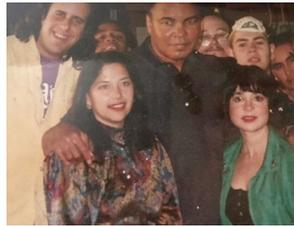
Muhammad Ali was standing there. The Greatest. In Steve's paint-splattered studio.
Steve put his arm around my shoulder and turned to Ali. "I want you to meet a very special person in my life."
Ali looked at me, then leaned toward Steve—not quite close enough. His voice was soft, but loud enough for me to hear: "Very pretty."
Steve walked us over to a canvas—a portrait of Ali, bold and vibrant. Ali studied it, nodding slowly, that famous face breaking into a smile.
We took photos. Steve, Ali, the gang kids, and—because this was Steve's world—a random porn star who happened to be there that
day. All of us grinning like it was the most natural thing in the world.
From left to right: Steve Kaufman, Lisa Pamintuan, Muhammad Ali
Around that same time, Don and I were working with Stan Lee on developing a new female superhero. We were in his office one afternoon, going over character sketches, when he leaned back and said, "There's an artist out here painting Spider-Man and some of the other characters I created. Beautiful work."
"Who?" I asked. "Steve Kaufman."
I laughed. "We know Steve. We're going over there this afternoon."
Stan grinned. "Great, I'll join you."
So that afternoon, the three of us ended up at Steve's compound. When we walked in, Steve had burgers and tacos laid out for us—his version of hospitality.
I looked around. "Where are we going to eat?"
"Right here," he said, pointing to a stack of oil canvases he'd painted—Marilyns, superheroes, bold colors stacked like placemats.
He took a huge bite of a taco. Sauce dripped straight onto one of the canvases.
"Oh!" I said, instinctively reaching toward it.
Steve burst out laughing, that big Bronx laugh that filled the whole room. "Don't worry about it," he said, rubbing his hand over the spilled sauce. "It's an oil painting. It'll come right off."
And somehow, it did.
Stan shook his head, still laughing. "Only Steve."
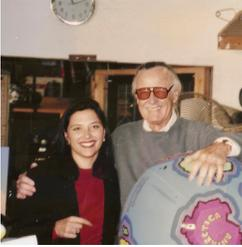
Stan Lee and Lisa Pamintuan
Steve grinned. "That's because they're good paintings."
Three weeks into production, I was at my apartment going through paperwork around nine at night. The doorbell rang.
Steve was standing there with a bag of Chinese food.
"Thought you might be hungry," he said.
He'd brought my exact order. The one I
always got. Down to the extra hot mustard.
He sat at my kitchen table and started eating. Didn't make a big thing of it. Didn't ask if I was okay or if the stress was getting to me. Just opened the containers.
He'd driven forty minutes out of his way. He'd been paying attention.
Don liked him immediately.
One night, the three of us went to dinner at Spago. Packed as always, and somehow, we ended up in a tiny corner table near the kitchen. Steve's massive frame barely fit in the chair.
Don looked around. "Why are we sitting here?"
Steve grinned and pointed up at the wall, where the Spago sign hung. A small dent in the plaster sat just beneath it.
"See that? I did that." "How?"
"I was painting the sign. Fell off the ladder." He started laughing—that huge, uncontrollable laugh. "Hit the wall on the way down."
I noticed the burn scars on his forearm. They ran from his wrist almost to his elbow, thick and ropy, except for one small patch near his wrist that was unmarked.
"What happened there?" Don asked.
Steve glanced down like he'd forgotten. "Oh. That. I built wings on a Harley once. Thought I could make it fly."
Silence.
"It didn't fly," Steve added, still grinning. "Fell off. Ripped my
arm apart. Only part that didn't get burned was where my watch was."
Don leaned back, studying him. "I used to do a lot of work with Major de Seversky. Russian aviation pioneer—expert in flight dynamics, aeronautical engineering. Received a commission as a major in the Army Air Corps."
Steve nodded, waiting.
"So I have to ask," Don said. "What made you think you could get a motorcycle to fly?"
Steve didn't hesitate. "Because I built it."
Don laughed. Not his usual quiet chuckle. A real laugh. "Fair enough," Don said.
Steve had stories for days. He'd gone to Japan once and blown half a million dollars in a week on a starlet. He'd gone ten rounds with a world-famous boxer in Amsterdam. He painted everything: guitars with Marilyn Monroe, a Gucci bag with Wonder Woman that became a museum piece.
We were working late one night—the three of us—and the conversation turned to Steve's romantic exploits.
"When you do this," I said, "are you doing them one by one, or is everyone just piled on top of each other?"
"Lisa!" Don said. "What? I'm just curious."
Steve let out a booming laugh that echoed through the studio. He laughed so hard he had to sit down, tears streaming down his face.
"That's when I had the heart attack," he finally managed to say. "Wait—what?"
"The thirty-two women. That's when I had the heart attack."
I stared at him. "You're telling me you had a heart attack in the middle of—"
"Yep."
"And you're still here." "Yep."
Don shook his head. "Steve, you're going to kill yourself one of these days."
"Maybe," Steve said, still grinning. "But what a way to go."
Shark Week
We'd been in the Bahamas for three days when the storm rolled in.
It was July 1998. Don had arranged the trip—my thirtieth birth-day. Marion's birthday was a few days after mine, so we celebrated together. The usual group. Sun, sand, ocean. The pattern we'd established over years of these trips.
The pattern was always the same. Barbara and Marion would stake out chairs by the pool or on the beach, settle in with their books, and read for hours. The sound of pages turning, the occa-sional sip of iced tea, the rustle of a magazine. Peaceful. Contained.
Mary, Don, and I would be in the water—swimming, scuba diving, exploring. We were the active ones. They were the relaxed ones.
It worked.
On the third day, the sky started to change. Clouds gathered on the horizon, dark and heavy, rolling in slowly but steadily. The air felt different—thicker, charged with something electric. The wind picked up, carrying the smell of rain and salt.
Mary looked up from her towel, squinted at the sky, and shook her head.
"I'm not going out today," she said.
I looked at the clouds. They were closer now, darker. "You sure?" Don walked over, grinning. "Let's rent a catamaran."
"Yeah, why not? We'll stay close to shore."
Barbara overheard and looked up from her book. She glanced at Mary, then at me, then back at Don. Her expression was somewhere between amused and exasperated.
"Mary has common sense," Barbara said dryly. "Lisa would jump off the Brooklyn Bridge if you asked her to."
I laughed. She wasn't wrong.
We walked down to the rental stand, where a local guy was sitting under an umbrella, half-asleep. The wind was stronger now,
whipping the umbrellas, making the palm fronds clatter. Don pointed to one of the catamarans.
"We want to rent that one."
The guy looked up, then looked out at the horizon. The dark clouds were closer now, the wind picking up, whitecaps forming on the water.
"No, mon. Storm coming. No rentals right now."
Don waved him off. "I've been sailing for thirty years. We'll be fine. We'll stay close to shore."
The guy hesitated, studying Don's face, then shrugged. "Your funeral."
We dragged the catamaran into the water. The hull scraped against the sand, then lifted as the waves caught it. We climbed on, pushed off. The wind caught the sail immediately, and we started moving, gliding across the water. It felt good—the spray of the ocean on my face, the pull of the wind, the sense of freedom.
I looked at Don. "When was the last time you did this?" "Long enough," he said, grinning.
We were maybe a quarter mile from shore when the tiller arm broke. It just snapped and then Don was holding a piece of wood that was no longer connected to anything.
He grabbed for the other end, but it was useless—we had no control over the sails, no way to steer, no way to stop. The cata-maran was just a piece of fiberglass at the mercy of the wind.
"Damn it," Don said.
I shot him a look. "What?" "Nothing. We'll be fine."
The wind picked up. The dark clouds were directly overhead now, moving fast. The catamaran started tilting, the sail catching too much wind. Don tried to adjust, pulling on ropes that did nothing, but without the tiller, we were just along for the ride.
And then we capsized.
One second we were upright, the next we were in the water. We both grabbed onto the side of the submerged catamaran. "You okay?" he called out.
"Yeah," I said. "You?"
That's when I saw the blood.
His leg—he'd cut it on something when we capsized. Not a deep cut, but enough. A dark red line running down his calf, blood mixing with seawater, spreading in thin tendrils.
I started laughing. I don't know why. Maybe it was the absurdity of it. Maybe it was the rum from earlier.
"Do you know the Bahamas is one of the shark capitals of the world?" I called out.
Don shot me a look. "Lisa—"
"Caribbean reef sharks, lemon sharks, tiger sharks," I continued, still laughing, my voice rising over the wind. "And you can't forget the hammerheads."
"Lisa, stop—"
"Do you know a shark can smell blood from a mile away?"
The wind caught part of the sail again, and I felt the rope pull taut in my hands. The capsized catamaran lurched forward, drag-ging me with it. Slowly at first, then faster. The rope burned against my palms as I held on, my knuckles white.
"Hold on to the rope!" Don shouted. "Stay with the boat!" Then he let go.
I screamed. "What are you doing?" "The blood," he said.
He stayed back, treading water, a yellow bob in the dark blue sea. The life vest made him visible, but barely. He was getting smaller as I drifted farther out.
I looked at him—this man who'd given me everything, who'd believed in me when no one else did—and I shouted, "Well, if we die out here, at least I won't have to open your fucking stores!"
The words came out raw.
The catamaran kept dragging me. Farther and farther from shore. Don was a tiny yellow dot now, barely visible against the dark water. My arms burned from holding the rope. My shoulders screamed. My legs cramped, useless, just dead weight hanging below me.
The waves slapped my face over and over. Salt water in my mouth, my nose, my eyes. I couldn't see clearly anymore—every-
thing was blurred, stinging. I tried to pull myself closer to the cata-maran, but I had no strength left. I just held on.
One hour passed. Then another.
My hands were numb. I couldn't feel my fingers anymore, couldn't tell if I was still gripping the rope or if it was just locked there by muscle memory. My throat was raw from coughing up seawater. My mind started to drift—not panic, just a strange, detached calm. This is how it happens. This is how people die. They just get tired and let go.
Then I saw a parasailer above me, being pulled by a boat. The bright colors of the parachute against the gray sky. I waved with one hand, holding the rope with the other, my arm shaking with the effort.
He signaled back. He'd seen me.
The boat turned, came toward me. Hands reached down, pulled me in. I collapsed on the deck, gasping, shaking. Someone wrapped a towel around me.
I pointed back toward where Don was. "There's someone else out there. Yellow life vest."
They went to get him.
Two and a half hours. That's how long we were out there.
We walked up the beach, soaking wet, exhausted. My legs barely held me. Don had an open gash on his leg, blood still seeping through the makeshift bandage someone on the rescue boat had wrapped around it. We left wet footprints in the sand.
Barbara and Marion were still in their chairs, books open, completely unaware. The same position they'd been in when we left.
Marion looked up. "Did you have a good time?"
Don and I looked at each other. His face was pale, his hair plas-tered to his head. I could still taste salt water in the back of my throat.
"Did you realize we were gone?" Don asked. Marion blinked. "Gone?"
Don told them what happened. The broken tiller. The capsizing.
The blood. The sharks. The drifting. The rescue.
Mary's eyes went wide. She started giggling—that nervous laugh
that comes when something is too absurd to process. "That is why I did not want to go. Lisa was watching Shark Week in the room, and there was no way I was going."
Barbara shook her head, smiling. "I told you she'd follow you into anything."
We all laughed. It was funny. It was a story we'd tell for years.
But the joke I'd made out there—about not having to open the stores—part of me meant it.
I didn't tell them that part.
Back in Los Angeles, daily routines seemed more difficult.
The restlessness continued. The racing mind. The wine most nights to quiet it enough to sleep. Simba helped—coming home to someone who was always happy to see me made the loneliness more bearable.
But the weight of carrying everything alone didn't go away. Something was wrong. I knew something was wrong.
I just didn't know what.