स्थानीय

Chapter 26
Roses

LET'S GO, BABY
When it came time to choose a commencement speaker, I suggested Nick Bollettieri.
A few board members hesitated. "Isn't he just a tennis coach?" No.
Nick had coached more than ten players to number one in the world. He built the first true sports academy—long before IMG, before the model was copied across continents. But that still wasn't the point.
What mattered was that Nick could see what each person needed and demand it from them without apology. He wasn't teaching tennis. He was teaching accountability. Discipline. Resilience. How to stay present when things got uncomfortable.
That was why I wanted him on that stage.
Nick accepted immediately. He was genuinely happy. He flew in with his family and nearly twenty of his closest friends, which meant we hired a small bus just to get everyone there.
On the morning of commencement, we left Manhattan together.
The morning should have been simple. Instead, we hit traffic almost immediately—the kind of stop-and-start crawl that tightens your chest. I could see Nick growing restless. Not angry. Alert. He hated wasted time. He leaned forward, hands on his knees, staring out the window as if he might will the road to move.
I leaned over and said quietly, "Don't worry, Nick. They can't start without us."
He looked at me for a moment. Then nodded. Still tense—but listening.
When we finally arrived, we were ushered into the holding area where the board and honorees waited before the procession. Gowns. Tams. Low voices. The contained hum of people who knew the ceremony hadn't started yet.
It was there—offstage, out of earshot—that the conversation drifted.
Someone referenced my engagement. Another person added a comment meant to be light, familiar. It edged, unintentionally but unmistakably, toward money. Toward assumptions people make when a woman's private life becomes visible alongside her public one.
Nothing overt. Nothing cruel. But enough.
I registered it immediately. Nick did too.
He was standing beside me in his gown and tam, suddenly very still. Head slightly bowed. Not saying a word.
That wasn't like Nick.
I leaned in and said quietly, "Nick, don't worry. You know I'm not like those girls."
A pause.
"I didn't invite Klaus to commencement."
He looked up at me and held my gaze for a second. Then he nodded. Just once.
He straightened, smoothed his gown.
"All right," he said, his voice warm again.
Then he smiled—the unmistakable smile I'd known since I was a kid. The one that said everything was going to be fine.
"All right," I said. "Showtime."
As we stepped into line, he added, exactly the way he always did when it mattered most:
"Let's go, baby."
Inside the hall, there was a flicker of uncertainty. Some people didn't quite know why he was there. Why he was receiving an honorary doctorate.
I walked to the podium and read the citation—his impact on the sport, the players he shaped, the lives he changed.
Nick stepped forward, adjusted the microphone, and smiled. "Thank you, President…" he said, then paused. "Or as I always
used to call you—Lisa." The room laughed.
"I know you're sitting out there thinking what I would have thought," he said, turning to the graduates. "Get your diploma and then get out of here."
More laughter.
"So I'll say to you what I say to my players all the time: Let's get it on, baby."
The room settled.
"As proud as I am of my students who became professional tennis players," he continued, "the greatest pride I have is in those who became champions of life off the court."
The uncertainty dissolved.
Nick told a story about a seventeen-year-old student who once said, I don't know who I am. I don't know if I can do it.
"I said to him," Nick told the room,
Nick Bollettieri and Lisa Pamintuan
"'Never use the words I can't do it.'"
The student became number one in the world. Fell. Climbed back. Learned what
he'd been given—and decided to use it.
Nick didn't dramatize it. He didn't need to.
Then he said something else.
"None of you would be here today if someone somewhere didn't believe in you and make sacrifices so you could be sitting here right now."
He paused.
"Stand up. Turn around. Thank them." The entire room rose.
The applause wasn't polite. It was full. Parents wiping their eyes.
Students hugging the people who had gotten them there.
That was the moment.
That was when everyone understood why he was on that stage. Nick waited until the room quieted.
"Figure out what you love to do," he said, "and then do it with all your heart."
He smiled.
"I've fallen more times than I can count. But I get right back up.
Because I know I can do it."
When he finished, the room stood again.
If you didn't know who he was before, you knew then. I stood too, watching him.
Later in life, I would understand that Nick had spent his life building people, not just players. Discipline. Accountability. The cost of excellence. He could see what someone needed and insist on it—without apology.
At the time, I didn't have language for it. I just knew he belonged there.
And I knew I had seen this kind of work before.
THE SAME WORK
It took me years to understand that elite coaching and addiction recovery are doing the same work.
They come from different worlds—one from sport, the other from survival—but they are built to solve the same problem: how to change a human being under pressure, when emotion overrides reason and habits collapse.
Nick never talked about psychology. He talked about work. But everything he did was psychological.
At the academy, winning mattered—but it was never where the work began. You were trained to identify your weaknesses, build around your strengths, and take responsibility for what happened when things went wrong. Champion wasn't a slogan. It was how you functioned when things were uncomfortable.
Nick didn't explain this. He demonstrated it.
"Get under the ball, my dear," he'd say. Again. Again. Responsibility came before results.
Recovery works the same way.
Alcoholics Anonymous doesn't begin with drinking. It begins with identity. Not I will stop drinking—but I am a recovering alcoholic.
The behavior changes after the identity does.
Because behavior collapses under stress. Identity holds.
Nick understood that instinctively. He stripped away fantasy early. Failure wasn't a moral event—it was information. He normal-ized losing, removed shame, and replaced it with feedback.
You didn't get comfort. You got clarity.
Recovery psychology does the same thing. Denial is the illness. The Matrix Model teaches you to look at what actually happened—not what you wish had happened, not what you meant to do.
You cannot improve what you are lying to yourself about. That was as true on a tennis court as it was in sobriety.
Neither system relies on motivation.
Nick never asked if you felt like training. The schedule didn't care about your mood. You showed up because structure carried you when willpower failed.
Recovery works the same way. Meetings. Sponsors. Check-ins.
Relapse-prevention plans. You act first. Feelings follow later.
Motivation is unreliable. Structure saves people.
And neither system treats failure as proof that you are broken. Losing a match wasn't evidence that you weren't good enough.
It was data—conditioning, decision-making, emotional regulation.
Recovery treats relapse the same way. Slips are analyzed, not punished.
Shame increases avoidance. Curiosity increases correction.
Nick never believed in self-coaching at elite levels. Blind spots don't resolve themselves. Even the best players had coaches—espe-cially the best players.
Recovery accepts the same truth.
If you could fix this alone, you already would have. Both systems also understand the nervous system.
Pressure triggers fight-or-flight. Nick trained athletes to stay regulated when everything in their body wanted to react. Addiction hijacks those same stress circuits. Recovery retrains coping so stress no longer equals escape.
Same brain. Same pathways. Same work. And neither system is sustained by pleasure.
Nick wasn't building trophy chasers. He was building mastery—people who could take responsibility for their performance over time. Recovery requires the same thing: a life worth protecting, built on purpose rather than escape.
Both demand radical honesty.
Film doesn't lie. Metrics don't care about excuses. Recovery is the same. Secrets accelerate relapse. Truth creates traction.
That's why Nick's philosophy resonated so deeply with recovery thinking—long before I had language for it.
He wasn't just building athletes.
He was building accountability. Self-awareness. Resilience.
Community. Purpose.
Understanding the framework didn't mean I could control the outcome. It only meant I could see it more clearly when it arrived.
Unbalanced
After commencement, I sat down with Klaus.
Not at a restaurant. At his apartment.
"We need to slow things down," I said. "I'm not saying break up.
But slow down."
Everything between us had moved quickly. Too quickly. Maybe we were both trying to prove something to ourselves—him, that he could move forward after the divorce; me, that I could have a career and a relationship at the same time.
He looked at me for a moment. Then he nodded.
"Okay," he said. "We can do that." Klaus talked to Don.
Don tried to help. His advice was simple: tire Lisa out. Schedule golf lessons, tennis. Keep her active during the day. By six o'clock, she'd be happy to sit down with a book or watch a movie.
It wasn't meant to be manipulative. Don genuinely thought it would work—that if I had an outlet for my energy, the evenings would be easier. More settled.
We went to Hyannis Port for the Fourth of July. Four days. Golf. Tennis. The beach.
It should have been relaxing. And it was—in a way.
But even there, I could feel the edge of something unresolved.
Hyannis Port had its own grammar. Everyone knew everyone else. Family homes passed quietly from one generation to the next, or were bought in clusters—close enough to share history, far enough to preserve privacy. The houses surrounding the club followed an unspoken code: weathered shingles faded to soft gray, porches built for watching rather than entertaining, windows posi-tioned to catch light without advertising views. Nothing was over-sized. Nothing asked for attention.
Driveways curved gently, disappearing behind hedges or low stone walls. Hydrangeas bloomed without apology, blue and white against the muted palette, as if even the flowers understood restraint. You could walk the neighborhood and sense who belonged

—not by what was shown, but by what wasn't. There was privacy there, but not isolation. Everyone was close enough to observe, far enough to avoid intrusion.
The beach club sat just beyond, understated and self-contained. You knew you were near it by the shift in sound—the slap of water
against docks, the creak of wooden steps, laughter that carried differently over sand. It wasn't a public beach, and it didn't pretend to be. Access was assumed, not explained.
The Fourth of July arrived already in motion.
By midmorning, American flags had appeared overnight—on mailboxes, handlebars, porch rails—some crisp and new, others soft-ened by years of salt and sun. The air smelled of cut grass, sunscreen, and charcoal just beginning to burn. You could hear the parade before you saw it.
The parade itself was informal in the way only old traditions can be. Children on bicycles wobbled past first, streamers tangled in spokes. Convertibles followed. Pickup trucks. Golf carts. Each carrying someone everyone seemed to recognize without needing an introduction.
And then there was Ethel Kennedy.
She rode past in an open car, leaning forward slightly, acknowl-edging people the way you acknowledge neighbors rather than an audience. When she saw me, she smiled and nodded—a small gesture, but deliberate.
Recognition, not ceremony.
It landed differently because it wasn't new. I had already been introduced to her. I had already been invited to Hickory Hill. This wasn't access being granted; it was continuity being acknowledged.
Around us, conversations paused. People stood a little straighter. Children were nudged gently—pay attention. The applause that followed wasn't loud. It was warm.
By afternoon, the beach club was full but never chaotic. White umbrellas. Damp footprints on wooden planks. Forks against paper plates. Children running in and out of the water. Adults lingering in groups that looked unchanged from year to year.
Upon my return from golf, Klaus got me to sit still long enough to watch television. Wimbledon. The men's final. Five sets.
I watched, aware that I could appreciate it without wanting to return to a version of life where stillness was the primary contribu-tion. I didn't resent it. I understood it. I just didn't live there exclusively.
Nothing was wrong.
But something was unbalanced.
That fall, I attended the Robert F. Kennedy Gala with Klaus.
The room was full of people whose names I'd known long before I'd ever met them—political families, cultural figures, people accustomed to being recognized on sight. Klaus introduced me. I smiled, shook hands, made conversation.
He was proud to have me there.
I understood that. I appreciated it.
At those events, my role was clear. I was welcomed. Included.
Introduced.
Presence mattered.
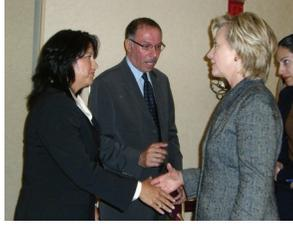
Then there was the event with Hillary Clinton on Long Island.
Five hundred people filled the room. We shared the dais. I spoke first—about leadership in education, about building institutions that serve students rather than systems, about accountability, responsibil-ity, and the kind of work that rarely makes headlines but determines whether organizations actually function.
Then she spoke.
When it ended, there was sustained applause. Hillary and I shook hands afterward, a brief exchange before we each moved on to our next commitments. No ceremony beyond what the work required.
It was the kind of moment that mattered—not because of who was in the room, but because of what the work represented.
At Klaus's events, I was introduced. Here, I was accountable.
And that difference stayed with me.
Each time I stepped further into his world, the gap became more visible. He wanted presence. I needed recognition that my work mattered. He wanted availability. I needed space to lead. His conversations were about vacations and family rhythms. Mine were about projects, decisions, responsibility.
Not because I didn't value his world. Because I already had one of my own.
Hyannis Port didn't ask you to perform. It didn't ask you to prove anything. It asked you to arrive, to participate, to belong.
What it didn't ask was whether you had somewhere else you needed to be.
By the end of the summer, nothing had ended. We had slowed things down, just as I'd asked. The pace was gentler. The expecta-tions looser.
Over the next few years, we broke up and got back together multiple times.
And I could see clearly what I had been trying to do. I wasn't asking him to change his world.
I was asking for mine to be acknowledged.
I wanted a balance that recognized that I worked. That I built things.
That I carried responsibility.
That presence didn't mean disappearance. That wasn't too much to ask.
But it was more than his world knew how to hold.
#### THE REUNION
Raffy flew in from Italy for a few days.
We spent time together in New York first—walking, talking, filling in the blanks. Then we flew down to Florida for the Nick Bollettieri Academy's thirtieth-year reunion.
Players came from everywhere. Europe. South America. Asia. Former juniors who had gone on to professional careers. Others who had left tennis entirely and built lives that looked nothing like the ones we'd imagined as teenagers.
It was a homecoming, but not a nostalgic one. No one was pretending the years hadn't passed.
As we walked toward the courts, a voice cut cleanly through the noise.
"PARMIN-twan!"
Chip had spotted me. He called out exactly the way he had decades earlier.
The nickname landed instantly.
Some names fade. That one didn't. It had survived drills, tour-naments, injuries, time.
Julio heard Chip call out and came over to welcome us. He put us on a golf cart and gave us the tour—the new courts, the air-conditioned indoor center, the adult condos that had once been off-limits.
He had grown with the place—no longer just enforcing Nick's rules, but carrying the culture forward with his own authority.
The Academy was bigger.
What had once been thirty acres—the first true sports training academy in the world—had grown into something massive. Now part of IMG, it sprawled across three hundred acres, encompassing multiple sports, multiple facilities, an entire ecosystem built around elite training.
New courts. Indoor facilities. Sports we never trained alongside. Athletes from everywhere. The scale was undeniable. The place hadn't softened with time—it had multiplied.
We laughed when we reached the track and saw pitchers of juice and water set out for the kids.
Juice.
Back in our day, there was no juice. No fruit laid out. You ran. You trained. You finished. If you were thirsty, that was part of the program.
"These kids have it easy," one of us said, and we all laughed—not bitterly, not dismissively, just with the shared recognition of what it had taken then versus what was offered now.
The Academy hadn't become less demanding. It had become more sophisticated. Better resourced. More humane.
The amenities had changed. The expectations hadn't. Work was still the entry fee.
Julio was proud—warm, expansive, still Julio. Then he dropped us off to see Nick.
Nick walked over and put a hand on each of our shoulders, grounding us the way he always had.
"Hi girls," he said. "Have you seen Carling yet?" We shook our heads.
"I just want you to prepare yourselves," he muttered, cursing under his breath. Then, as always, he snapped right back into charm. "Hey, my girls! Glad you made it. You know we're all going to dinner later, right? The Italian place."
We wandered toward the adult condos, then the pool. And there she was.
Carling.
All ninety-eight pounds of her. The girl who used to jog beside me at 6:30 in the morning. Who sang Grease with me in the dorm
—blonde Danny to my dark-haired Sandy. Who had once been pure kinetic energy.
She looked up when she saw us.
"Hey, smartypants," she said. "Can you help me with my laptop?"
Raffy and I exchanged a glance and laughed quietly.
We sat on the lounge chairs and talked. Carling drifted in and out of the conversation—present but not anchored. Flat. Fried. Disconnected in a way that didn't need explanation.
Later, back at the condo, Raffy shut the door and turned to me. "If you ever do what she did," she said sharply, "I'll kill you."
I wasn't sure if she meant the drinking or the anorexia.
"Do you really think I could be anorexic?" I said. "I'm flattered." Then, softer, "Come on, Raffy."
That was the end of it.
The weekend stirred memories, but it didn't reopen them. There was no would have. No should have. No if only.
Just facts.
Some of us had made it through better than others.
#### FLOWERS
Steve had already had a few mini-strokes by then. The last one was different. It left him paralyzed on one side and struggling to speak for months.
When he could finally talk again, he said only one thing. He had to get back to work.
He hated sitting in circles with other men, watching them drool, listening to stories that went nowhere. Work gave him structure. Purpose. Dignity. It was how he stayed himself.
We didn't talk often. We didn't need to. We checked in. Short calls. Emails. Updates. We laughed about being buried in work. When I told him a friend was asking me for money, he reminded me of Los Angeles.
"They're not your friend," he said. "Just tell them you already had to help out family."
The Warhol estate had offered him a license to paint Andy Warhol's portrait on canvas, and he was buried in paperwork for the project. I was buried in yet another accreditation report.
He sent roses to cheer me up. No explanation. No occasion. When Simba died, he offered me his cat.
Then he started emailing about his eyes—red, burning. I scolded him to go to the doctor.
He said he was still planning a trip to New York. We were also supposed to talk about a clothing line using his images.
One night, I got a late call. It was Steve.
He wanted to say hi. And to let me know he was going to Aspen first.
"Aspen?" I said. "But the altitude. Why take the risk?" He reminded me of the circle of men.
"What did the doctor say about your eyes?" I asked. "Oh, they know nothin'," he said.
That was that.
He asked how my report was going. How Don was. How
Barbara was. We laughed about how I'd never taken a ride on one of his Harleys.
I wished him luck with the show. We said goodbye.
The next morning, his longtime assistant and friend Bobby called me.
"Lisa," he said. "Steve died. He died."
I tried to comfort him. Then I just sat there. I called Don. I called Barbara.
Two hours later, flowers arrived. Happy Valentine's Day. Love, Steve.
That night, when I got home, the doorman stopped me. "There's another delivery," he said. "We had to use the luggage
rack."
Inside my apartment was a massive display of roses from Klaus. I stared at the two sets of flowers.
A dozen from Steve. A full arrangement from Klaus.
I took Steve's flowers and placed them on my nightstand.
Steve never tried to manage me. He never tried to redirect me.
He never asked me to be less.
He just showed up.
27