स्थानीय

Chapter 1
The Quiet House

It was picture day at school. Mom wanted me to wear a navy blue wool dress with a thin white stripe down the middle. Matching stockings.
I didn't like it. The wool scratched. But it looked good. I wore it for the pictures.
As soon as I got home, I put on sweatpants and a sweatshirt.
That was how things worked in our house. There was the version you showed the world. And the version that existed behind the front door.
From the outside, we looked like we had it all figured out.
Nice big brick house with a mansard roof in Munster, Indiana. Lawn meticulously trimmed. Hedges always shaped. Two polished cars in the garage—washed every Saturday without fail.
My father, Dr. Florino Pamintuan—everyone called him Reno
—was the kind of success story people loved to tell. Filipino kid. Scholarship to prestigious medical school. Worked his way through residency. Became a cardiologist with a thriving practice.
He was outgoing, athletic, the life of any party. Loved music.
Loved to dance. Loved to make people laugh.
My mother, Eilis, had her own immigrant story. She'd come
from Belfast at sixteen, escaping the Troubles. Bombs and bullets traded for something safer. She was beautiful. Stay-at-home mom raising my brother Sean and me—and later, Anna, my baby sister who was born ten years after me.
The bills were always paid. The mortgage was never late.
When neighbors looked at us, they saw first-generation Amer-ican success. Proof that the system worked.
Our house was quiet. Orderly. There were rules—some spoken, most not. I learned them the way you learn which floorboards creak. By paying attention.
My mother had a saying she repeated often, in different varia-tions: "Family business is our own business."
What happened in our house stayed in our house. We didn't air our dirty laundry.
The only time I moved through the world unsupervised was walking to and from elementary school with my brother Sean. Those walks were ours. The morning air. The afternoon freedom of the sidewalk stretching ahead of us.
We didn't talk much. But we didn't need to. The silence between us was companionable. Easy.
I had friends—Colleen, Kerry, Ellen. I could play at their houses, and those hours felt different. Their mothers smiled at me. Asked me questions. Seemed genuinely interested in the answers.
At Kerry's house, I could hear her mom laughing from the kitchen. At Colleen's, everyone talked over each other at dinner.
But I never brought friends to my house. Our house wasn't a place for other people. I understood this without being told.
I learned to code-switch early. One person outside the house.
Another person inside it.
Outside, I was Lisa Pamintuan, daughter of the successful doctor and his beautiful wife. I smiled. I was polite. I played the role.
I learned which stories to tell and which to keep private.
We drove to Warren, Michigan three or four times a year. Eight hours each way.
My Granny and Grandda's house was different. Smaller. More cluttered. But warmer somehow.
My Granny would hug me when we arrived. A real hug that lasted more than a perfunctory second. My Grandda would ask me questions about school and actually listen to the answers.
They'd tell stories about Belfast. About the old neighborhood. About my mother as a young girl—stories that made her seem more human, more real than the careful, controlled woman I knew at home.
My Grandda taught me to play gin rummy at their kitchen table. We'd play hand after hand, cards slapping down, him telling stories between deals.
Sometimes he'd start singing, and I'd join in. Old Irish rebel songs - the kind with a pounding rhythm and chorus.
My voice was louder there. Freer. No one shushed me. No one measured the volume.
I'd sit there and feel something loosen in my chest. Some tension I didn't even know I was carrying.
But then we'd drive home. Eight hours back to Munster.
And I'd feel that tension settle back over me as soon as we pulled into our driveway.
Ms. Levine's Quiz
In fourth grade, Ms. Levine gave a quiz every Friday. Twenty-five multiplication problems. Whoever got the most right got to go to McDonald's with her.
I came in second. Every single week. Joanne always won.
When I got home from school, I started my chores. Vacuuming the house.
Afterwards, I practiced at the kitchen table. Multiplication tables over and over. Timing myself with the kitchen timer.
Mom came into my room one evening. Maybe she didn't hear me come in.
"What are you doing?" she asked.
"I'm practicing my multiplication tables," I said. "I lost to Lisa again. I have to get faster."
Friday morning, I'd walk to school going through them in my head. 7x8. 9x6. 12x7.
Ms. Levine would hand out the quiz face-down. "Ready?
Begin."
I'd flip it over and start. Pencil flying. No hesitation. I'd finish. Look up.
Joanne's hand would already be raised. Every single Friday.
Week after week after week. Then we broke for summer.
The Talent Show
There was a talent show at school. I was going to sing.
I'd chosen "Baby Face"—"You've got the cutest little baby face..."
The audition was in front of five or six members of the talent show committee. I got up and sang it a cappella.
When I finished, they all stared at me.
I looked down at my shirt. Wondered if I'd spilled something.
Then one woman said, "Wow. Thank you. That was wonderful."
Another asked, "How old are you? What grade are you in?"
They said I definitely had to be in the show. But I needed sheet music. They wanted the piano teacher to accompany me.
"Why?" I asked.
They explained. The piano. The accompaniment. How it would sound better.
"My mom is pregnant," I said. "She can't leave the house right now. She's due soon."
They looked at me. Said they'd figure something out. I didn't go back.
I don't know exactly why. Maybe because my mom was preg-nant and I couldn't ask her to coordinate sheet music and piano
teachers and all the logistics. Maybe because it felt too complicated. Too many moving parts I couldn't control.
I sang at my Granny and Grandda's house. Old Irish rebel songs where nobody needed sheet music or piano accompaniment. Where my voice could just be what it was.
But I didn't sing in the talent show.
I didn't know yet that I needed something different.
Something where the outcome depended more directly on my effort. Where practice actually led to winning. Where the complica-tions were fewer and the path was clearer.
I didn't know yet that tennis would give me that. But it was coming.
The talent show came and went without me in it. The multipli-cation quizzes kept going, Joanne's hand kept rising first, and the school year wound toward summer. But something I didn't yet have a name for was taking shape underneath—a need for a different kind of measure. A clearer one. It would be another year before my parents signed the membership forms at the Omni 41 Sport Center. When they did, everything that came next began there.
The First Escape
I was nearly nine when my parents joined the Omni 41 Sport Center.
A massive complex in Munster—two ice rinks, a gym, a swim-ming pool, racquetball courts, and tennis courts.
Indoor tennis courts.
I hadn't known those existed.
Walking through it for the first time felt like discovering a secret city. The ceilings were high. The hallways wide. Everything echoing with the sounds of activity—skate blades on ice, the thwock of racquetballs, the splash of swimmers, voices calling out encourage-ment and instruction.
It smelled like chlorine and ice and possibility.
My parents joined. Signed Sean and me up for classes. The Omni offered free introductory tennis lessons for kids.
A bunch of us showed up that first day. Maybe ten or fifteen kids. All of us holding borrowed racquets that were too big for our hands.
We were laughing, nervous, excited. The way kids get when they're about to try something new and don't yet know if they'll be good at it or terrible at it or somewhere in the unremarkable middle.
The instructor lined us up. Started showing us how to hold the racquet.
Right hand here. Left hand there for support. Shake hands with the grip. Keep your wrist firm. Bend your knees.
I watched. I listened. I followed the instructions exactly.
He showed us how to stand: feet shoulder-width apart, knees slightly bent, weight on the balls of your feet.
I mimicked his stance. Making micro-adjustments until my body matched his.
He showed us the basic forehand swing: turn your shoulders, bring the racquet back, step forward, swing through, follow through across your body.
I watched other kids swing wildly, enthusiastically, their racquets flying through the air in approximations of the movement.
I watched the instructor again. Studied the precise path his racquet took through space.
Then I copied it.
Slowly at first. Then again. Then again. Each repetition a little closer to the original. Then he started feeding us balls.
Something clicked.
I can't explain it better than that. Something in my brain, in my body, in some place where the two meet and become indistinguish-able—something clicked into place like a key turning in a lock.
The ball came toward me, and I knew where it would be. I knew when to start my swing.
I knew how to adjust my position, how to time the contact, how to send the ball back over the net to the exact spot I was aiming for.
It wasn't magic.
It was pattern recognition. Cause and effect.
It was: if I do this, then that happens. If I adjust this variable, the outcome changes in this predictable way.
It was a system.
And systems made sense to me.
Systems had rules. And unlike the unspoken rules at home, these rules were clear. Visible. Learnable.
The First Tournament
My coaches were Ken Viscoki and Rick Armbrust.
I don't remember exactly how or when they became my coaches
—whether my parents sought them out or whether they noticed something in me during those early lessons.
But suddenly I had coaches. And regular lessons. And a purpose that extended beyond those first experimental swings.
The first tournament came quickly.
Maybe too quickly, by normal standards. But I didn't know what normal standards were.
I just knew that they said I was ready. And so, I was ready.
I wasn't shocked that I could win.
That's the part that might sound arrogant, but it's just the truth. I expected to win.
Not because I thought I was naturally gifted or special, but because I was better.
I had listened to my coaches. I had watched other players—the older kids, the better kids—and I had studied what they did that worked. I had copied the techniques that produced results and discarded the ones that didn't.
I was consistent. I didn't miss.
I ran after every single ball like my life depended on it.
If an opponent wanted a point from me, they had to hit a clean winner or force me into an error.
Nothing came easy. I made sure of that.
The tournament was full of kids who were there because their
parents thought tennis lessons would be good for them. Or because they liked the idea of tennis. Or because their friends were playing.
I was there because tennis was the first thing I'd found that made sense.
The first thing where effort equaled reward in a direct, measur-able way.
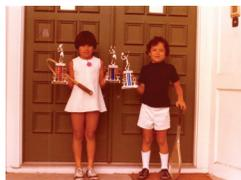
I won two trophies that day.
First place in singles. First place in doubles.
My doubles partner was Amanda, a girl I went to school with and took lessons with. We worked well together. Both of us would keep the ball in play till we could get to the net. If there were lobs I was the one who
First Trophies
sprinted back to get the ball back into play. Amanda yelling what side she was covering. Both of us understanding without having to
say it that we were there to win.
First place.
Not second place like Ms. Levine's quiz. First.
My parents were happy. My coaches were happy.
Everyone seemed pleased with this development. This discovery that I was good at something. That I could win things. That I could bring home trophies with my name engraved on little brass plates.
The tournaments started immediately after that.
I'd come home from a tournament, trophy in hand. Walk up to my room. Find a spot on the shelf.
Another one. And another one. Each with my name engraved on a little brass plate.
Physical proof that said: you are good at this. You have value here. You matter in this space.
Sean played tennis too, for a while. He played for about a year.
Got second place in a tournament once. Then quit.
Just stopped.
Decided it wasn't for him and moved on to other things. He took up chess.
I remember being baffled by this—how could you find some-thing you were good at and then just walk away from it? And you got to run around.
But Sean was different from me.
Sean didn't need tennis the way I needed tennis. Tennis wasn't just a sport to me. It was escape.
Not the singing, even though I loved singing. Even though my voice was strong and could fill my Granny and Grandda's house with rebel songs that made them smile. But the talent show had needed sheet music and piano teachers and coordination I couldn't make happen. I'd walked away.
Tennis was different. Tennis I could control.
Tennis took me to tournaments in other towns, other cities. Hotel rooms and restaurant meals and a whole world beyond the careful, quiet order of home.
Tennis gave me a reason to leave.
And leaving—even temporarily, even with the knowledge that I'd have to return—felt like breathing.
On the tennis court, the rules were clear. The lines were visible. You could see them, white and definite against the green surface. In bounds or out. Fair or foul. Win or lose.
No guessing. No reading invisible signals. No trying to calculate the exact radius of acceptable behavior.
Just the court. The ball. The opponent. And me.
For the first time in my life, I had found a place where I knew exactly what was expected of me.
And I could deliver it. Every single time. Tennis was mine.
And once I realized that, everything changed.
Outgrowning The Game
I was nine and a half years old when I started outgrowing Indiana.
I won everything locally. Every tournament. Every match. Every trophy they had to offer.
So they moved me up an age group.
I won there too.
That's when practice matches stopped being fair. The other kids would show up ready to play, and I'd see it in their faces before we even started. That look. The one that said they knew how this was going to end.
So we started making adjustments. Handicaps.
I'd give my opponents the doubles alleys in singles matches—those extra strips of court on either side that you're not supposed to use. Suddenly they had more space to aim for. I had to thread needles just to keep the ball in play.
Didn't matter. I still won.
Then we tried starting games down. I'd begin every game at 0-
30. Two points in the hole before I even served. Sometimes 0-40. Love-40. One point away from losing before the first ball was struck.
Still won.
Line Drills
The thing is, I was tiny. Genuinely small.
Some of the boys I played against—even the ones my age—towered over me. I barely came up to their waists.
They'd stand at the net and I'd look up at them like they were giants. These long-limbed creatures who could cover the court in three strides while I scrambled and lunged and dove.
But then we'd do line drills.
Line drills were races, pure and simple. Sprint from the baseline to the net. Touch the line. Sprint back. Touch the baseline. Sprint to the service line. Back. To the net. Back.
Over and over until your legs screamed and your lungs burned and you wanted to collapse right there on the court.
I always won. Every single time.
It didn't matter how much taller they were. How much longer their legs were. How much more they weighed.
When that whistle blew, I was gone.
My feet barely touched the ground. I was all speed and fury and
desperation, my chest heaving, gasping for air, unable to catch my breath but refusing—absolutely refusing—to stop.
I'd cross the finish line first and bend over, hands on my knees, my whole body shaking, my lungs screaming for oxygen.
My chest would heave so hard I thought my ribs might crack.
I couldn't breathe. Couldn't speak. Couldn't do anything but stand there and try not to pass out.
But I never stopped. Never gave in. Never let anyone pass me.
Coach Ken used to say it to the other kids, half-joking but not really: "She'd rather die than let you win."
He wasn't wrong.
The Men's League
Soon I was playing in the men's league.
Not boys my age or even a few years older—grown men. Older, stronger players with decades of experience. With serves I could barely see and groundstrokes that made the ball sound different coming off their racquets. Heavier. More dangerous.
I loved it.
I loved the drills, the competition, the camaraderie. I loved the friends I made there. The laughter between points. The way these adult men treated me like one of them. Not like a little girl they had to go easy on. Like a real player. A real competitor. Someone who belonged.
My dad played in the league too. He loved watching me thrive. Loved seeing me hold my own against players twice my size and three times my age.
I could see it in his face when I won a tough point or hit a shot that made the other guys whistle and shake their heads. Pride. Pure, uncomplicated pride.
Mom played tennis for a while until she was pregnant with Anna.
We'd finish our matches and sit around talking, drinking water, laughing about the points we'd blown or the shots we'd somehow managed to pull off.
My dad would be there, part of the group.
And for those moments everything felt right. Like this was how life was supposed to be. Like we'd found the place where we all fit.
Outgrowing
But I was outgrowing even this.
The local competition, the age groups, even the men's league—I could feel myself pushing against the edges of what Indiana had to offer.
The matches were getting easier, not harder. The challenges were becoming routine.
I'd show up to tournaments and know before they started that I was going to win. Not because I was arrogant, but because I'd already beaten everyone there. Multiple times.
It wasn't enough anymore.
I needed more. Needed better competition. Tougher opponents.
Higher stakes.
Needed to test myself against players who would push me to my absolute limit and beyond. Players who wouldn't fold when I turned up the pressure. Players who had that same fire, that same refusal to quit.
My coach knew it. My dad knew it.
I think even the other kids knew it, though nobody said it out loud.
I'd reached the ceiling of what this place could teach me. The world beyond Indiana was calling.
I just had to be brave enough to step onto it.
The World Stage
The letter came in December.
Orange Bowl World Championships for 10-and-under. Miami, Florida.
I'd qualified.
My parents were proud, but in their measured way. My dad nodded when we got the letter. Said "Good job." Went back to reading the paper.
My mom hugged me, then immediately started making lists—what I'd need to pack, how we'd get there, whether my racquets needed restringing.
They understood what I was only beginning to grasp: this was a step, not a destination.
##### Miami
The tournament was in Miami. Hot. Humid.
I don't remember every detail. Memory works in flashes. Snap-shots. Moments that burned bright enough to stick.
But I remember the courts. They were pristine. Professional.
Nothing like the Omni's indoor courts with their familiar scuffs and the sound that echoed just so off the walls.
These were outdoor hard courts. The kind you see on television. Perfect lines. Surfaces so smooth they seemed to glow in the sunlight.
The nets were taut. Regulation height. No sag or give. Everything about them said serious.
Everything about them said this matters.
The Players
The players were different too.
Serious. Trained. From all over—California, Florida, Texas, a lot of international kids whose parents had brought them specifi-cally for this.
They moved differently than the kids I'd played back home. With a kind of confidence that came from knowing they belonged here.
Their strokes were clean. Their footwork precise.
They didn't just hit the ball. They constructed points. Thought three shots ahead. Played with a strategy that felt almost adult.
And the parents. God, the parents.
They hovered like generals surveying a battlefield. Intense and focused, their eyes tracking every point, every movement.
Some of them called out instructions between points—"Move your feet!" "Get to the net!"—until the officials had to quiet them down.
Others sat in rigid silence. Their tension visible in clenched jaws and white-knuckled grips on armrests.
You could feel their investment. Their hopes. Their dreams projected onto these ten-year-old kids in a way that was both touching and slightly terrifying.
My parents sat together, watching quietly.
My dad took notes sometimes. Observations about my serve or forehand that we'd discuss later.
My mom just watched. Her face calm but attentive. They weren't like the other parents.
I was grateful for that, even if I didn't fully understand why at the time.
The Competition
The atmosphere was thick with it all. The big stage. The real competition. The sense that something important was happening.
The sound was different too. Sharper.
The pop of balls off racquets had a crispness I'd never quite heard before. Maybe because of the outdoor acoustics. Maybe because everyone was hitting harder, cleaner.
The squeak of shoes on the hard court. The grunt of effort. The calls of "Out!" and "Let!"
It all blended into this symphony of serious tennis that felt both foreign and exactly right.
I was ten years old, standing on those courts. I felt very small and very alive all at once.
This was a different level than what I knew. That became clear within the first few matches.
These were players who'd been training like I'd been training—hours every day, private lessons, tournament experience. Some of them had been doing it longer. With more resources. Better facili-ties. Coaches who'd worked with professionals.
They had the strokes. The fitness. The mental game.
It was the first time I wasn't the only one who was that serious.
Back home, I'd been the outlier. The kid who practiced when others were at birthday parties. The one who chose tennis over sleepovers.
Here, everyone cared that much. Everyone had made those same choices. Everyone understood.
These were my people, even if we were competing against each other.
And being around them, competing against them, made me want to be better.
The Photo
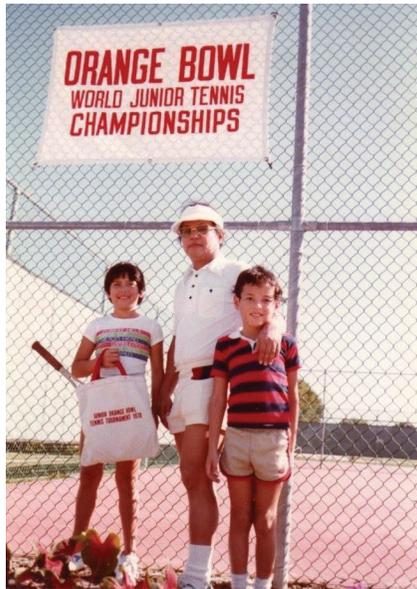
There's a photo from that tournament that I kept for years. Still have it somewhere. Probably in a box in my parents' attic.
I'm ten years old in it. Wearing my tournament gear—my white shirt with a peter pan collar with different colored stripes. Each stripe had a different name on it. Forest Hills, Wimbledon, French Open, Australian Open and the US Open. Navy blue shorts. A baseball cap.
I did not have a racquet bag like the other kids. They had 3 racquets—the same 3 racquets. I had my Stauwaert racquet from Omni.
I'm standing in front of one of those pristine courts. The net visible behind me. The surface gleaming in the sun.
I look young—impossibly young, now that I think about it—but there's something in my expression. Determination, maybe. Focus. A seriousness that seems almost funny on such a young face.
My mom took a photo of Sean, Dad and me in front of the Orange Bowl World Championships' tournament sign.
Proof that I'd been there. Proof that I belonged.
Lisa, Dad and Sean at Orange Bowl World Junior Championships
##### The Drive Home
I didn't win the tournament. Didn't even make it very far.
But that wasn't the point.
The point was that I'd gotten my first real glimpse of what tennis could be beyond Indiana. Beyond the Omni and the local tournaments and the familiar faces I'd been beating for years.
This was the wider world.
And it was vast and challenging and full of players who were just as hungry as I was.
On the drive home, my dad talked about what I'd need to work on—my second serve and my forehand especially when the matches get tight.
My mom was already thinking ahead. Asking questions about other tournaments. About what it would take to keep progressing.
We didn't know where it would lead.
But we'd taken the first step onto a bigger stage. And there was no going back.