स्थानीय

Chapter 14
Herald Square

The instructions were simple: be at Herald Square at 10 a.m., 7th floor in Macy's. I was going to see one of the retail operations.
I sat on the hotel bed the night before with a paper map splayed across my knees, tracing the route with my finger. Ferry from Weehawken, bus to Herald Square. I traced it twice, folded it along its creases, and tucked it into my bag. Maps are small anchors; you can feel a plan in your pocket.
The next morning, I did a trial run. Left early, gave myself time to get lost. The ferry smelled of diesel and stale coffee; the river cut gray beneath us. Manhattan rose up like a dare. The bus lurched through streets whose names meant nothing to me; its rhythm taught me how the city moved—stop, hold, push when you can.
I got off at Herald Square, found Macy's and the subway entrance and the newsstand stacked like bricks. Timed it. Figured out the rhythm. Got back on the ferry to Weehawken.
I hadn't been mugged. That counted as a victory.
First Day
The morning of my first actual day, I arrived early.
The building smelled of cleaning solution and a faint, industrial tang—cardboard that had been sitting in a warehouse. I took the escalator up and was met by Donald Spector and Mary Rodas, the VP of Marketing.
Mary was known as the teenage toy tycoon. I'd seen her name in magazines, on television—Lifestyles of the Rich and Famous, busi-ness segments, features about young entrepreneurs breaking barri-ers. She was a Latina prodigy who'd built a public face for a hundred-million-dollar toy company while most kids her age were worried about prom dates.
She stood maybe 4'8" tall, but her presence filled the room like she was a giant.
Her smile was a thousand watts—immediate, genuine, the kind that made you want to smile back before you'd even decided to. She wore a black skirt, a red sailor jacket, black tights, and polished shoes. Sharp. Professional. But unmistakably young.
And when she spoke, I almost laughed.
If you closed your eyes and just listened, you'd swear you were hearing Mickey Mouse's sister. High, bright, effervescent—a voice that should have been cartoonish but somehow wasn't. It was hers. It worked.
"Hi!" she said, extending her hand. "Everything good at the hotel? The ferry okay?"
"Yes," I said. "Everything was great."
I noticed her lipstick. Red. The same shade I wore.
She caught me noticing and grinned wider. "Great minds," she said, tapping her lips.
Her energy was off the charts—warm, professional, engaging in a way that made you feel like you'd known her longer than thirty seconds. She was a teenager navigating boardrooms, sitting across from executives twice her age, holding her own. A kid who could have been at a school dance one night and on national television the next.
The Street
We took the escalator down to the street —Donald, Mary, and me. The street was packed with tourists, the usual crush of people taking photos, checking maps, looking up at buildings.
A woman stopped mid-stride when she saw Mary. "Oh my God—are you Mary Rodas?"
Mary's smile didn't waver. "I am!"
"Can I get your autograph? I saw you on Dateline."
Mary pulled a pen from her bag like this happened every day. Because it probably did. She signed the woman's shopping bag, posed for a photo, thanked her warmly.
Two more people approached before we'd crossed the block.
I stood there watching. This wasn't just a VP of Marketing. This was a celebrity. A teenager who couldn't walk down a Manhattan Street without being recognized.
Donald didn't seem fazed. He just waited, hands in his pockets, while Mary signed napkins and receipts and the backs of Playbills.
When the crowd finally cleared, Mary turned back to me, still smiling.
"It's been a wild ride," she said, as if signing autographs on a Tuesday morning was the most normal thing in the world.
Standing next to her in my Ann Taylor suit, I felt the contrast. She was the face of the company. I was about to bounce balls in Macy's.
But something about her made me think: if she can do this at her age, I can figure out what I'm doing.
Doug
Donald had introduced me to my supervisor, Doug.
He was five-eight in boots, heavy with a beard and the practiced ease of a man who knew how to size a room. His smile arrived a half-second before his words, as if the grin softened whatever came next. He picked up a sample ball, flipped it once, and said, "This is where you start."
The demonstrators wore Balzac T-shirts, tight jeans, and chewed gum. The pitch mattered more than polish. Doug led me over to the crew—kids who wore casual confidence like armor.
One of them looked me up and down. "She came here all the way from where?"
"Indiana," I said.
"Indiana." Doug laughed. "Now she's in New York—in the big city."
A girl with a high ponytail—maybe nineteen—whispered some-thing to the guy next to her. They both smirked. She didn't bother lowering her voice when she said, "Bet she doesn't last a week."
I felt my neck heat up. My jaw tightened. But I kept my face blank, my shoulders square.
I stood there in my Ann Taylor suit—the one I'd bought for law-firm interviews—and held the sample ball Doug handed me.
Okay, I thought. I can do this.
The Pitch
Macy's smelled of pretzels and floor wax; the fluorescent light flat-tened everything.
The pitch was simple: "Hi! Can you believe how light it is? It's a Balzac Balloon Ball—a balloon inside a cloth sac. You blow the balloon up and the cover gives it strength."
My first customer was a woman in her forties with a shopping bag already full. I held out the ball. She glanced at it, then at me, then kept walking. Didn't even slow down.
The second was a teenage boy. He took the ball, squeezed it once, tossed it back at me without a word.
The third was a man who said, "Not interested," before I'd even opened my mouth.
I kept going.
"Hi! Can you believe how light—"
By the tenth attempt, the words had lost meaning. Just sounds my mouth made on repeat.
Then a little girl stopped. Maybe six years old, braids tied with pink ribbons. She stared at the ball in my hands.
"It's light," I said, softer this time. "Want to try?"
She reached out. Took it. Squeezed it gently, then harder. Her face lit up.
"Mom!" she called. "Mom, look!"
Her mother came over. Watched her daughter hug the ball like it was something precious.
The mother caught my eye. Nodded. Then signaled to a buyer across the aisle.
That afternoon we secured a reorder for the display.
The number mattered. The small victory proved the technique.
The Work
I worked six days a week.
One afternoon, Doug brought me to a store in Brooklyn. The display was set up wrong—the smaller, cheaper balls at eye level, the premium products shoved to the bottom shelf where nobody looked.
"This isn't moving," the store manager said, annoyed. "You said this would sell."
Doug turned to me. "Fix it."
I crouched down, started rearranging. Premium balls at eye level. The ones with the bright covers, the ones that caught light. The cheap ones at the bottom—impulse buys for parents who'd already said yes.
The manager watched. "That's it?" "That's it," I said.
Two weeks later, the store reordered.
It was a small thing. But I'd learned something: placement matters. What people see first is what they buy.
The Escalator
Doug had a way of talking about the other girls.
Early on, he'd mentioned it—casual, almost bragging. How they loved working with him. How they'd hang around after shifts, how they'd laugh at his jokes.
I'd nodded. Said nothing.
One day, on a narrow wooden escalator at Macy's, I felt it.
His lower torso pressed against me as the escalator evened out at the top. Not accidental. Deliberate.
I stepped forward abruptly. Kept walking. Didn't wait for him. He caught up, started talking. Something about the store layout,
the buyers, chitchat that had nothing to do with work and every-thing to do with keeping me there.
I cut him off.
"We should get back to FAO." His smile tightened. "Yeah. Sure."
After that, I made sure I was never alone with him in tight spaces. Professional, not friendly. A map of distance I enforced with my body.
Sunday Calls
On Sunday nights I called my parents and told them I was in the corporate office, drafting contracts.
It was a lie that kept questions at bay. If they knew I was bouncing balls in Macy's aisles and living in a hotel in New Jersey, they'd tell me to come home.
I would not go home. I would figure it out.
The Executive Offices
The weeks blurred into routine. Macy's. Herald Square. FAO Schwarz. Brooklyn. The ferry back to Weehawken. The hotel room. Fax confirmations curling out of the machine. Sunday calls home.
Two months in, I received a message. A phone call. Go to the executive offices.
I took the elevator up. The hallway was quiet. Carpeted.
Different from the warehouse floor.
I walked into Donald's office.
It was a corner office with big bay windows overlooking the city. One side of the room was lined with built-in mahogany shelves—prototypes displayed like museum pieces, awards, a few leather-bound books. Antique Chinese redwood chairs with red cushions sat near the desk. A chandelier hung from the ceiling. Masterpiece artwork on the walls—the kind you see in auction catalogs.
And the desk.
It was museum-quality—heavy carved wood with intricate scrollwork and decorative flourishes that looked hand-chiseled. Warm golden tones, polished to a soft sheen. Even the back was decorated, designed to stand in the center of the room rather than against a wall.
Donald had gotten it at auction. Sotheby's or Christie's. This wasn't just an office. It was a statement.
Barbara and Michael
Barbara Carver was there.
She never appeared unfinished. Her wardrobe was couture—every line of fabric tailored to precision. Even in a corporate office, she looked dressed for a magazine spread. Makeup flawless. Hair set. Jewelry chosen with the restraint of someone who understood that elegance is control.
She was one of Donald's longtime partners. Senior Vice Presi-dent. Her professional career had been a case study at the Amos Tuck School of Business Administration at Dartmouth. Former Vice President of Business Development at Charles of the Ritz, a division of Squibb Corporation. Senior Product Manager and Manager of Corporate Concept Development at Gillette. A Clio Award in Packaging.
If Donald's open collar and big hair was a quiet rebellion, Barbara's polished silhouette was its counterpoint: a declaration that power could be worn, and she wore it every day.
She looked at me when I walked in. Her gaze was steady, assess-ing, professional.
"You're the one from Indiana," she said. Not a question.
Michael Deutsch was there too.
On paper, he looked like the prototype of a Wall Street success story: dual degrees in Economics and Mechanical Engineering from M.I.T., a Master's from Columbia, and a coveted seat as a Member of the American Stock Exchange. Prior to working for Donald, he'd worked for Ivan Boesky.
But in person, Michael was nothing like the loud, polished, ego-driven men who filled that world.
He dressed simply, almost ascetically—jackets that were serviceable rather than tailored, shirts chosen for practicality rather than style. His beard was trimmed but soft, giving him a gentle, thoughtful appearance. Wire-rimmed glasses. Steady posture. He looked more like a quiet professor than a Wall Street trader.
His expression was mild, even kind—the face of a man who preferred analysis over theatrics, substance over spotlight.
When Donald introduced us, Michael shook my hand. His grip was firm but not performative.
"Good to meet you," he said.
His voice was calm. Measured. The kind that didn't need to fill space.
He glanced at the prototypes on the shelves behind Donald's desk, then back at me. Taking measure quietly.
I was bouncing balls at Macy's.
They were moving markets, shaping deals, building empires. But somehow, I was part of the same company.
Tomorrow
Donald was standing by the window. He turned, hands in his pockets, and asked, "Do you want to open our West Coast offices?"
I didn't pause. "Sure. When?" "Tomorrow."
I said yes—not knowing what "open our West Coast offices" actually meant.
Leaving
I stood in the hotel room that night. My suitcase open on the bed. Through the window, the Twin Towers caught the last of the daylight, turning the glass gold.
I'd been here two months. Hadn't found an apartment. Hadn't made friends. Hadn't learned the subway system beyond the routes I needed.
And now I was leaving.
I folded a shirt. Then another. Packed until there was no room for hesitation.
I bought a ticket. Flew to Los Angeles—a city I had never seen before.
I left my car in a New Jersey parking lot; a girlfriend picked it up later and eventually had it shipped back to my parents' house in Indiana.
Before I left, Doug insisted I call him as soon as I landed.
"I want to know as soon as you get there," he said. "Call me even before you get to the hotel."
Okay. So I did.
Months later I heard he'd told people I was impossible to get rid of—that even in LA I was hounding him.
He'd been the one who insisted I call.
It didn't matter. People rewrite stories to keep themselves central. He wanted to keep control.
But I was already gone.
ROUTES OF RESPONSIBILITY
I was twenty-six. I'd lived in a hotel for three weeks after I arrived—an interim life of suitcases and takeout—until Don told me I should find a place. I guess he thought I would work out.
Marina del Rey was perfect—near the water and Venice Beach, tucked off the 405 so I could hit stores quickly, and only twenty minutes from Beverly Hills and Century City, where Don stayed at the JW Marriott.
The apartment was small, two stories, tucked into a develop-ment. My front door and small patio faced the parking lot—asphalt and cars, not water. I kept the curtains closed most of the time down there.
Both bedrooms had windows that looked out over the entire marina. Sailboats bobbing, masts swaying, people living on their boats full-time. The whole waterfront spread out like a postcard.
I turned the spare bedroom into an office. The fax machine sat on a folding table, coughing up routing confirmations at all hours. I taped a map to the wall—routes sketched in marker, store locations circled. My passenger seat became a mobile desk: clipboard, routing confirmations, a black coffee in the cup holder I refilled at gas stations between stops.
Most nights I ate takeout alone. Chinese from the place on Lincoln. Pizza. Sometimes a burrito from the taco stand near Wash-ington. I'd sit on the small patio facing the parking lot, the food going cold while I went over the next day's route.
Sunday Calls
Sunday nights I called Granny. She'd ask how I was doing, if I was eating enough, if I'd met anyone. I'd tell her work was good. The weather was nice. Everything was fine.
"You sound tired," she'd say. "I'm fine, Granny."
I called my friends too. Ireland. Indiana. Italy, where Raffy had retired from the circuit—she'd reached 13 in the world—and now had a baby.
No relatives nearby. No boyfriend to call. Long-distance phone calls to people living other lives.
Venice Beach
A few mornings a week, I walked to the Coffee Roasters on Washington Boulevard. Early—7 a.m., before the circus started. Sometimes I ordered an omelet and ate it at one of the small tables outside. Mostly I just got coffee and kept walking.
Venice Beach at 7 a.m. was a different place. The bodybuilders were already at Muscle Beach, lifting in the cool morning air. A few joggers. Some rollerbladers gliding past. A handful of homeless
people who stayed to themselves, sleeping or packing up their things.
It was quiet. Almost peaceful.
Later—when I'd drive past on my way to stores—Venice would turn into the circus I'd come to recognize. Rollerbladers in neon shorts dancing to boom boxes. Acrobats. Street performers. Crowds pressed shoulder to shoulder. The smell of salt and sunscreen and marijuana and grilled onions all at once.
But at 7 a.m., it belonged to the people who lived there. The ones who worked out early, the ones who slept there, the ones who moved through before the tourists arrived.
I watched. Didn't talk to anyone. Just "hi" when I ordered coffee.
Then I'd walk back to the apartment, close the curtains down-stairs, and get ready for work.
Jim McGraw
My first day I drove to Burbank to work from Deco Disc, one of Don's companies. I was to meet Jim McGraw, the company's West Coast operations chief and a legend in the business—he'd built and sold his own label and distribution company to Handleman, the era's dominant rackjobber.
The building sat low and square, smelling faintly of old coffee and paper. Jim ran it with the blunt certainty of someone who'd paid his dues and expected others to do the same.
Jim and I maintained a cordial, professional relationship. He ran his operation; I ran mine. We stayed in our lanes.
On my way there that first morning, a car merged into my lane and hit me. The impact was sharp, more irritating than dramatic. I pulled over, checked the damage, and called the office to let them know I'd be late.
Jim answered. His voice was low and direct. "I'll take care of it," he said.
"I've got it," I told him. "I just wanted to let you know I'll be late."
And that was that. I handled it myself.
Later, I learned Jim had told Don I was "too independent."
The phrase landed cold. I'd managed the accident, made the
call, kept moving. Jim had run labels and distribution for decades. Protecting the operation—and protecting Don's narrative—were his default impulses. If I'd been stranded, that reflected on him. If I were unmanageable, that reflected on him too.
Small crises show how power is exercised. Taking care of your-self can be read as stepping out of line.
The Circuit
I was managing five stores. My days became a circuit of free-ways and storefronts: Torrance, Pasadena, Santa Monica, the Valley. Traffic pressed in, personalities clashed, inventory lists piled up.
The freeways were my office—the 405, the 10, the 101. I learned their rhythms and choke points, when you could move and when you had to wait. The clipboard was constant company.
Each store was its own ecosystem: fluorescent glare, pegboards, the twitch of a point-of-sale printer. People passed through those aisles as if they had other lives waiting—stops on a longer trip.
Miguel Rivera was regional on paper but absent in practice.
Carla Jensen kept her floor tidy as if order could prop up morale.
And then there was Tom Avery.
Tom Avery
I was interviewing for a store position when I met Tom. He was born and raised in Torrance.
"I've worked here five years," he said. "And I got a raise every year. Twenty-five cents total."
He said it with pride.
I looked at him. Twenty-five cents. Over five years. "That's great," I said. And hired him.
Tom was steady. Showed up on time. Knew where everything was. Good with customers. I started giving him different tasks—inventory checks, training new hires, fixing displays when they went sideways.
I gave him incremental raises. Bonuses. More than he'd ever gotten before.
One afternoon I pulled him aside.
"How would you feel about managing the Santa Monica loca-tion? More money, but also more responsibility."
He blinked. "Me?"
"Yeah. You're good at this. You know the work. I think you could run that store."
He looked at me for a long moment. His face changed—grate-ful, earnest.
"I will not let you down," he said.
Tom managed Santa Monica for a year. Then one day he came to see me. In person.
"I wanted to tell you myself," he said. "I at least owed you that." I knew what was coming.
"I can't do this anymore." "What happened?"
"The commute. It's too much." I paused. "Tom. It's ten miles."
"I know. But I don't like it. And the responsibility—it's not what I want."
We were the same age. That's what hit me sitting there.
He just wanted to stay in Torrance. Work his shift. Go home. Not carry the weight of managing people, fixing problems, being responsible when things went sideways.
I drove circuits across LA every day—Torrance to Pasadena to the Valley and back. A hundred miles, easy. Meetings, crises, late nights fixing displays, phone calls at midnight about shipments.
I couldn't imagine not wanting more.
But Tom didn't want more. He wanted less.
Kelly
I hired an assistant. Her name was Kelly. She was young, eager, organized. We worked well together—or so I thought.
One day Don called me from New York.
"Your assistant," he said. "You said she was great. Dependable." "She is."
"Is she someone you want on your team?" I paused. "What do you mean?"
"Is she loyal?"
"Of course she's loyal."
"To you or to the company?"
I was confused. "Both. I hired her."
"She told me she could do your job," Don said. "When you weren't in the room."
"What?!"
I couldn't believe it. I'd been sharing everything with her—how we wanted to build on the West Coast, the strategy, the plans. She'd sat across from me taking notes, nodding, asking questions.
"Don't worry," Don said. He laughed. "She really doesn't have any idea what you do."
I didn't say anything. My face was hot.
It was hard to look at her after that. I didn't trust her. A few days later, I told her things weren't working out. She picked up her purse and left.
She already had what she needed—the company name on her résumé. That would open doors.
The Race
When Don arrived in LA, everything shifted.
One afternoon in Torrance he pulled up in a Lincoln Conti-nental—the official corporate car—while I had a rented Mustang.
He teased me about the Lincoln's pace.
"No way," I said. "That thing can't touch a Mustang." Don laughed, confident. "You're on."
We started on the 405. At a turn I was in the wrong lane; he slipped through clean. I wasn't going to lose. I took a sliver of a turning lane—technically oncoming traffic—and surged ahead. The Mustang leapt, tires humming, adrenaline sharp in my chest.
At the valet I jumped out laughing.
He shook his head, half smiling, half incredulous. "You're crazy. You didn't win. I slowed down because you were going to kill yourself."
"That's not true," I said. "You lost." "You went into oncoming traffic!"
"So what? It wasn't oncoming—it was coming, but it wasn't right there. And I won."
We still argue about it.
Don's Visits
During Don's visits I served as his assistant. His NYC executive assistant treated me as an extension of herself, sending me his itin-erary. His pace was relentless: late morning meetings, lunch—some-times at restaurants where valets gleamed and menus hid prices, sometimes at the Century City food court—another meeting, then dinner with more executives.
It felt like walking into a TV show: big boardrooms, polished tables, presidents of companies who spoke in calibrated tones. I'd spend mornings managing demonstrators and moving boxes in fluo-rescent aisles, and afternoons in rooms with art on the walls and assistants who brought water in glass tumblers.
I was always moving between them.
The only time I felt included was when I assisted Don on his trips. With him I wasn't managing indifference—I was part of a project with someone who expected the same exacting standards I did.
Disney
One morning Jim, Don, and I drove to Disney.
The boardroom was sunlit and immaculate. The Disney execu-tives filed in with assistants behind them. Everyone was polite—handshakes, smiles, a pleasant temperature.
Then Disney asked to change the inventory mix after they'd already ordered it. Hundreds of thousands of dollars. Items already made.
Jim's jaw tightened.
The Disney executives spoke evenly, as if this were a minor tweak rather than an upheaval.
Jim slid something onto the table that had no business being in a conference room. The room stilled. Everyone stared at what was on the table. I was sure security would be called and the meeting would end right there.
The conversation resumed. Voices softened.
Then Jim picked it up again, slipped it back into his jacket, and the meeting continued.
At the end of the meeting, we all stood and shook hands. "Plea-
sure to meet you," I said to one of the executives. Everyone acted as though the entire exchange had been perfectly normal.
Outside, the sunlight felt obscene in its normalcy.
We crossed the street to a diner to eat omelets. Jim ordered like a man who had nowhere else to be.
After breakfast I asked Don about it.
He looked at me, almost amused. "Jim has a reputation as a hothead," he said, and then told me about the time he fired shots inside a studio. Suddenly the way Jim carried himself — that mix of John Wayne steadiness and Cagney edge — made a different kind of sense.
And the business deals continued as if nothing ever happened.
Buddy Hackett
Don drove me to meet Buddy Hackett one afternoon. We pulled up to a Beverly Hills driveway where an elephant sculpture sat like punctuation and a Mercedes bore the plate MR. BALZAC.
Buddy was shorter than I expected—round, warm, voice raspy from years onstage. His foyer was a gallery of photos: him onstage, him with presidents.
Don and Buddy traded names and projects.
Before Don left for New York, he said, "If you get into any trouble in LA, call Buddy."
"You want me to call the guy from Herbie the Love Bug?" I asked. Don's face stayed flat. "Buddy is a lot more than that."
And he drove away.
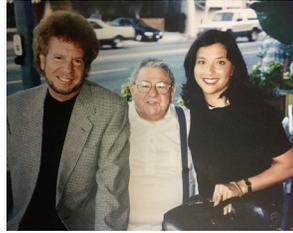
From left to right: Donald Spector, Buddy Hackett and Lisa Pamintuan
The Shipment
The first week of December the holiday crush made empty pegs roar. Our best seller—SKU 954126, Super Earth—had been sold out for weeks.
I'd been asking Doug for the shipment. He said it hadn't arrived. Don's walkthrough came that morning. He moved through the store like an inspection in human form—listened for the system's pulse, whether displays held up, whether demos captured attention,
whether staff did the invisible labor that kept things breathing. He paused at the empty Super Earth peg. Didn't ask politely. "Where's the shipment?"
"Sold out," I said. "We've been waiting for it to come in." "Who told you that?"
"Doug."
The question opened a door I should have been standing in.
I called the main office. The inventory had been delivered.
Doug had it. He'd had it the whole time.
I never spoke to Doug again.
Don shook his head. His face was tight, the line of his mouth flat. "You're like a girl from Little Rock."
I didn't know the reference until he explained: gullible, overly trusting, foolishly innocent—as if I'd never been exposed to the wider world.
I'd traveled the globe competing in tennis. How could I be naive?
But he was right.
People will protect little kingdoms even when it hurts everyone.
The Systems
That afternoon I rewrote the routing checklist with a bluntness that would not tolerate ambiguity. Mandatory shipment notifications for hot SKUs. Required scanner signatures tied to district delivery. A new column logging the receiving signatory and company. A direct escalation line into the main office that bypassed regional diplomacy.
From then on, I stopped relying on anyone between me and the source. I called the main office directly. I called the warehouse directly. I documented who signed for a pallet, the routing code, the
time of the last scan. I photographed displays for proof. I laminated a card with escalation phone numbers and kept it in my back pocket.
Those systems were small scaffolds that kept whole stores from slipping apart when I wasn't there.
The Question
One night I sat on the patio of the apartment. The parking lot was quiet. Someone's car alarm went off, then stopped. A siren wailed in the distance.
I had takeout going cold on the table next to me. Chinese. I couldn't remember ordering it.
I looked at the fax machine through the sliding glass door.
Papers curled out of it like accusatory fingers.
For the first time since I'd arrived, I let myself ask the question I'd been avoiding:
Why am I doing this?
I could go back to Michigan. Take the personal injury job. Be close to Granny. Have a normal life.
But even as I thought it, I knew I wouldn't.
My parents thought I was thinking too big. That I needed secu-rity. But I could not imagine settling for a life that I did not want.
So, I picked up the cold Chinese food. Ate it standing at the counter.
And the next morning, I got back in the car.
Lessons
The work taught stubborn lessons. People lied even when it hurt everyone. The staff you counted on could fold under pressure. Titles didn't always carry the work their labels implied.
My solution wasn't to replace people so much as to make the system less fragile. I documented everything. I built redundancies. I enforced accountability.
The program kept running.
I said yes to the work, folded the map I'd been using to plan routes, and got on with making it stick.
CHRISTMAS
Christmas Eve, and I was still working.
I'd been visiting stores all day—checking displays, talking to managers, making sure holiday sales were tracking. The demonstra-tion program at Toys "R" Us was new. The sales performance was directly tied to my performance—my operations, my execution.
I kept calling one manager to follow up. No answer. I called again. And again.
Finally, someone picked up at her house.
"She's not here," they said. "She left town for the holidays." My jaw tightened.
"Do you have a number where I can reach her?" They gave me a number. Out of state.
I sat in the apartment that evening. Alone. Folding laundry in front of the TV.
The phone rang.
Don and Marion. Calling to wish me a merry Christmas.
Marion's voice was warm. "Do you have plans with your family?"
"No," I said. "I have no plans. I'm by myself." "Well, merry Christmas," Marion said. "Merry Christmas."
I hung up. Went back to folding laundry. The phone rang again.
Don and Marion.
"How would you like to spend Christmas here—with us?" Marion asked.
I stopped. Held the phone. "In New York?"
"Yes. We'll send you a ticket. We'll arrange everything." I didn't know what to say.
"Okay," I said finally. "Thank you."
The Flight
The flight left that evening.
Somewhere over the Midwest I made the call.
The phones on planes back then were clunky and expensive, attached to the seat in front of you. I pulled the handset out, dialed, and waited.
She picked up.
I didn't waste time. I told her I knew she wasn't at the store. I told her she'd lied. And I fired her.
Her voice went quiet, then defensive, then the call was over. I hung up and stared at the seatback in front of me.
I'm going to go to hell for this, I thought.
It was Christmas Eve and I'd just fired someone.
But she'd forced my hand—lied and abandoned her post during the most critical week of the year—and left me scrambling while I was supposed to be taking a few days off.
The Plaza
When I landed, a stretch limo was waiting at baggage claim.
The driver held a small sign with my name on it. Handed me a note: Welcome to New York. Reservation confirmed at the Plaza.
I looked at him. "The Plaza?" He smiled. Opened the door.
We drove up Fifth Avenue. The city was dressed for Christmas
—lights strung across every storefront, windows filled with elaborate displays. People moved in thick crowds along the sidewalks. Steam rose from grates in the street.
The Plaza rose ahead.
It sat at the corner of Fifth Avenue and Central Park South—a French Renaissance château built in 1907, all white stone and château rooflines. Nineteen stories of elegance and history. The kind of hotel where Fitzgerald had set scenes, where the Beatles had stayed, where Eloise lived in the children's books. Gold trim gleamed around the entrance. Flags hung from the façade. Doormen in long coats and top hats stood at attention.
The limo pulled up.
The doorman opened my door. "Welcome to the Plaza."
Inside, the lobby was breathtaking. Marble floors. Soaring ceil-ings painted with murals. Crystal chandeliers hanging like jewelry. Gold everywhere—trim, fixtures, details that caught the light. Palm
trees in huge urns. The kind of space that made you feel small and significant at the same time.
I checked in. Took the elevator up.
When I opened the door to my room, I stopped. There was a chandelier over the bed.
An actual chandelier.
The room overlooked Central Park. The city stretched out below, dark except for the paths lined with lights.
I called my friend Ellen back in Munster, Indiana.
"Hold on," I said. "I have to put the phone down. Hopefully you can hear this."
I set the phone on the bed. Jumped as high as I could. My fingertips barely reached the crystal. I jumped again. This time they clinked.
I grabbed the phone.
"Can you hear that?" I laughed. "That's a chandelier. Over my bed."
She laughed. "Where are you?"
"The Plaza. In New York. Overlooking Central Park."
We talked for a while. She told me about Christmas in Indiana.
Her family. The snow.
I told her about the stretch limo, the room, the view, the city lights.
When we hung up, I sat by the window for a long time.
That night a man—almost like a butler—brought me a hot whiskey.
I sat by the window and watched the city lights flicker across the park. For the first time in months, I let myself stop moving.
Marion
Christmas morning, Don and Marion picked me up from the Plaza.
Marion stepped out of the car first.
She was medium height, with a balanced frame and quiet, assured composure. Blonde-brown hair, neatly styled in a classic, softly waved shape that framed her face. Her features were rounded and approachable, with a gentle softness that contrasted with
Donald's sharper, restless energy. Light grey eyes—steady, observant. She took in rooms without needing to perform.
Her expression was reserved but pleasant. An understated smile.
The bearing of someone who leads under pressure.
She was respected nurse and clinical educator at Bellevue Hospital. A first responder. The kind of steadiness that holds communities together.
"Lisa," she said, extending her hand. "It's good to finally meet you in person."
Her handshake was firm. Grounded.
Don stood beside her and relaxed in a way I rarely saw him during business trips.
"Ready to see the city?" he asked. "Yes," I said.
Central Park
We rode in a carriage through Central Park. The horse's hooves made a soft, rhythmic sound against the pavement. The air was cold, crisp. The air smelled like roasted chestnuts.
Marion pointed out landmarks—buildings, statues, places I'd only seen in movies.
"How long were you in New York?" she asked. "Two months."
"And you never really saw it?"
"Just the ferry and Herald Square. That was it." She smiled. "Well, we're fixing that today."
Don sat beside her, quiet for once, watching the city pass.
Christmas Dinner
That evening, we had Christmas dinner at Don and Marion's home in Midtown.
The house was quiet. Furnished with the careful ease of people who lived in rooms that meant something.
Mary Rodas was there—the VP of Marketing, the face of Balzac Balloon Ball. She moved through rooms like someone who'd learned to carry attention without asking for it.
Barbara Carver was there too. Couture at Christmas. Not a detail out of place.
I sat at the table. Listened more than I spoke. After dinner, I stood and started collecting plates. Marion looked up. "You don't have to do that." "I don't mind," I said.
She smiled. "You're a guest. Sit." "I'd rather help."
Marion studied me for a moment. Then nodded. "All right.
Bring them to the kitchen."
We worked in comfortable silence. She washed. I dried.
The kitchen was warm. Quiet. The kind of moment that didn't need filling.
Katz's
The next day, December 26th, Don and Marion took me to see the city.
We went to Rockefeller Center. Times Square. The windows on Fifth Avenue.
And Katz's Delicatessen. Michael Deutsch met us there.
Katz's sat on the Lower East Side. The kind of place that felt like a New York institution the second you walked through the door. Inside, the place hummed with loud, joyful chaos. The ceilings were lined with old photographs, faded celebrity portraits, soft neon signs. The counters were long and gleaming, stacked with rye bread,
pickles, and mountains of sliced meat.
The smell hit you immediately. Warm brisket. Peppery pastrami. Spicy mustard. Fresh-cut pickles. The slightly smoky scent of a deli that had been alive since 1888.
"Take a ticket," Marion said.
I grabbed one at the door. We shuffled into line at the carving station where the deli masters worked with a surgeon's precision. They hand-cut the pastrami in thick, steaming slices, slipping Don a sample to taste while they stacked the sandwich so high it looked architectural.
Michael sat across from me at one of the old wooden tables. His jacket was serviceable, not tailored. Wire-rimmed glasses. That same quiet, thoughtful presence I'd seen in Donald's office.
"This is one of my favorite places," he said, looking around the deli with genuine appreciation.
"You come here a lot?" I asked.
"When I can. I'm a bit of a foodie. And this—" he gestured at the crowded room, the counters, the organized chaos "—this is the real New York. Not the fancy places. This."
Don laughed. "Michael drove here in that car of his."
Michael smiled. Reached into his wallet. Pulled out a small photo.
He handed it to me.
It was a photo of an odometer. The numbers read: 217,843 miles.
"That's my Honda," he said. "I carry this to remind myself what actually matters."
I looked at the photo. Then at him. "You carry a photo of your odometer?" "I do."
"Why?"
"Because everyone I work with drives new cars to prove some-thing. I drive a Honda with over 200,000 miles because it runs perfectly, and I see no reason to replace it."
Don shook his head, smiling. "Michael's the only guy on Wall Street who won't buy a new car."
"Status symbols mean nothing," Michael said simply. "This pastrami sandwich? This matters. A reliable car? That matters. The rest is noise."
The sandwiches arrived. Enormous. Perfect. I couldn't finish mine.
"That's fine," Marion said. "No one finishes the first time."
Michael took another bite of his sandwich, savoring it. "You know what's great about this place? It hasn't changed in a hundred years. Same counters, same recipes, same chaos. That's integrity."
The Manager
At some point I told Don about the manager I'd fired. He nodded. "You did what you had to do."
That was it. No lecture. No praise.
In his world, it was just another problem handled.
Two Worlds
Later that night, the limo took me back to the Plaza.
I walked through the lobby. Took the elevator up. Opened the door to my room.
The chandelier glowed softly above the bed. Through the window, Central Park stretched out below, dark and still.
I sat by the window.
A few days earlier, I'd been visiting stores in LA. Climbing ladders to fix displays. Chasing down shipments. Firing a manager from a plane.
Now I was staying at the Plaza with a chandelier over my bed. Being picked up in a stretch limo. Eating pastrami at Katz's with a man who carried a photo of his odometer in his wallet. Sitting at tables with people whose names carried decades of influence.
I was living in two worlds, and they barely touched.
One was fluorescent-lit aisles. Inventory sheets. Fax machines coughing up routing codes. The hum of keeping a program from falling apart.
The other was boardrooms. Valet parking. Hot whiskey deliv-ered by a butler. Conversations that moved millions with a nod.
I didn't belong fully to either one.
Back to Work
I flew back to LA two days later.
The apartment was exactly as I'd left it. Curtains closed down-stairs. The fax machine humming. Papers curled out of it.
I unpacked. Made coffee. Looked at the routing schedule for the week.
And got back to work.