स्थानीय

Chapter 6
The Arrival

I was twelve and a half when I walked back through Nick's gates. Not the Colony this time. The Academy. The machine my wins had helped build.
I walked past the pool area and looked down—red clay, hard-court, and then court after court stretching into the distance. The place felt endless, like a grid of discipline laid out under the Florida sun.
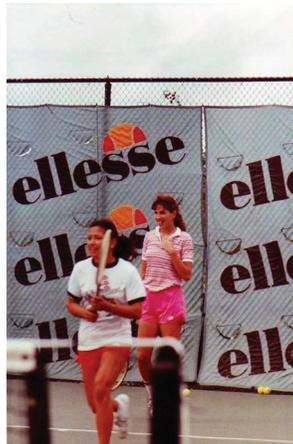
A boy walked by. "Hey," I asked, "I was told to go to Nick's court. Can you tell me how to get there?" He smirked, pointed toward the standalone hardcourts lined with sponsor-stamped wind-screens, and said, "Good luck."
When I got to Stadium Court, the first thing I noticed was the red phone. It sat in a wooden box mounted to the fence, bright red, absurd. Like something out of a Batman comic. Who puts a phone on a tennis court?
Nick Bollettieri, apparently.
Steve Owens was on the court, feeding balls to a line of kids. I recognized him immediately—same grin, same easy energy. He looked up when I walked in.
"Look what the cat dragged in," he called out, loud enough for everyone to hear. "A Hoosier!"
A girl with blondish-brown hair pulled back in a ponytail broke away from the drill and walked over. She had a smile that was easy, genuine. Not guarded like the others. Sticking her hand out, she said, "Hi! I'm Raffy." Rolling her R, like it was the most natural thing in the world to greet the new girl.
She said it like we were already friends. "Lisa," I said.
"I know," she grinned. "Everyone knows. You beat half of us at the Invitational." She said it without edge. Without resentment. Just fact.
The other kids on the court turned to look. I recognized some of them from two weeks ago—the Invitational. One girl I'd beaten in straight sets, 6-2, 6-3. Another I'd edged out in a tiebreak. Their eyes flicked over me, measuring, remembering. No one said anything. They just turned back to the drill.
Raffy saw it too. "Don't worry about them," she said, her voice low. "They'll get over it."
She saw me glance toward the red phone. Nick was on it. I hadn't seen him since I left the Colony. Two years gone, and here he was—same gravelly voice, same command of the court. He was mid-call, gesturing with one hand, the receiver pressed to his ear. But he'd heard us. I saw his eyes look up toward me.
Raffy lowered her voice. "I guess he saw you and he wants you to wait!"
We waited at the fence, the drill still running. Steve feeding balls and the other girls split-stepping as they practiced coming towards the net for two volleys—the rhythm unbroken.
Then Nick hung up—short, clipped—and turned. His eyes landed on me. "Well, my dear, how are you."
He put his hand around my shoulder. "Hey everyone, stop.
Steve, stop."
The balls stopped bouncing. The kids stopped moving. The court went quiet.
"I want to introduce you," Nick said. "This is Lisa. Some of
you've already met her." He paused. They knew what he meant. I'd beaten three of them at the Invitational two weeks ago.
"She's a great gal," Nick continued. "She was with us at the Colony." He turned to Steve. "Do you remember that?"
"Yes," Steve said.
Nick clapped again. "So let's go. Lisa, you go—you already know what to do."
I dropped my bag at the fence and stepped onto Stadium Court. Not the back courts this time. Not the borrowed space at the Colony where I'd fought to be seen. Stadium Court. The place where Nick's showcase group trained.
Steve fed me a ball. I split-stepped, swung, made contact.
Squeak. Squeak. Squeak. Thwack.
The rhythm demanded it. The machine didn't wait for you to catch up. You either folded in or you didn't.
By the third ball, I wasn't the girl who'd just walked in. I was part of the drill.
The session lasted two hours. By the end, my shirt was soaked through—but so was everyone else's. It was Florida. And I'd kept up.
When Nick finally called time, he walked over to me, put a hand on my shoulder. "That's it, my dear," he said. "Good work."
Then he turned back to the Batman phone, already onto the next call.
Carolina
When practice ended, a woman walked toward me. Clipboard in hand, posture straight, expression composed. I hadn't seen her before.
"Hi Lisa," she said. "I'm Carolina. I'm here to show you where you'll be staying." Her voice was warm but formal—not maternal, not casual. Maybe twenty-one or twenty-two, but carrying herself older.
As we started walking, she glanced over. "So," she asked, "how was your first day?" It wasn't small talk. It was part of her job—checking the temperature, making sure the new kid hadn't cracked.
Raffy and the other girls peeled off toward agility drills.
Carolina and I walked together—back the way I'd come in.
As we passed the stadium claycourt, she pointed to a building just beyond the fence. "That's study hall," she said. "You'll be there after dinner." Rows of tables, fluorescent lights, windows over-looking the court.
We walked through the pool area next. "That's the TV room," she said. Then the cafeteria—long brown tables, drink station, and her office tucked just off to the side. "If you ever need anything," she said, "this is where you'll find me."
She didn't explain much. Just pointed things out as we passed. "You'll get your schedule tomorrow." "Lights out is at ten thirty."
Then we reached the dorms—two-bedroom, two-bath condos. Four kids per unit. She lived in the condo next to mine. I didn't know it yet, but that would make sneaking out nearly impossible. Later, I'd learn that her presence shaped the edges of my freedom. Every move had to be timed, every whisper measured, because Carolina's watchful quiet was part of the architecture of the dorms.
The layout was simple. Two bedrooms, two bathrooms. Four kids per room—two bunkbeds, two dressers per bedroom. Four more dressers lined the living room wall where a TV should have been.
Brown and beige furniture built to withstand kids. A sagging sofa. A heavy coffee table. Everything functional, nothing soft.
The dining room held a rectangular wood table with metal and rattan-backed chairs. The living room had windows on the far side, but on the second floor where I stayed, there was no sliding glass door. That mattered later, when sneaking out became part of the rhythm. Carolina's condo was right next to mine, which made it even harder. On the first floor, kids had easier escapes—sliding glass doors that opened straight to the outside.
The kitchen was small. We weren't allowed to cook—no food permitted. Everything was controlled through the cafeteria. Disci-pline extended even to hunger. The refrigerator held water, nothing else. No Gatorade—ants would swarm if you tried. We shoved our filled Igloos into the freezer, stacking them like survival gear. Drinking glasses were allowed, but that was the limit.
And the one thing that never changed from the Colony to the Academy: we always ran out of hot water. Showers had to be rotated, first come first served. Whoever got the last turn learned to live with cold water.
It wasn't glamorous, but it was orderly. The condos weren't meant to be homes. They were meant to contain us, to keep us uniform, to keep us focused.
"There's an empty bed in each room," Carolina said. "You have your pick." Then she smiled, turning toward Raffy. "So Raffy, you can show her around, right." It wasn't a question. It was an instruction.
"Of course," Raffy said, bounding into the bigger back bedroom. "Hey! I'm over here. Stay in my room," she laughed. She didn't ask. She decided. And so did I.
Ei
As Carolina was leaving, the other roommates started to trail in from practice—bags slung over shoulders, hair damp with sweat, voices low from drills.
Raffy didn't miss a beat. "Hey, it's my turn to get the first show-er," she announced, already moving toward the bathroom.
Then she turned back, grinning. "Ei, this is Lisa."
Ei was tall, athletic-looking, with perfect English. She smiled politely, then asked, "Where are you from? What school are you going to?"
She told me she was going to Bradenton Academy. I asked if she liked it. She laughed, putting her hand over her mouth. "It's ok."
I told her I was going to take correspondence courses from the University of Nebraska. She looked at me as if she didn't understand.
So I explained: "They send me the books. I study on my own." I pulled a book out of one of my bags to show her.
She nodded slowly, her hand covering her mouth as she laughed again. "Oh… ok… that's different!" Her eyes lingered on the book in my hands, as if trying to picture what it meant to study alone, without teachers or classmates.
Unpacking and the Shower
I set my bag down and started to unpack—folding clothes into the dresser, lining up shoes outside the door like everyone else.
By the time I finished, the others had already showered. I was last.
The hot water was gone. I stepped into the spray, bracing myself. Cold shower. No one apologized. No one explained. It was just part of the rhythm.
Dinner
By the time we walked into the cafeteria, the tables were already claimed—clusters of kids scattered across the room. Some sat together because they were roommates. Others because they were all from South America. Still others because they trained in the same group and carried that rhythm into dinner.
Raffy didn't hesitate. She walked me straight to one of the older
groups' tables, smiling as if it were the most natural thing in the world. "This is Lisa," she said, rolling her R the way she always did
—RRRaffy—like music. Names blurred together—too many, too fast. Then she turned, grinning wider. "You know Jimmy, riiight?" she laughed.
She must have known I'd lived at Nick's house when Jimmy was there. He was still there whenever he wasn't on tour. Jimmy looked up, eyes twinkling. "Rrrrrafffyy and Lisa, that is some combo! How are you, Lisa?"
Everyone knew Raffy. Everyone loved Raffy. Her laugh carried across the room, her voice pulled eyes toward her table. She didn't whisper. She didn't hedge. She claimed space, and by sitting me there, she claimed me too.
I felt the eyes of girls my age flicking toward me from another table. They noticed I wasn't sitting with them. I was sitting with Raffy, with the older group—and now, with Jimmy.
Chairs scraped back, trays clattered into the return window, voices rising and falling in waves. The cafeteria pulsed with hierar-chy. Raffy's laugh cut through it, Jimmy's smirk sealed it, and I understood: I had been placed.
Study Hall
But Raffy was older. Out of school. She didn't follow the study hall rhythm anymore. When dinner ended, she stayed behind on the pool deck with Jimmy, her voice still echoing through the glass doors.
Ei nudged me. "Come on," she said, smiling. "Study hall."
We filed out together, past the vending machines humming by the pool, and crossed toward the low building Carolina had pointed out earlier. The windows glowed fluorescent against the night, rows of desks visible inside.
The air was cooler, humming with ceiling fans. Kids dropped into chairs, books and notebooks spread across the tables. The fluorescent lights buzzed overhead, casting everything in flat white. The windows overlooked the claycourt, but at night they
reflected only us—rows of kids bent over work, contained in silence.
Chip stood at the front, clipboard in hand, stopwatch ticking. He didn't speak much. He didn't need to. His silence was louder than any whistle.
I slid into a seat, opened a book, and felt the weight of his gaze. A boy two rows over shifted in his chair, the scrape of wood against tile breaking the silence.
Chip clicked the stopwatch once, sharp. "Sit still." The boy froze. The silence sealed itself again.
I bent my head lower over the page, heart thudding. It wasn't a drill, but it felt like one. Discipline here wasn't just on the court. It was everywhere.
Lights Out
By nightfall, the dorms settled into their own rhythm. Staff made their rounds, checking doors, enforcing lights-out with a mix of toughness and care.
In our condo, the rhythm was automatic. Shoes were lined up outside the front door. Bags stacked neatly against the wall. Raffy laughed as she climbed into her bunk, Ei folded her clothes with precision, and I slid under the blanket of the empty bed I'd chosen.
The air was thick, the oscillating fan doing little more than pushing the heat around. Posters were taped to the walls—a band here, a flag there—each one a claim of identity in a place built for sameness.
From the next room, a voice whispered through the thin walls. "You think she'll last?" Another voice, lower: "Nick likes her. That's enough."
I lay on my back, staring at the ceiling, the hum of the fan cutting through the night. My body ached from the drills, my mind replaying the day: the boy's smirk, Steve's "Hoosier," Nick's booming "That's it, my dear," Chip's stopwatch silence, Raffy's steady pres-ence, Ei's quiet precision.
And although the lights were out, it wasn't like we stopped talk-
ing. Whispers threaded through the dark—fragments of jokes, ques-tions, secrets—voices carrying just enough to remind me that discipline had its limits, and life still pulsed beneath it.
It was relentless, but it wasn't dreary. It was alive. And I was in it.
Day Two
It was my second day when Greg called me over after the Stadium Court drill.
"You've got a match," he said.
I followed his gaze to a boy standing near the Har-Tru courts, arms crossed, expression tight. Dark hair, lean build, older than me by at least a year. Maybe two.
He wasn't happy.
"A girl?" he muttered, loud enough for me to hear. "A girl?"
Greg didn't flinch. His voice stayed even, patient. "You guys, go play a set on the Har-Tru."
The boy—Michael—didn't move. He stood there, rooted, the silence stretching between us like a challenge.
Greg's voice sharpened. "NOW."
Michael turned, finally. His eyes landed on me for the first time
—measuring, annoyed, resigned. "Come on," he said, clipped.
And just like that, we walked toward the court together.
We walked a few steps in silence, the Florida sun pressing down on my shoulders, the Har-Tru clay stretching out ahead of us.
I broke the silence first. "Your name is Mike, yes?"
He stopped. Turned. Corrected me without hesitation. "Michael. But here in the States, everyone calls me Mike." His accent was thick, clipped. I recognized it immediately. "Where are you from?"
"DUB-lin," he said, like the two syllables were separate countries.
I smiled. "Dublin? I'm half Irish."
He turned, really looking at me for the first time.
The Florida sun had browned my skin deep. My Filipino half
was written across my face, my arms, everything visible. He saw it. I could tell.
"You are not Irish," he said flatly.
I lifted my chin. Refused to let it pass.
"Yes, I am. My mother is from Belfast. The Falls Road."
I held out my hand. The gold Claddagh ring caught the light—heart, hands, crown. The one Granny had given me before I left Indiana.
"And look," I said. "My Granny gave me this." Michael's eyes dropped to the ring.
He paused.
Then he looked back at me, and the edge in his face softened into something closer to a smile.
"Well then, Lisa," he said. "Yes, you are."
He turned toward the court, his tone lighter now. "Let's go play that set."
The Set
I lost.
Not badly. But decisively.
Michael's game was different from the girls I'd been playing. Heavier. More angular. He didn't just hit the ball—he placed it, moved me around, made me work for every point.
By the time the last ball slid past me, my wrists throbbed. I'd been gripping the racquet too tight, trying to match his power.
Michael didn't grin. Didn't gloat.
He squared his shoulders, lifted his chin, and said evenly, "Well-played."
It was measured. Almost formal. The way someone older might close out a match.
I laughed, shaking my head. "Sure."
We walked off the Har-Tru side by side, the red clay dust clinging to our socks, the sound of other courts echoing around us.
No big moment. No dramatic pause.
Just two kids who'd gone from strangers to something closer to teammates.
Buddies.
The Dorms
The dorms had their own rhythm.
Sliding doors. Carpet muffling footsteps. The hum of air condi-tioners filling the silence. Shoes lined up outside each door. Voices low after lights out, whispers threading through thin walls.
After dinner, I'd stop by the training room. Grab a bag of ice from the freezer, wrap it around my right wrist, hold it there while I walked back to the dorm. By then, icing was just routine. Everyone had something that hurt. You just iced it, taped it the next morning, and kept going.
For me, it was structure. A cadence I could map and master. For Michael, it was exile.
He hated it.
I could see it in the way his shoulders slumped when we walked back from dinner. In the way he stared at the carpet instead of his correspondence course books during study hall. In the way he'd start sentences and never finish them.
"Back home…" he'd say, his voice soft, the words hanging in the air.
He didn't need to go on.
I could hear the rest in the silence—the streets, the voices, the life he missed. Dublin was in the way he held himself, in the way his eyes stayed fixed on something I couldn't see.
I didn't press him.
Sometimes I teased him just enough to make him laugh. Some-times I let the silence sit.
But every time he said "Back home…" I knew how far away he
felt.
And how much he needed a buddy to stand beside him here.
Study Hall
The wooden door was the metronome.
Every time Chip Hart opened it, the hinges gave a long creak.
When it closed, the thud echoed through the room.
No one looked up. But everyone heard it.
The study hall was lined with long tables, fluorescent lights buzzing overhead, the air heavy with pencil shavings and the faint smell of sweat carried in from the courts. Pages turned. Chairs scraped. But the real rhythm was Chip's door—open, close, open, close—his steady stride down the aisle, then back again.
I sat with my correspondence course book open, eyes on the page but ears tuned to that sound. My wrists ached from the day's drills. I flexed my fingers under the table, trying to ease the stiffness.
Michael sat across from me.
One night, maybe two weeks in, the door creaked open. Chip walked his usual route—slow, deliberate, scanning the rows of bent heads.
Michael leaned in, just enough to whisper.
"He fell asleep once, you know." His grin was quick, dangerous. "Out cold. Right there in the chair."
A couple of kids nearby stifled laughs, shoulders shaking against the silence.
I bit back a smile, the tension cracking just slightly. The door creaked again.
The room snapped back into stillness.
But the whisper lingered —proof that even inside the machine, there were cracks. Tiny rebellions that made us feel human.
Detention
It hadn't taken long for me to learn what detention meant at the Academy.
Hours of silence. No movement. No escape. Just the weight of time pressing down.
Michael and I landed there together in my sixth week.
Michael had been making another joke—something about Chip's stopwatch, I think—and we'd been talking instead of being quiet and studying.
Chip Hart didn't lose his cool often. He was strict, yes—stop-watch, rules, the whole system—but he kept it measured. That was part of his authority. He didn't need to raise his voice.
Which is why the day Michael pushed him too far stuck with me.
Chip's face tightened. His voice sharper than I'd ever heard it. He snapped.
And before I knew it, we were handed garbage bags and gloves.
Detention wasn't humiliating—nobody cared if you were out there picking up trash around the courts. The real shock was that Michael had managed to get under Chip's skin at all.
That almost never happened.
Michael laughed through it, tossing wrappers into the bag like it was a game. But I felt the weight of it.
If Chip could get that pissed off once, he could do it again. And I wasn't about to get dragged into it twice.
So later, back in study hall, when Michael leaned over with his smirk—"Back home… oh, you have no idea"—I didn't bother with explanations.
I just turned, gave him the look, and said flatly, "Shut up." One word was enough.
He grinned, satisfied, and bent back over his book. He knew exactly why.
The Cafeteria
By the third week, Michael had turned "Back home…" into a performance in the cafeteria.
He'd sit at the table with Raffy, me, and whoever else was around, and he'd lean back in his chair, grinning.
"Back home…" he'd start, louder this time, playing to the audi-ence. "Oh, you have no idea."
The others would laugh. Roll their eyes. Egg him on.
I rolled mine too—seriously, another story about Dublin—but he knew me.
He knew I'd listen.
So he kept going, turning homesickness into theater, making the noise of the cafeteria his stage.
It became part of the soundtrack.
By the time a month had passed, Michael and I had settled into something unspoken.
Buddies
Just two kids who'd found each other in a place that didn't make room for homesickness or grief or anything that slowed you down.
He still hated the dorms. Still stared at the carpet during study hall. Still started sentences with "Back home…" and never finished them.
But he had me. And I had him.
Someone who knew what it felt like to be far from home. Someone who could crack a joke under Chip's stopwatch silence. Someone who'd take detention with you and laugh through it, even if you promised yourself you weren't going back.
At night, when the compound went quiet and the hum of air conditioners filled the dark, I'd lie in my bunk and listen to the whis-pers through the walls.
Raffy laughing above me. Ei folding something with precision. Michael's voice drifting from somewhere down the hall, probably telling another "Back home…" story to someone who'd listen.
And I'd think about Granny and Grandda in Michigan. About the cards still on the table, the pennies still stacked. About how far away everything felt.
But here, in the machine, I wasn't alone. I had Raffy. I had Ei. I had Michael.
And that was enough.
The Rhythm
By the third week, I stopped counting days.
There was a clock radio, but we were up before it went off. Every morning, the same routine. I rolled out of the bottom bunk, feet hitting beige carpet. Maybe some stiffness in my back.
The dorm smelled like shampoo and coconut oil.
Raffy was already moving above me, rustling through her bag. Ei folded her sheets with precision. Another student was trying to finish homework that was due.
We had thirty minutes to get dressed and get to the cafeteria. I learned quickly: the rhythm didn't wait for anyone.
The Place
Some mornings, before drills began, the Florida humidity carried a strange weight. If the wind shifted just right, the whole place smelled like burnt oranges drifting from Tropicana's factory across town, where mountains of peels were processed into cattle feed. It wasn't every day, but when it came, it wrapped the morning in something sour-sweet, industrial and natural at once.
Other mornings, the smell was pure tennis. Every week the instructors wheeled out baskets filled with hundreds of brand-new balls. The lids popped, and the scent hit all at once—sharp, clean, undeniable. The sight of all that bright yellow, the sound of balls spilling into baskets, the rubber-felt smell rising in the humid air—it was as much a part of the Academy as Nick's voice or Julio's whistle. For me, it was the best smell in the world.
The indoor center looked nothing like a tennis facility. From the outside it was a giant metal box, the kind of warehouse you'd expect to see in an industrial park. Large garage doors stood at each end, and when they rolled open you could see straight through the build-ing. It had been built for two reasons: so kids with upcoming indoor matches could practice on the same surface, and so that when Flor-ida's skies opened up, tennis didn't stop. The drillers just moved the machine indoors.
But there was no air conditioning. If you thought it was hot outside, you melted inside. The air hung heavy, trapped under the metal roof. Everyone wanted the court nearest the big garage doors, where you could steal a breath of fresh air.
The gym was walled off inside the same building, divided from the courts by blue partitions about eight feet high. Above them, the ceiling stretched nearly fifty feet, cavernous and echoing. The gym smelled like a gym should—sweat, iron, rubber—the scent of bodies and effort pressed into the air. Next to it was the aerobics room, also boxed in by eight-foot walls. Instead of barbells, it had a full-length mirror running nearly forty feet wide, the distance from net to base-line on a tennis court. The carpeted floor softened the sound of sneakers, but the mirror amplified everything else—every stretch, every movement, every flaw reflected back at you.
The pool was there, but it wasn't really part of our lives. Chlo-rine hung in the air, sharp and chemical, but most days it just drifted over empty water. We were too busy—drills, classes, study hall, more drills. Maybe on a Sunday you'd see a few kids stretched out on the deck or splashing in the shallow end, but not often. It was strange, really. In the middle of all that grind, there was this leisure pool, a place that could have been freedom. But mostly it sat unused, a reminder that at the Academy, even relaxation was crowded out by the machine.
The cafeteria was the one place where the Academy felt almost normal. Things had changed since the Colony days, when one of the instructors doubled as cook. Back then, the same people who fed you balls on court might be stirring sauce in the kitchen. They still helped, but one day an army cook arrived. His name was Arthur.
Arthur looked like a bad version of Mel from Happy Days—the same gruff stance, only sweatier. You could see him leaning over the steaming pots of spaghetti, sweat dripping as he stirred. I never ate the spaghetti when Arthur made it.
The cafeteria itself smelled of spaghetti sauce and burgers on the grill, ketchup and buns, the clatter of trays and sneakers squeaking on tile. It wasn't gourmet, but after hours on the courts it didn't matter. It was fuel, and it tasted like survival. You sat with
your condo buddies, or the kids you trained with. Sometimes the room sorted itself into groups by nationality—the Asians at one table, the British and Irish at another, the Italians clustered together, the South Americans holding their corner. It wasn't about exclusion so much as comfort, language, and familiarity. In a place where everything else was regimented, the cafeteria was where you gravi-tated to your people.
Breakfast
The cafeteria looked like any school cafeteria. Long brown tables with attached seats that folded up so the floor could be mopped. You picked up your tray and slid from right to left—entrée, sides, done. At the end of the line, a window where you placed your tray. Garbage can beneath it for whatever you didn't eat.
To the left of the food line stood a six-by-three-foot table. Morn-ings: toasters. Lunch and dinner: potato chips. Orange juice, water, iced tea—always there. Vending machines hummed by the pool area.
The walls were beige-white. Plain. Functional. The smell of bagels.
I grabbed a bagel, sliced it, dropped it onto the conveyer belt. Waited. Peered in to see when it was going to drop. Pulled it out, spread peanut butter and jelly thick across both halves. Orange juice. Done.
Some kids ate bagels with cream cheese and jam. Some with peanut butter and jelly. Bagels were easy—we could take them with us.
Some kids ate cereal, but you had to sit down. Same thing with eggs and bacon. We also had grapefruit.
Raffy was already seated with the older girls, laughing about something I'd missed. I slid in next to her.
"Morning," she said, grinning. "Morning."
The cafeteria buzzed—voices low, half-awake, the kind of chatter that fills space without saying much. Kids loading up on
toast and cereal. Coaches moving through with clipboards. Staff clearing trays.
By eight, we were supposed to be on the courts.
Morning Drills
At 8:05, we were on the court next to Stadium, stretching. Hamstrings, quads, shoulders, wrists. The sun already warm, the air already thick.
The morning would start humid until it burned off by ten. By afternoon, it was fine—high seventies. But in May, you started to feel the real Florida heat.
The hardcourts carried a faint smell of rubber and tar.
I bent over to touch my toes. Sweat rolled off my nose—one drop, then another, making small splats on the court. Then another drop. And another.
By 8:30, we moved to Stadium Court.
We were used to walking around in soaked t-shirts. If it got really hot, the guys would take their shirts off.
Steve Owens was the driller. Same easy grin, same steady energy. Nick was there too—not at the fence, but on the court. Moving between players, watching, adjusting.
"Let's go," Steve called. "Groundstrokes. Crosscourt. No errors." Squeak. Squeak. Squeak. Thwack.
The rhythm started.
Forehands crosscourt. Deep. Over and over. Then backhands.
Then down the line. Then inside-out.
Steve fed balls fast. If you missed, the next one was already coming. You didn't have time to think about the error. You just hit the next ball.
I wore wristbands to soak up the sweat. Sometimes I would go to the back of the court and run my palm on the ground to pick up dirt and ball lint—this would dry off my hand.
When a ball hit the fence, it didn't make a clean metallic ping the way it does on bare chain link. Against a wind-screened fence, it made a soft, swallowed thud—a "whuff" more than a clang. First
you heard the impact of felt on vinyl: a dull paff or fup, like a hand slapping a stretched tarp. Then, half a beat later, the chain-link underneath shivered, giving a faint, rattling after-sound—not sharp, but a low chrrr that faded quickly.
And if you had an off day? You'd hear about it from Steve. Not yelling. Jokes. He'd rip you apart.
"What was that?" he'd call out, grinning. "You trying to hit the fence? Because you're doing a great job."
Or: "Hey, you saving your good shots for later? Let me know when you're ready."
Everyone would laugh. Even the player he was making fun of. You had to. It was Steve. The older guys would try to zing him back sometimes.
And it wasn't just the kids on court. Students who walked by weren't safe either.
"Those shorts are so tight, I thought you were smuggling tennis balls."
"That sweatband makes you look like a rejected extra from Karate Kid."
He'd grin, feeding the next ball like nothing happened, while everyone cracked up. You'd grit your teeth, try not to laugh, and hit the next ball better.
It was every day. It lightened the mood as we bashed the balls.
That was Steve. Not mean. Just relentless. He made you prove you belonged there every single day.
Nick stepped behind me. I could feel him there, just off to the side, watching my footwork, my preparation, my follow-through.
"Get under the ball," he said. "Under." I adjusted. Next ball, got under it more. "That's it," he said. "Again."
I hit another. Better contact. Cleaner. "Good. Next."
The next player stepped up to the baseline. Nick moved on.
No name. Just "next." That's how it worked. You were part of the drill, part of the machine. Not special. Not singled out. Just next. At nine, we switched to volleys. Approach shots, split-step,
punch the volley deep. Then two-on-two volley drills—quick hands, sharp reflexes, communication with your partner.
The sun climbed higher. My shirt stuck to my back. At 9:30, Nick clapped his hands. "OK, next group."
We grabbed our racquets and water bottles and left the court. The guys were already waiting at the fence, ready to take our place.
Match Play
One of the other instructors was waiting for us at the edge of the courts. He divided us up for match play—pairing us by level, by who needed what, by who Nick wanted tested.
We moved to the other courts. Singles matches. Scratch matches
—no score kept for tournaments, just rankings within the Academy. Who got court time. Who got Nick's attention. Who moved up to Stadium Court permanently.
I played a girl from South America. Tall, heavy topspin, relent-less from the baseline. I won 6-3, 6-2.
By eleven, we were done.
Lunch
Same cafeteria. Same setup.
Lunch meat and cheese. Or PB&J. Raffy put potato chips on hers. Salted potato chips. I grabbed chips and water.
Sat with Raffy and Ei.
The conversation drifted—someone's match, someone's blister, someone's family visiting next week.
I stayed quiet. Listened. Ate.
At some point, Raffy glanced at me. "You doing okay?" "Yeah," I said, yawning. "I just could not sleep."
She nodded. Didn't push.
No one asked why I was here. No one asked about the tourna-ment I'd withdrawn from a few weeks ago. It was just accepted. I was here now. That was enough.
I didn't always play in the morning. Sometimes I had to study.
Afternoon Courts
By 1:05, we were back on the courts.
More drills. More matches. Different focus—strategy now, patterns.
Nick would call out adjustments. Steve would feed balls. The rhythm continued.
I never got tired. That was one of my strengths.
Conditioning
At 4:30, conditioning began.
Agility drills first. Cones lined up across the court, the whistle sharp, the rhythm unforgiving. We sprinted forward, shuffled side-ways, backpedaled, lunged. Over and over. The Florida sun pressed down, sweat stinging my eyes, the clay dust sticking to my socks.
Raymond or Mike would call out: "Let's go. Come on.
That's it."
It wasn't just exercise. It was survival. Every drill was a race—who could finish first, who would get called out for slowing down. No one wanted to be last. You could feel it in the way kids pushed past their limits, lungs heaving, faces tight with effort.
Maybe some of the short-timers threw up. The ones that came for two weeks. But not us.
Then the mile on the track. The air was heavy, the heat relent-less. We weren't running to get through it. We were running to be the best. Every stride was proof, every lap a contest. No one slowed. No one stopped.
By the time we finished, the competition itself was the point. It wasn't about aching or fatigue—it was about proving you belonged, proving you could keep pace with the machine.
After conditioning, my quads felt slightly tight climbing the stairs back to the dorm.
Dinner
By six, we were back in the cafeteria.
You could smell the garlic toast from the pool deck when it was pasta night. The menu rotated—chicken, pasta, whatever Arthur was making that day.
Dinner was louder than breakfast. More energy. Kids laughing, voices carrying, the day's tensions releasing into noise.
I sat with Raffy and whoever else was at our table. Sometimes Michael. Sometimes other girls from Stadium Court.
The food didn't matter. The conversation didn't matter.
What mattered was the rhythm. The predictability. The sense that tomorrow would be the same, and the day after that, and the day after that.
After dinner, I'd stop by the training room. Grab a bag of ice from the freezer, wrap it around my right wrist, hold it there while I walked back to the dorm. By then, icing was just routine. Everyone had something that hurt. You just iced it, taped it the next morning, and kept going.
Study Hall
At seven, we filed into study hall.
The wooden door was the metronome. Every time Chip Hart opened it, the hinges gave a long creak. When it closed, the thud echoed through the room.
No one looked up. But everyone heard it.
The study hall was lined with long tables, fluorescent lights buzzing overhead, the air heavy with pencil shavings and the faint smell of sweat carried in from the courts. Pages turned. Chairs scraped. But the real rhythm was Chip's door—open, close, open, close—his steady stride down the aisle, then back again.
I sat with my correspondence course book open, eyes on the page but ears tuned to that sound. My wrists ached from the day's drills. I flexed my fingers under the table, trying to ease the stiffness.
Chip stood at the front, clipboard in hand, stopwatch ticking. He
didn't speak much. He didn't need to. His silence was louder than any whistle.
Roommates
By ten-thirty, the dorms settled into their own rhythm.
Raffy laughed as she climbed into her bunk, Ei folded her clothes with precision, and I slid under the blanket of the bed I'd chosen.
The air was thick, the oscillating fan doing little more than pushing the heat around. Posters were taped to the walls—a band here, a flag there—each one a claim of identity in a place built for sameness.
From the next room, a voice whispered through the thin walls. "Did you see Nick's face when—"
Another voice cut in, laughing softly.
I lay on my back, staring at the ceiling, the hum of the fan cutting through the night. My body ached from the drills, my mind replaying the day: Steve's jokes, Nick's "Next," Chip's stopwatch, the rhythm of the machine.
And although the lights were out, it wasn't like we stopped talk-ing. Whispers threaded through the dark—fragments of jokes, ques-tions, secrets—voices carrying just enough to remind me that discipline had its limits, and life still pulsed beneath it.
Breaking the Pattern
We practiced six days a week. Monday through Saturday mornings. The rhythm was relentless.
But there were moments when the machine cracked just enough to let something else through.
Sometimes the guys would place bets on practice matches. The loser had to do butts-up. Stand on the service line with his back to the server, bend over. The server got three serves to try and hit him.
Tension relief. A break in the grind. Laughter that cut through the intensity.
On Fridays, if Greg was in a good mood, they'd play music through the intercom system. The sound would drift across the courts, filling the air with something other than the thud of balls and the bark of commands.
Those moments mattered. Not because they changed anything. But because they reminded us that underneath the machine, we were still just kids.
It was relentless, but it wasn't dreary. It was alive.
Wake. Breakfast. Drills. Lunch. Courts. Conditioning. Dinner.
Study hall. Lights out.
The same rhythm. Every day. Six days a week.
Small breaks. Rare moments when the pattern cracked. But mostly just the machine, turning.
And I was part of it.